Assemblymember Shea Backus (Las Vegas) has announced a bill draft request to establish a statewide Missing and Murdered Indigenous Peoples (MMIP) Alert for consideration during Nevada’s 2027 Legislative Session.
If introduced and passed, the legislation would create a coordinated statewide system to rapidly share information with law enforcement, Tribal Nations, media, and the public when an Indigenous person goes missing under qualifying circumstances. Colorado, Washington, New Mexico, and California have similar alert systems.
Our faith calls us to recognize the God-given dignity of every person. That commitment includes listening to Indigenous families, respecting Tribal sovereignty, and advocating for systems that respond with urgency, care, and accountability when someone goes missing.
Lutheran Engagement and Advocacy in Nevada will make this legislation an advocacy priority during the 2027 Legislative Session, following the leadership of Indigenous communities and organizations working to address this crisis.
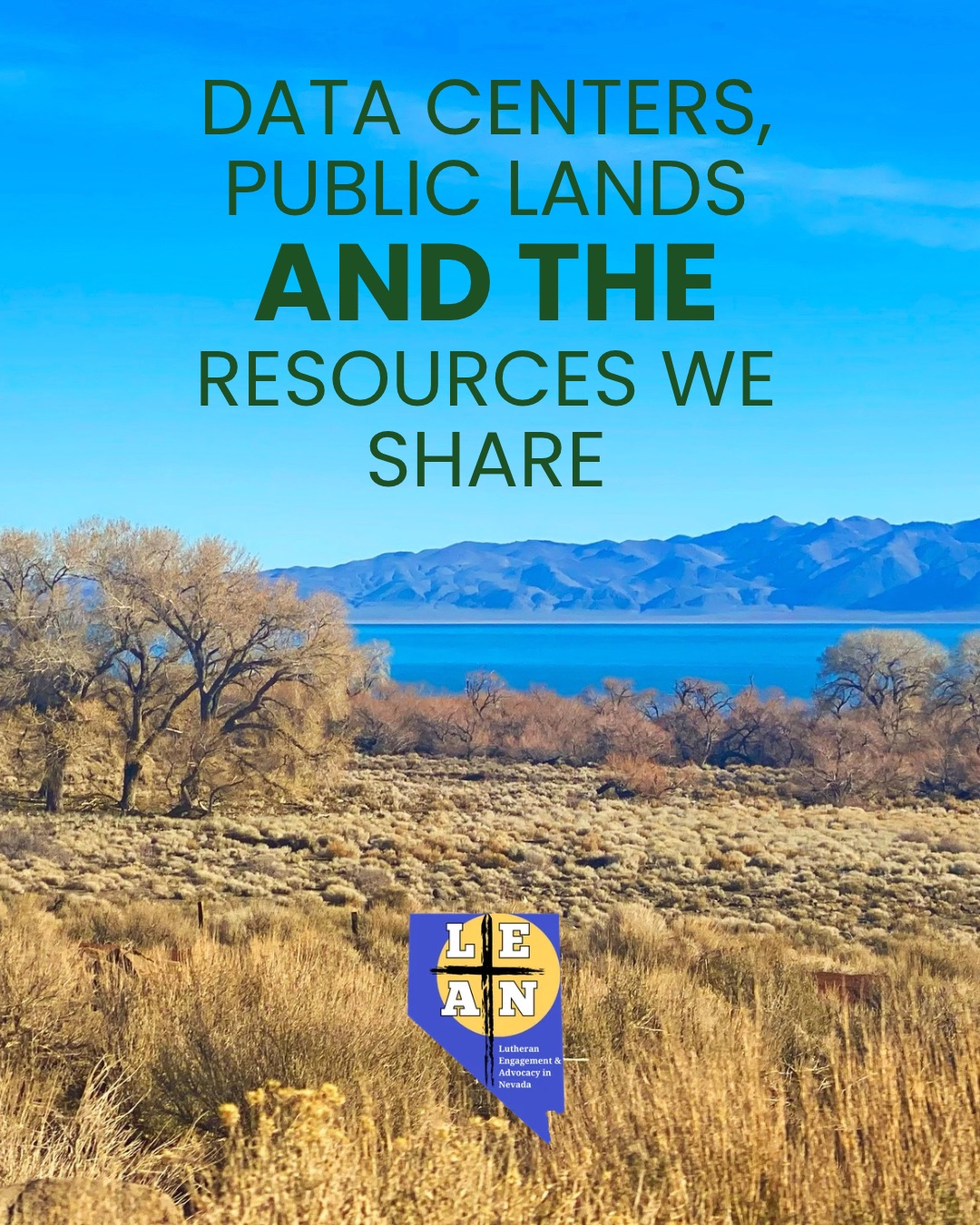
The debate over data centers and public lands continues to grow as we prepare for Nevada’s 2027 Legislative Session. It is bringing together people across the political spectrum and becoming an issue in midterm elections across the country. The questions reach into our communities: Who benefits? Who pays? And who gets a say?
LEAN has shared information and updates about data center development. Recent developments deserve a closer look.
First, the Nevada Current reported that approval for a proposed data center near Boulder City has been revoked. The Bureau of Land Management had relied on an environmental review for a solar project previously proposed at the same location. The agency must now conduct additional environmental review before the data center can move forward.
Those questions matter. How could the project affect wildlife, air quality, noise, and nearby communities? What resources would it require? Will the people who live with those impacts have a meaningful opportunity to be heard?
Meanwhile, the Nevada Current reported that Switch is seeking approval for a 510-megawatt natural gas power plant at the Tahoe-Reno Industrial Center. The plant could operate for 30 years or more, and a proposed gas pipeline expansion could support additional development. These decisions will shape Nevada’s energy future long after the construction crews leave.
That matters for our neighbors.
Families deserve to know whether new infrastructure will affect their utility bills. Communities deserve clear information about water use, air pollution, and the combined impact of these projects. The public deserves honest answers about what protections will be in place and how promised benefits will reach the people who live here.
As we prepare for the Legislative Session, we should be asking how Nevada will protect households from additional costs, hold developers accountable, and ensure communities have a meaningful voice in decisions about their future.
For people of faith, caring for creation and loving our neighbors belong in this conversation. Those commitments call us to pay attention to people already struggling to keep the lights on and the generations who will live with the decisions we make today.
Lutheran Engagement and Advocacy in Nevada calls for careful review, transparent decisions, meaningful public participation, and accountability that protects our communities.
Caring for our neighbors includes caring for the places and resources we share.
Research highlighted by KNPR found that droughts and wet periods across major Western watersheds often happen together. When Nevada is dry, neighboring regions may be struggling, too, limiting the water available to provide relief.
For Lutheran Engagement and Advocacy in Nevada, this raises an important question: Are we planning for the water we can realistically depend on?
Our public choices should support conservation, responsible growth, regional cooperation, and reliable, affordable drinking water. Tribal Nations, rural communities, and neighbors with limited resources must have a meaningful voice in those decisions.
God calls us to care for creation and our neighbors. Protecting the water that sustains us is part of that calling.
A recent rule proposal from the Census Bureau was published Sep. 10 to the Federal Register with an atypically tight window for public consideration and comment. The concerning proposal includes two major changes ahead of the 2030 U.S. Census regarding who would be counted and what data would be collected. Amplifying concern is that these changes will likely set the population baselines through 2040.
The first proposed change (Part 60) would exclude undocumented immigrants and many temporary-status noncitizens from the population count used for congressional apportionment and would establish new residence criteria for determining who is included in that count. Currently all people living in the United States are counted – regardless of citizenship or immigration status – based on the “usual residence” standard which counts individuals where they live and sleep most of the time. “Usual residence” in the proposed rule would be redefined more restrictively by incorporating factors such as immigration status and tax records into determinations. As a result, certain noncitizens could be excluded from the census count, potentially impacting the distribution, or apportionment, of seats in the U.S. House of Representatives.
The second proposed change (Part 70) would prohibit questions regarding race, ethnicity or sexual orientation from appearing on the short-form decennial census questionnaire. Eliminating questions related to race and ethnicity would signifcantly reduce the availability of demographic data used to enforce civil rights laws, monitor racial and ethnic disparities, allocate public resources and inform policymaking.
An accurate count is essential to ensuring that communities receive fair representation and appropriate allocations of public resources. For example, in FY 2021, $2.85 trillion in federal funds were distributed based on collected census data.
“Civic participation cannot be fully realized without confronting the structural barriers that limit access for many. These barriers, which function to silence voices and restrict public engagement, disproportionately affect already marginalized communities and contradict both democratic ideals and the biblical call to seek justice,” reads the ELCA social statement Faith and Civic Life: Seeking the Well-being of All (p. 65).
With so many consequential decisions riding on census data, the census must continue to account for populations that have been historically undercounted. This includes rural residents, young children, individuals living with disabilities, students, LGTBQIA+ individuals, people experiencing homelessness, individuals whose primary language is other than English, Indigenous communities and racial and ethnic minorities. Additionally, a census is critical for the many temproary legal residents who live, work, study and worship in our communities, and for the communities themselves, which benefit from a complete and accurate census count.
Who gets counted in matters because it determines representation, federal funding, and the important services our neighbors depend on.
The Census Bureau’s proposed changes to the 2030 Census could exclude some noncitizens from the population count used to determine congressional representation and eliminate race and ethnicity questions from the census questionnaire.
For Nevada, the stakes are substantial. Our state has large immigrant and mixed-status communities, 27 federally recognized Tribal nations, extensive rural areas, and many children and families who have historically been difficult to count. An incomplete census could affect Nevada congressional representation, legislative redistricting, and the population data used to distribute federal resources for nutrition assistance, schools, housing, transportation, and other essential services. Eliminating race and ethnicity questions could also make it harder to identify disparities affecting Tribal communities, Latino families, and other marginalized and under represented populations.
The Census Bureau says the proposed changes would better align the count with constitutional requirements and improve efficiency. The ELCA raises a different concern: that restricting who is counted and what information is collected could leave communities less visible in decisions about representation and public resources.
As Lutherans, we believe every neighbor deserves dignity and a voice in our common life. The ELCA’s social statement Faith and Civic Life: Seeking the Well-being of All reminds us that barriers to civic participation can silence already marginalized communities. An accurate census is more than a statistical exercise; it helps Arizona understand and serve the people who actually live here.
The ELCA invites public comments on the proposed census changes through November 2, 2026. Arizona residents can review the proposal and submit a comment describing how accurate population counts affect their congregations, communities, and ministries, particularly those serving rural, Tribal, immigrant, and low-income neighbors.
Take action!
This action alert directs a comment from you to the formal register at regulations.gov through Nov. 2, 2026 (more about the process here).
Customize your comment with your lived or ministry experience and values.
Contact your lawmakers today. Customize your message with your experiences and values.
If you would like to schedule time with your legislator, please reach out to Pastor Paul,and he is willing to work with ELCA Advocacy Partners to secure a time.
Nevada’s midterm elections are well underway. Nearly 400,000 Nevadans voted during the first week of early voting, and that number continues to grow. The Nevada Independent’s election blog is a helpful resource as you follow the races and make your plan to vote.
Federally, voters across the country will elect all 435 members of the U.S. House of Representatives. Nevada has four congressional districts, and all four are competitive. Nevada does not have a U.S. Senate race this year, but control of the Senate is very much in play.
The party that controls each chamber shapes the legislative agenda, committee assignments, investigations, and budgets. Congressional decisions affect taxes, health insurance, energy policy, access to federal assistance like SNAP and TANF, infrastructure spending, and public lands. Congress also has oversight authority over the executive branch, including the power to hold hearings and subpoena records.
Here in Nevada, we are electing a governor. Attorney General Aaron Ford and incumbent Governor Joe Lombardo are among the candidates in a closely watched race. Voters will also choose leaders for the other constitutional offices: lieutenant governor, attorney general, secretary of state, treasurer, and controller.
The governor helps set the state’s agenda and proposes a two-year budget, which will be introduced in January during the State of the State Address. As we have seen in recent years, the governor also has significant power to veto legislation passed by the Legislature.
We have shared a full breakdown of the offices and candidates in an earlier post, and we have highlighted the races Lutheran Engagement and Advocacy in Nevada is following. If you live in one of those districts, make a plan to vote. If your congregation is in a targeted district, encourage one another to participate.