ELCA Needs Your Input On New Social Statement Draft: ‘Civic Life and Faith’

The Evangelical Lutheran Church in America (ELCA) is developing a social statement on civic life and faith, the relationship of church and state, and related matters, as called for by the 2019 ELCA Churchwide Assembly.

Social statements are the ELCA’s primary documents to address significant social issues. They are intended to aid reflection, shape conscience and set forth the ELCA’s teaching and policy on the major social issues and questions of contemporary life. Social statements are developed by task forces, using an established process of study and widespread participation across the church to guide theological and moral deliberation.

At this time the task force encourages you to study and give feedback on a draft version of the social statement. You can participate by filling out a survey, found here, or by participating in a hearing in your synod, if available. Hearings are public gatherings where participants share their specific affirmations or concerns about a draft statement. To find out if your synod will host a hearing, or to learn how to host one, please email the ELCA here

The feedback period is open until Sept. 30, 2024.

To download a copy of the draft social statement, click here. Printed versions are unavailable at this time.

To download the draft in Spanish, please click here. You can find the online version of the Spanish survey here and a printable version here.

For the online version of the survey, click here. For a version of the survey to print and mail in, click here

In 2023, the task force put out a six-session study for public feedback. The ELCA would like to thank everyone who participated and sent input. Click here to read the report on the analysis of that public feedback, which informed the draft social statement and will continue to inform the task force’s work.

If you have any questions, email the ELCA here.

To learn more about the task force members, click here.

Read a detailed timeline of the task force’s work.

ELCA: August Is Apt Month for Advocacy

A point-by-point plan to contact and engage with your representatives and senators

By Ryan Fonseca-Vega, ELCA Advocacy Intern

Quotation on a purple background about the church's commitments to human dignity, justice, peace, and environmental care.

August presents unique opportunities to bring our deep concerns as Christians about many things related to our planet and the beings that inhabit it to U.S. Congress in our own backyards. In-person and virtual meetings, as well as Town Halls, can be scheduled in this month as the U.S. Congress usually takes a recess. Representatives and senators often visit their congressional districts and/or home states in August to reconnect with their constituents – like you.

TIPS FOR ARRANGING A MEETING

Whether in-person or virtual, a social ministry or faith-based group you are part of may want to connect to highlight your experience and priorities with your federal elected official directly on an issue about which they have influence.

Who and Where

First and foremost, learn who your elected official is and where they are located. To locate your member of the U.S. House of Representatives, house.gov/representatives/find-your-representative is a great tool. Also available is govtrack.us, using your location to find your senators and representatives .

Follow links to get a photo of the elected official and their website, which will include office locations and other resources.

From the elected official’s website is often a link to make a scheduling request (but an old-fashioned phone call can also help you learn how to accomplish this).

Scheduling a Virtual District Meeting

Quotation on a deep purple background with a large, black curly brace on the left side.

This may be the easiest way to arrange a meeting, and the online tool from the lawmaker’s website should guide the process. For you and those who may take part with you, there is a minimal need to consider travel time, and it can take place anywhere.

  • Make sure to inform the official’s office that you are a constituent.
  • Clearly prepare the reason for the meeting or what the meeting will be focused on. For example, you may want to share your priorities on the Farm Bill or other legislation in federal discussion.
  • TIP: You may be providing the virtual platform for the meeting. If so, clearly determine the correct link. For example, will you use Skype/Teams/Zoom?
  • TIP: Assure there is no time limit for the platform you have chosen so that there is no pressure to rush the meeting.

In my experience, these meetings usually go well and smoothly. Most likely, it will be a staffer of the elected official on the virtual call. Get to know the staffer and get their contact information. They are a person consistently speaking with the elected official.

Scheduling an In-Person District Meeting

It is a bit more difficult to schedule such a meeting, especially since the plan may need to account for travel to and from the location. You may try to meet in the elected official’s local office or at your venue. You may want to offer a tour of your facility or even a more hands-on approach such as allowing the policy maker to volunteer some of their time in a pantry or experience daily life in your facility/space.

  • Here too – make sure to inform the official’s office that you are a constituent.
  • Here too – clearly prepare the reason for the meeting or what the meeting will be focused on, such as an issue or legislation focus.
  • TIP: Be ready with options for times and days that the elected official may meet with you. By having a more flexible schedule, and being open, the likelihood of your elected official attending is increased.

Always Confirm

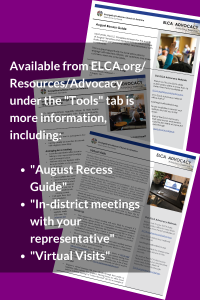
ELCA.org advocacy resources and guides on purple background, with titles - August Recess Guide, In-district meetings with representative, and Virtual Visits.

In my experience, there have been times when a request for a meeting has gotten lost between the website and the assigning staff member or other glitches. It is important to follow-up with the scheduler to assure that a meeting, virtual or in-person, is documented on the elected official’s calendar.

  • TIP: I always follow up with them a few days (4-6) after the initial request to confirm it is on their radar.

PARTICIPATING IN A TOWN HALL

Traditionally, elected officials host two town hall meetings in their respective districts in the month. Your legislators will respond to inquiries during the town hall. By raising your important issue, you can publicly hold your legislator accountable to constituents and start or advance a meaningful conversation.

By checking the legislator’s webpage, you can see if and when they are hosting town halls along with the important details of location and other specifics.

My experience… has been nerve-racking. I recommend that it is important that you have a longer list of questions to avoid asking similar questions that someone else has already asked. If there is a link for you to enter your questions ahead of time, ensure that you do it as early as possible to have the best possibility of it being answered during the town hall. Also, remember to breathe if you are not familiar with public speaking!

GENERAL PREPARATION

As already shared, be very clear on why you want to have this encounter with a lawmaker. Other considerations include deciding who will be part of the meeting (4-5 people in a group is a good number) and developing talking points on your issue/concern that are based on your priorities and experiences.

Not sure how to start? Take a look at the “2024 Federal Policy Priorities” developed by the ELCA advocacy team on the ELCA Advocacy Resources page (under “Tools” tab). In 2023, a blog post example of key issues and possible questions could also inform your approach, available from the ELCA Advocacy Blog. Connecting with your local ELCA-affiliated state public policy office, if available, or synod leaders can also help you shape your approach.

Although a town hall is different, other meetings can benefit by assigning roles to people participating in the encounter. Following is one way to assign roles.

Introducer/Framer – This person introduces your group at the beginning of the meeting. They also keep an eye on time, wrap-up the meeting, and get the business card or contact information of the staff person that is with the elected official.

  • TIP: As part of the wrap-up, this person should be sure to express thanks! Something like: “Thank you for meeting with us. We are members of the ELCA and appreciate talking with you about [whatever the vote or concern/issue is]” will reinforce your purpose and end the meeting on a high note.

Storyteller – This most effectively is someone who is impacted by what the bill you are raising is trying to fix or an aspect of the issue/concern. Sharing (as comfortable) personal experience or the experience of the people you are organizing with is valuable.

  • TIP: I’ve found it is helpful to give a little personal background to allow others to “get you.” Help them understand where you are coming from and how you have been impacted – and how a bill or initiative can change that.

Point Person – This person is more familiar with facts of the bill or issue and can speak to technical questions if they come up – for example: where a bill is in the process or something missing from current discussion.

Closer (may be same as Introducer/Framer) – Near the end of the meeting, this person expresses thanks and asks for further support or highlights district needs overall.

  • I’ve found it is important to keep a sense of URGENCY for the bill or issue/concern about which you are advocating.

FOLLOWING UP

Great job showing up in this August Recess opportunity! But just because the meeting or town hall is over, the opportunity is not.

Every participant, if possible, should email your contact or the elected official’s office to thank them for their time, and/or tag them in a social media post.

  • Build on the experience before a vote or key action on your issue/concern by following up.
  • And keep the relationship going.

Once the relationship starts, phone calls and other contacts will establish familiarity by name and can make it easier for you to schedule future events and opportunities to bring the concerns shaped through your faith convictions and experiences into the policy process.

This post was shared with permission from the Evangelical Lutheran Church In America. To access more advocacy resources and tips from the ELCA, visit its advocacy page.

ELCA World Hunger Offers New “Health And Hunger” Toolkit

ELCA World Hunger has released a new toolkit for churches, ministries, and small groups, exploring the relationship between hunger and health.

Hunger is shown to have negative affects on both short and long term health, and understanding these complex outcomes is an important part of understanding food insecurity. This tool kit includes information about how poverty, unexpected health problems, and inaccessible communities can worsen and are worsened by hunger and lack of access to nutritious foods. The kit includes three modules of study and activity, including prayers, liturgy, and Bible readings. In addition to statistics and contemporary hunger information, this kit also includes interactive activities! Groups can learn together through building maps, playing the “Healthy Life Board Game,” using prompt cards to share their own health stories, and more. Each module ends with discussion questions, and the kit finishes with service opportunities your congregation can implement.

This toolkit is meant to be explored and learned together! We encourage you to use this tool kit with your social justice ministries, civic engagement groups, human care committees, or adult forums!

Click the button below to read and download the Health and Hunger Toolkit.

Join LEAN’s Mission As It Enters New Era

As the state of Nevada awaits the November 2024 general election and start of its next biennial legislative session in February 2025, Lutheran Engagement and Advocacy in Nevada (LEAN) finds itself in a transition period with plenty of potential for growth in advocacy action ahead.

LEAN’s advocacy work is indeed central to God and the church’s continued presence in the world, and with so much ongoing need among what Jesus called “the least of these” in Matthew 25, the organization will continue speaking up for the voiceless, powerless and marginalized in Nevada, guide by the ELCA’s Social Statements.

A Successful Session

LEAN entered 2024 on the heels of a fruitful 2023 legislative session. A total of 12 bills supported by LEAN on the basis of its main areas of advocacy — Criminal Justice, Health Care, Education, Children and Family, and Housing and Human Dignity — were passed by the legislature and signed into law by Gov. Joe Lombardo thanks to the hard work of Advocate Bill Ledford, blessings of the LEAN Policy Council, and continued support of Evangelical Lutheran Church in America congregations throughout the West, especially those in the Grand Canyon Synod (Southern Nevada) and Sierra Pacific Synod (Northern Nevada). While other supported bills did not make it to the governor’s desk, the session as a whole yielded positive, justice and fairness-driven change at the state level as the world continued to recover from the economic and social shocks of the Covid-19 pandemic.

Fond Goodbyes

The year 2023 also brought loss to the LEAN family.

On April 15, Larry Struve, who for more than a decade led the advocacy efforts for LEAN and its previous incarnations including Lutheran Episocopal Advocacy in Nevada, Lutheran Advocacy Ministry in Nevada and the Religious Alliance in Nevada, passed at age 80 after a long illness. Larry spent more than 26 years in public service, including stints in the Nevada Attorney General’s office and Washoe County District Attorney’s office, and as Director of Nevada’s Commerce Department and Director of Business Finance and Planning for the Nevada Department of Business and Industry. He was also a lifelong member of Lutheran Church of the Good Shepherd in Reno.

Larry set the standard for faith-based advocacy in the state, chronicling his efforts in his 2013 book A Humble Walk for Justice: Advocacy for the Least of These in Nevada, 2001-2012. “When the simple act of advocacy directed at the hearts and minds of those entrusted to govern made policy decisions that better served the common good, something was at work that appealed to the better nature of those officials,” he wrote in the book’s introduction. “The words spoken by an advocate, grounded in the wisdom of scripture, helped define what justice required in modern times.”

Larry’s successor, Mike Patterson, passed on November 13. An ordained Episcopal priest and former school teacher, Mike acted as LEAN’s legislative advocate for several years, speaking strongly for state support of the public education system and stronger laws against the scourge of human trafficking. He also led several direct community outreach efforts on LEAN’s behalf, including food drives for the Food Bank of Northern Nevada and what he called “Pencils for Pupils,” which provided school supplies to teachers in at-risk elementary and middle schools.

Larry and Mike were tireless, dedicated, and focused advocates on behalf of thousands of Christian believers in Nevada’s halls of power. Their spirits will live on as LEAN charts its way forward, toward the next legislative session and beyond.

Another Goodbye, New Challenges

In November 2017, LEAN named Bill Ledford as its new legislative advocate on the recommendation of Mike Patterson, who went on to mentor Bill during the 2019 session while continuing on as a policy board member (another experienced Christian advocate and board member, Allan Smith, also served as an interim LEAN advocate and advisor as well as a board member).

Recently relocated to Nevada from Oregon with a young family, Bill brought to LEAN a deep desire to live out his Christian faith as tireless voice for the state’s marginalized residents, including LBGTQI+ communities. He served with distinction through three legislative session even as he attended Lutheran seminary and learned the liturgical and leadership ropes as an intern at Lord of Mercy in Sparks, Nevada. He completed his studies and was recommended for ordination as the new year dawned.

Bill’s commitment to Christian leadership and service was realized with his calling to be pastor at Prince of Peace Lutheran Church in Logan, Utah, a congregation in the Rocky Mountain Synod of the ELCA. He was ordained as pastor of word and sacrament at Lord of Mercy on March 3 with Rocky Mountain Bishop Jim Gonia presiding, and will begin his pastorate in Utah on March 10.

Bill’s blessed departure positions LEAN at an important crossroads, with much discernment and direction to be undertaken and pursued over the balance of 2024, with input from national and synod leaders, congregations and their pastors, and other interested parties.

While the policy board update its partnership agreements and job descriptions in preparation to seek and identify at least one new legislative advocate—and perhaps two, representing the northern and southern halves of the state—longtime board member Vic Williams will serve as as connection point for Bill’s ministry partners throughout the west and state, reaching out to stakeholders to maintain a continuous conversation regarding ideas, goals and best practices. Meanwhile, the policy board will continue its work to identify and welcome new members to its ranks, with the goal of establishing proper representation from all corners of the state. The board nominally meets monthly via Zoom with the legislature is in session and at least bimonthly during off years, and strives to meet in person periodically as well.

Broad goals for LEAN in the near term also include:

• Identifying and recruiting contacts at the congregational level to keep members apprised of activities, events and advocacy opportunities, and inviting policy input at the pew level

• Planning and coordinating informative, effective, and useful events on a regional or congregational basis. These could include seminars on various public needs and ministry goals, led by LEAN and its advocacy partners, non-profit organization and public assistance agencies, and other stakeholders

• Work more closely with other organizations and agencies to identify opportunities for fundraising and volunteer involvement

LEAN will post updates on policy objectives, staffing and board progress, and other news in the coming months. In the native, Nevadans who feel called to become a LEAN policy board member or serve in some other capacity can contact Vic Williams at vwilliams@leanforjustice.org.

LEAN POLICY BOARD

Pastor Diane Drach-Meinel, President

Dr. Ed Cotton, Vice-President

Vic Williams, Secretary/Treasurer

Pastor Mari Larson, At-Large Member
LEAN Seeks Southern Nevada Legislative Advocate

JANUARY 3, 2023 — As the 2023 Nevada Legislature prepares to convene its 82nd session on February 6, Lutheran Engagement and Advocacy in Nevada (LEAN) is offering a temporary part-time contracted position for a Southern Nevada Associate Legislative Advocate to help statewide advocate Bill Ledford connect with assembly and senate members, identify and follow legislation that meets LEAN policy board criteria for support or opposition based on Evangelical Lutheran Church in America (ELCA) Social Statements, and keep the board and all LEAN constituents apprised of all legislative developments.

Applicant should be a Southern Nevada resident — specifically Clark and Nye Counties.

Representing member congregations of the Grand Canyon and Sierra Pacific Synods of the Evangelical Lutheran Church in America, Lutheran Engagement and Advocacy in Nevada (LEAN) advocates for the common good and promotes public policies that reflect the Christian values of peace, justice, dignity, reconciliation, and empowerment for all people, as well as for care of creation. Advocates on these issues, in both public and private sectors of society, provide representation for those who are denied access to the political process due to current conditions or limitations.

The position is by part-time and arms-length independent contractor agreement will be in effect through June 30, 2023. Offered rate of pay is $16, minimum 8 hours per week, maximum 12 hours per week.

Duties include:

• Meet and engage with Nevada assemblypersons and state senators, electronically and in person when possible, during 2023 legislative session from February 1, 2023 through June 30, 2023, preferably as a registered lobbyist on behalf of Lutheran Engagement and Advocacy in Nevada (LEAN) and the Grand Canyon Synod of the Evangelical Lutheran Church in America (ELCA). 

• Attend monthly Zoom board meetings and provide full report of activities, legislation updates, etc.

• Monitor all potential and fully written assembly and senate legislation, including Bill Draft Requests (BDRs) and joint resolutions, as listed on official Nevada Legislature website, on a regular basis

• Identify bills with language and goals that fit LEAN’s advocacy mission and ELCA Social Statement guidelines. Make recommendations to Board on which bills to target for advocacy engagement. The LEAN board will select targeted legislation based on ELCA Social Statement guidelines and in keeping with LEAN’s mission statement. Areas of interest include hunger, social justice, criminal justice, education, children/family, housing, financial equality, and human dignity.

• Create spreadsheet listing “target” legislation as directed by Board and maintain spreadsheet with updates on each bill’s progress.

• Follow selected legislation through all stages of development and report progress board regularly. 

• Arrange regular in-person interaction with Southern Nevada ELCA congregations to offer updates on LEAN-endorsed legislation, based on ELCA Social Statement parameters

• Advocate for clergy and parishioners to follow LEAN initiatives and activities and become involved in the organization’s mission

• Participate and help organize LEAN events such as hunger simulations or educational seminars

Interested parties are invited to e-mail leanforjustice@gmail.com