ELCA: August Is Apt Month for Advocacy

A point-by-point plan to contact and engage with your representatives and senators

By Ryan Fonseca-Vega, ELCA Advocacy Intern
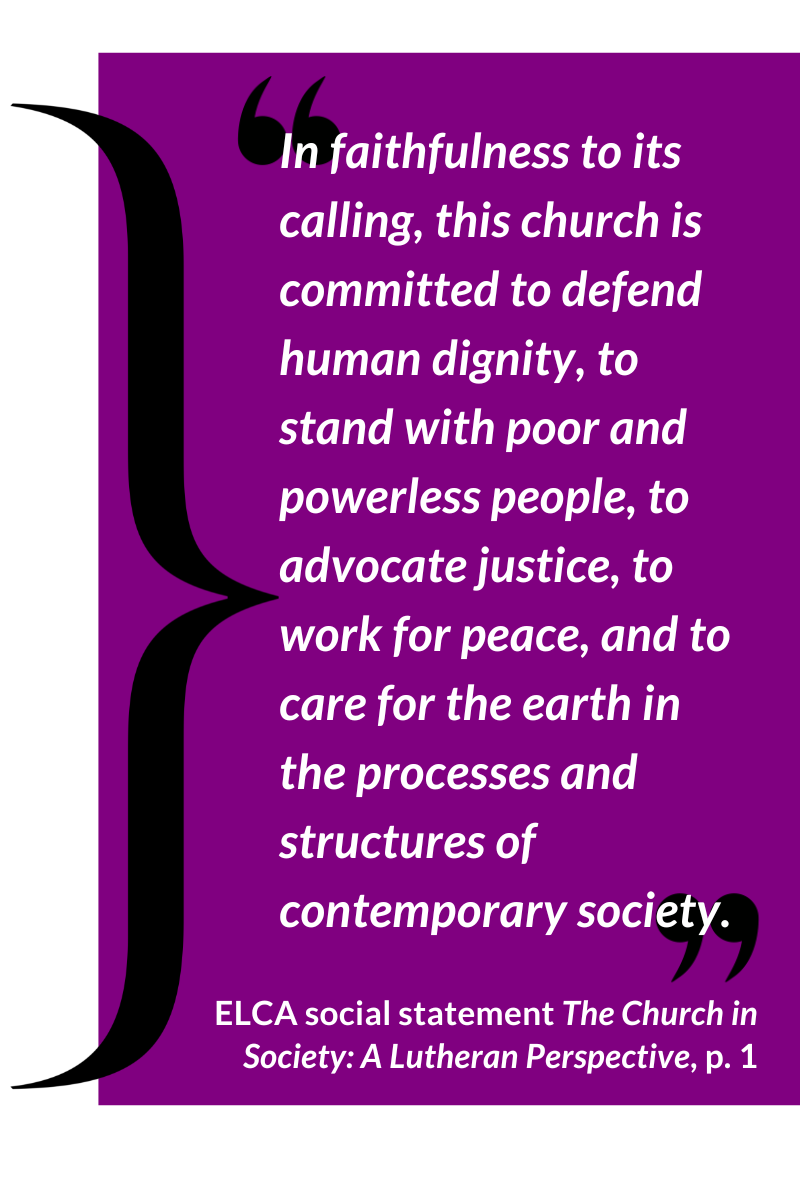
Quotation on a purple background about the church's commitments to human dignity, justice, peace, and environmental care.

August presents unique opportunities to bring our deep concerns as Christians about many things related to our planet and the beings that inhabit it to U.S. Congress in our own backyards. In-person and virtual meetings, as well as Town Halls, can be scheduled in this month as the U.S. Congress usually takes a recess. Representatives and senators often visit their congressional districts and/or home states in August to reconnect with their constituents – like you.

TIPS FOR ARRANGING A MEETING

Whether in-person or virtual, a social ministry or faith-based group you are part of may want to connect to highlight your experience and priorities with your federal elected official directly on an issue about which they have influence.

Who and Where

First and foremost, learn who your elected official is and where they are located. To locate your member of the U.S. House of Representatives, house.gov/representatives/find-your-representative is a great tool. Also available is govtrack.us, using your location to find your senators and representatives .

Follow links to get a photo of the elected official and their website, which will include office locations and other resources.

From the elected official’s website is often a link to make a scheduling request (but an old-fashioned phone call can also help you learn how to accomplish this).

Scheduling a Virtual District Meeting
Quotation on a deep purple background with a large, black curly brace on the left side.

This may be the easiest way to arrange a meeting, and the online tool from the lawmaker’s website should guide the process. For you and those who may take part with you, there is a minimal need to consider travel time, and it can take place anywhere.

  • Make sure to inform the official’s office that you are a constituent.
  • Clearly prepare the reason for the meeting or what the meeting will be focused on. For example, you may want to share your priorities on the Farm Bill or other legislation in federal discussion.
  • TIP: You may be providing the virtual platform for the meeting. If so, clearly determine the correct link. For example, will you use Skype/Teams/Zoom?
  • TIP: Assure there is no time limit for the platform you have chosen so that there is no pressure to rush the meeting.

In my experience, these meetings usually go well and smoothly. Most likely, it will be a staffer of the elected official on the virtual call. Get to know the staffer and get their contact information. They are a person consistently speaking with the elected official.

Scheduling an In-Person District Meeting

It is a bit more difficult to schedule such a meeting, especially since the plan may need to account for travel to and from the location. You may try to meet in the elected official’s local office or at your venue. You may want to offer a tour of your facility or even a more hands-on approach such as allowing the policy maker to volunteer some of their time in a pantry or experience daily life in your facility/space.

  • Here too – make sure to inform the official’s office that you are a constituent.
  • Here too – clearly prepare the reason for the meeting or what the meeting will be focused on, such as an issue or legislation focus.
  • TIP: Be ready with options for times and days that the elected official may meet with you. By having a more flexible schedule, and being open, the likelihood of your elected official attending is increased.

Always Confirm
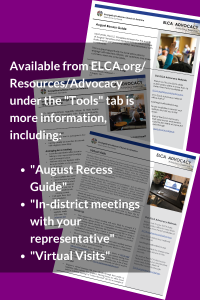
ELCA.org advocacy resources and guides on purple background, with titles - August Recess Guide, In-district meetings with representative, and Virtual Visits.

In my experience, there have been times when a request for a meeting has gotten lost between the website and the assigning staff member or other glitches. It is important to follow-up with the scheduler to assure that a meeting, virtual or in-person, is documented on the elected official’s calendar.

  • TIP: I always follow up with them a few days (4-6) after the initial request to confirm it is on their radar.

PARTICIPATING IN A TOWN HALL

Traditionally, elected officials host two town hall meetings in their respective districts in the month. Your legislators will respond to inquiries during the town hall. By raising your important issue, you can publicly hold your legislator accountable to constituents and start or advance a meaningful conversation.

By checking the legislator’s webpage, you can see if and when they are hosting town halls along with the important details of location and other specifics.

My experience… has been nerve-racking. I recommend that it is important that you have a longer list of questions to avoid asking similar questions that someone else has already asked. If there is a link for you to enter your questions ahead of time, ensure that you do it as early as possible to have the best possibility of it being answered during the town hall. Also, remember to breathe if you are not familiar with public speaking!

GENERAL PREPARATION

As already shared, be very clear on why you want to have this encounter with a lawmaker. Other considerations include deciding who will be part of the meeting (4-5 people in a group is a good number) and developing talking points on your issue/concern that are based on your priorities and experiences.

Not sure how to start? Take a look at the “2024 Federal Policy Priorities” developed by the ELCA advocacy team on the ELCA Advocacy Resources page (under “Tools” tab). In 2023, a blog post example of key issues and possible questions could also inform your approach, available from the ELCA Advocacy Blog. Connecting with your local ELCA-affiliated state public policy office, if available, or synod leaders can also help you shape your approach.

Although a town hall is different, other meetings can benefit by assigning roles to people participating in the encounter. Following is one way to assign roles.

Introducer/Framer – This person introduces your group at the beginning of the meeting. They also keep an eye on time, wrap-up the meeting, and get the business card or contact information of the staff person that is with the elected official.

  • TIP: As part of the wrap-up, this person should be sure to express thanks! Something like: “Thank you for meeting with us. We are members of the ELCA and appreciate talking with you about [whatever the vote or concern/issue is]” will reinforce your purpose and end the meeting on a high note.

Storyteller – This most effectively is someone who is impacted by what the bill you are raising is trying to fix or an aspect of the issue/concern. Sharing (as comfortable) personal experience or the experience of the people you are organizing with is valuable.

  • TIP: I’ve found it is helpful to give a little personal background to allow others to “get you.” Help them understand where you are coming from and how you have been impacted – and how a bill or initiative can change that.

Point Person – This person is more familiar with facts of the bill or issue and can speak to technical questions if they come up – for example: where a bill is in the process or something missing from current discussion.

Closer (may be same as Introducer/Framer) – Near the end of the meeting, this person expresses thanks and asks for further support or highlights district needs overall.

  • I’ve found it is important to keep a sense of URGENCY for the bill or issue/concern about which you are advocating.

FOLLOWING UP

Great job showing up in this August Recess opportunity! But just because the meeting or town hall is over, the opportunity is not.

Every participant, if possible, should email your contact or the elected official’s office to thank them for their time, and/or tag them in a social media post.

  • Build on the experience before a vote or key action on your issue/concern by following up.
  • And keep the relationship going.

Once the relationship starts, phone calls and other contacts will establish familiarity by name and can make it easier for you to schedule future events and opportunities to bring the concerns shaped through your faith convictions and experiences into the policy process.

This post was shared with permission from the Evangelical Lutheran Church In America. To access more advocacy resources and tips from the ELCA, visit its advocacy page.

LEAN Seeks Southern Nevada Legislative Advocate

JANUARY 3, 2023 — As the 2023 Nevada Legislature prepares to convene its 82nd session on February 6, Lutheran Engagement and Advocacy in Nevada (LEAN) is offering a temporary part-time contracted position for a Southern Nevada Associate Legislative Advocate to help statewide advocate Bill Ledford connect with assembly and senate members, identify and follow legislation that meets LEAN policy board criteria for support or opposition based on Evangelical Lutheran Church in America (ELCA) Social Statements, and keep the board and all LEAN constituents apprised of all legislative developments.

Applicant should be a Southern Nevada resident — specifically Clark and Nye Counties.

Representing member congregations of the Grand Canyon and Sierra Pacific Synods of the Evangelical Lutheran Church in America, Lutheran Engagement and Advocacy in Nevada (LEAN) advocates for the common good and promotes public policies that reflect the Christian values of peace, justice, dignity, reconciliation, and empowerment for all people, as well as for care of creation. Advocates on these issues, in both public and private sectors of society, provide representation for those who are denied access to the political process due to current conditions or limitations.

The position is by part-time and arms-length independent contractor agreement will be in effect through June 30, 2023. Offered rate of pay is $16, minimum 8 hours per week, maximum 12 hours per week.

Duties include:

• Meet and engage with Nevada assemblypersons and state senators, electronically and in person when possible, during 2023 legislative session from February 1, 2023 through June 30, 2023, preferably as a registered lobbyist on behalf of Lutheran Engagement and Advocacy in Nevada (LEAN) and the Grand Canyon Synod of the Evangelical Lutheran Church in America (ELCA). 

• Attend monthly Zoom board meetings and provide full report of activities, legislation updates, etc.

• Monitor all potential and fully written assembly and senate legislation, including Bill Draft Requests (BDRs) and joint resolutions, as listed on official Nevada Legislature website, on a regular basis

• Identify bills with language and goals that fit LEAN’s advocacy mission and ELCA Social Statement guidelines. Make recommendations to Board on which bills to target for advocacy engagement. The LEAN board will select targeted legislation based on ELCA Social Statement guidelines and in keeping with LEAN’s mission statement. Areas of interest include hunger, social justice, criminal justice, education, children/family, housing, financial equality, and human dignity.

• Create spreadsheet listing “target” legislation as directed by Board and maintain spreadsheet with updates on each bill’s progress.

• Follow selected legislation through all stages of development and report progress board regularly. 

• Arrange regular in-person interaction with Southern Nevada ELCA congregations to offer updates on LEAN-endorsed legislation, based on ELCA Social Statement parameters

• Advocate for clergy and parishioners to follow LEAN initiatives and activities and become involved in the organization’s mission

• Participate and help organize LEAN events such as hunger simulations or educational seminars

Interested parties are invited to e-mail leanforjustice@gmail.com

LEAN Endorses Nevada State Ballot Questions 1 and 2

Nevada’s early and mail-in voting runs Oct. 22-Nov. 4 in advance of the Nov. 8 general election, and LEAN is prepared to endorse two of the three State Questions that, if passed, would alter current Nevada State Constitution language.

After careful consideration, and guided by the ELCA Social Messages and Statements, LEAN advocate Bill Ledford and the LEAN policy board strongly endorse Question 1­, which would expand language guaranteeing equal rights to all. We also endorse, with certain understandings and acknowledgements, Question 2, which simplifies language that makes $12 per hour the minimum wage in Nevada beginning in 2024.

In keeping with Nevada Constitution-enshrined process, should Questions 1 and 2 pass, they would become law. Question 3, an initiative petition that promises changing the state’s primary voting process, would return to the ballot in 2024 should it pass legislative muster as a bill during the 2023 session. LEAN remains neutral on Question 3 since it deals directly with how candidates would be elected.

Here is the condensed language Question 1 as presented on the official ballot:

Senate Joint Resolution No. of the 80th Session: 

Shall the Nevada Constitution be amended by adding a specific guarantee that equality of rights under the law shall not be denied or abridged by this State or any of its cities, counties, or other political subdivisions on account of race, color, creed, sex, sexual orientation, gender identity or expression, age, disability, ancestry, or national origin?

This question earns LEAN’s strong endorsement for a “YES” vote. Its language reflects scriptural tenets of justice, fairness, mercy, social equality, and equal protection under the law – the very beliefs Jesus lived by, through word and action, as written in the gospels and acted upon throughout the New Testament, most powerfully in texts such as Matthew 25, which remains LEAN’s guiding scripture. And it fits into the parameters put forth in the ELCA’s Social Message on Human Rights.

Here is the condensed language Question 2 as presented on the official ballot:

Assembly Joint Resolution No. 10 of the 80th Session:

Shall the Nevada Constitution be amended, effective July 1, 2024, to: (1) establish the State’s minimum wage that employers must pay to certain employees at a rate of $12 per hour worked, subject to any applicable increases above that $12 rate provided by federal law or enacted by the Nevada Legislature; (2) remove the existing provisions setting different rates for the minimum wage based on whether the employer offers certain health benefits to such employees; and (3) remove the existing provisions for adjusting the minimum wage based on applicable increases in the cost of living?

This question deals with a constitutional change that LEAN has advocated for in the past: Increasing Nevada’s minimum wage to a livable, viable level. Though we believe that $12 per hour is still inadequate given ongoing cost of living challenges for Nevada workers and families, and indeed represents a legislative compromise in the two most recent sessions, it is far better than the $10.50 per hour currently enshrined in the Nevada State Constitution ($9.50 for those whose employer offers health insurance benefits). And though the minimum wage is already slated to increase to $12 in 2024, this Question’s passage would remove the language maintaining Nevada’s current tiered structure, which allows employers to pay a dollar less per hour if they also offer health insurance. We believe that simplifying the language to put all employees at the $12 level — with the ability for the legislature to raise the wage in the future, either on their own or in keeping with federal guidelines — is ultimately beneficial to workers and their families.

However, LEAN endorses a yes vote on Question 2 with the understanding that it is, by its nature and in keeping with state law, a more “permanent” change since it is indeed enshrined at the Constitutional level. We also understand that the law would be altered, as expressed in part 3 of Question 2, to remove language allowing for automatic cost of living increases. In the final analysis, we see this a plus for workers and families, since it would take nearly a decade for cost-of-living adjustments currently provided by the Nevada Constitution to exceeed the $12 per hour minimum. With that language removed, the mimimum wage could be raised sooner and more effectively.

Again, early voting runs Oct. 22-Nov. 4. Completed ballots can also be mailed up to and including election day, as long as the are postmarked by Nov. 8 and arrive at the country registar of voter’s office within four days of election day. They can also be dropped off at any early voting location or at your county’s main office.

If you are a first-time Nevada voter or need to update your voter registration, visit www.RegisterToVote.NV.gov.

LEAN Seeks New Advisory Board Members

Are You Passionate About Social Justice? Join Us!

Lutheran Engagement and Advocacy in Nevada (LEAN), a faith-based organization that represents Nevada’s ELCA congregations at the Nevada State Legislature by advocating for fair, equitable laws that protect and champion the state’s underserved populations, seeks to expand its volunteer Advisory Board before the next Nevada Legislature biannual session begins in February 2023.

Since its inception in the late 1990s as Lutheran Advocacy & Ministry in Nevada, and now as LEAN, the organization works with a contracted, registered “advocate” who follows each legislative session’s docket of potential bills, known as Bill Draft Requests (BDRs), and full-fledged proposed legislation through every stage of the legislative process. LEAN’s current advocate, Bill Ledford, is preparing for the 2023 session with direct and regular input from the organization’s Advisory Board, which meets monthly to set advocacy goals, discuss expected and introduced legislative bills and vote to either advocate for the passage or dismissal of legislation based on ELCA Social Statement guidelines. During off years, the LEAN Advisory Board continues to meet monthly to discuss general business and budgeting, event planning, and initiatives such as its recent “Living With Hunger” project. Supported solely by donations from the Grand Canyon Synod and Sierra Pacific Synod of the ELCA, and donations from congregations and individual believers,

LEAN has long built its advocacy foundation on Matthew 25 in the New Testament, specifically verses 35-40: “…‘Truly, I say to you, as you did it to one of the least of these my brothers, you did it to me.’” It has a 25-year-plus record of advocating for legislation that helps Nevadans who don’t have the voice or power to advocate for themselves, including minority and disabled populations, prison inmates returning to society, sex trafficking victims, the unsheltered, the hungry, the uninsured or underinsured, families in need and many others.

Time commitment is minimal for LEAN’s Advisory Board — one one-hour meeting per month maximum (with potentially fewer meetings in legislative session off-years), along with occasional participation in special advocacy events or fundraisers. There is no fee or cost to join the Board for a three-year term, with the option to stay on for an additional term. LEAN is interested in attracting a mix of rostered clergy and laypersons as potential Board members.

If you have a passion for advocacy work and making a difference for Nevadans from a faith-based perspective, please consider joining us. To volunteer or for more information, please send an email of inquiry to leanforjustice@gmail.com.

LEAN Marks 2021 Session Successes

Supported Legislation Puts ELCA Social Statements Into Action

When the 2021 Nevada Legislature convened for its biennial, 120-day session in early February, the world was still in the throes of a deadly pandemic. Much of “normal” life was still months away. Most churches still worshipped online. Millions of Americans were out of work, in danger of losing their housing, and searching for the way forward. State legislators stared at huge fiscal holes, deep social fissures, and freshly exposed tears in the social safety net.

Thanks to a series of congressional stimulus packages, the fiscal alarms subsided as winter gave way to spring, which helped reorient Nevada’s assembly and senate toward addressing some of those rips in the fabric of society, many ignored for decades. And that gave the advocate and policy council for Lutheran Engagement and Advocacy in Nevada (LEAN) plenty of opportunity to lend its support to legislation that would change Nevadans’ lives for the better.

Guided by the ELCA’s Social Statements and Social Messages, LEAN identified more than 30 active, sponsored bills to follow through the legislative process, with advocate Bill Ledford voicing support, strong support or opposition during virtual committee meetings – where the real “sausage” is made via amendment and debate – conducted via Zoom.

Following are eleven LEAN-supported bills that passed both legislative chambers and have either been signed into law by Gov. Steve Sisolak, or are awaiting his signature, plus one important senate resolution that LEAN heartily endorsed – and one bill that went down to defeat with LEAN’s stated opposition. They are organized under four specific categories tied directly to the Statements. These bills highlight the good work LEAN is doing on behalf of Nevada’s ELCA congregations, and provide the opportunity for parishioners to discuss them, pass them along or use as inspiration to get involved in current community social concerns, and  when the 2023 session approaches.

HUNGER, HEALTH AND HUMAN SERVICES

Assembly Bill 62 (Passed) – Increases support for savings accounts for low-income citizens

AB 185 (Failed) – Rescinds minimum wage increases voted on last session (Opposed by LEAN)

Senate Bill 209 (Passed): Allows workers to use sick leave for any medical reason

SB420 (Passed): Establishes mechanism for creating a state public healthcare option

VOTER ACCESS

AB321 (Passed) – Establishes permanent law allowing for mail-in ballots in every election

AB422 (Passed) – Creates a modern centralized voter registration database, helping assure accurate information across all agencies and assuring both voter access and legal eligibility

JUSTICE REFORM 

AB158 (Passed) – Lessens penalties of minors offending via alcohol and cannabis, and moves policy from punishment to counseling

AB186 (Passed) – Prohibits Police quotas for citations and arrests, and personnel evaluations based on such

AB396 (Passed) – Restricts cases of police “justifiable homicide” to uniform standards

SB50 – (Passed) — Restricts the legal conditions allowing for no-knock warrants

RACIAL AND GENDER JUSTICE & EQUITY

AB157 (Passed) – Penalizes public use of calling police to infringe on others’ rights

SB327 (Passed) – Adds language to anti-discrimination laws to include racial hair styles

SCR5 (Passed) – Urges certain actions to address the public health crisis in Nevada (systemic racism)

To read either the full text of each piece of legislation, or its digest, click on the live link for each bill.