Creating Change from … Nothing

Editor’s Note: The following is from a March 27, 2015 Lenten e-mail message by ELCA Director of Advocacy Stacy Martin. It goes to the heart of why Christ-based advocacy matters.

“They all ate and were satisfied, and the disciples picked up twelve basketfuls of broken pieces of bread and fish. The number of the men who had eaten was five thousand.”

Mark 6:42-44 (NRSV)

Like Thomas Jefferson, I’ve never seemed to have much patience for the Bible’s miracle stories. They’re difficult to deal with. To my modern mind, it’s hard to imagine that seas can part, food can appear from nowhere and that the dead can be raised.

It’s so tempting for me, in my very modern way, to domesticate miracles – like reducing the feeding of the 5,000 miracle to an idyllic picnic or desert potluck. Not that thousands of human beings sharing isn’t miraculous. It is. In the four Gospels, there are six accounts of this miracle. Six! It must be too important a story for it to be about people sharing their lunches. Miracles are tricky that way.

In the Gospel of John account of the miracle of feeding the crowd, the disciples estimate that the crowd is so large that not even six months’ worth of paychecks would be enough money to feed the mass of people assembled. By expressing the amount in such stark terms, what I think the disciples are really saying is, “We don’t have enough money to feed all these people.” And Jesus is saying, “Exactly. Isn’t that great?”

Isn’t that just like Jesus?

One disciple retorts with what I hear as screaming sarcasm. “There’s a boy with five loaves and two fish,” he says. Imagine! Five thousand hungry people on the side of a mountain, and only five loaves and two fish in sight to feed them with. But it seems that this is exactly what Jesus wanted. The funny thing about God is that we are called to be God’s hands in the world at precisely those times when there’s a whole lot of nothing to work with; which is to say, God calls us all of the time. God even sets God’s communion table so that we come with nothing. It seems that God likes it best that way.

God also likes to turn things on their heads. Jesus’ disciples, who expected to be the ones to provide what was needed, found themselves surprisingly dependent upon the generosity of a small child. The Gospels’ accounts of this miracle indicate that the boy gave over his lunch with the kind of abandon and generosity that we only associate with God. It is just the kind of juxtaposition that God seems to enjoy best. Jesus’ faith is placed in a little child to stave off what might become a riot if the crowd is not fed. This is the same kind of juxtaposition we find ourselves in as church when we advocate in the halls of power in Washington, D.C.

This story about feeding 5,000 with so little is, among other things, a story about perspective. The disciples’ main mistake in this story, I think, is that they have no idea what it is that they have. Namely, they have a God who can feed many on nothing. A God who created the universe out of nothing. A God who put flesh on the nothingness of dry bones. “Nothing” is God’s favorite material to work with. Perhaps God looks upon that which we dismiss as “nothing,” “insignificant,” “worthless,” and says, “HA! Now THAT is something I can work with!”

It is our poverty that we are asked to bring to God, not our treasure, because whether we think we have it all or we think we have nothing, we are all of us beggars fed at the table of God’s mercy. What do we have? Five loaves, a couple of fish? Not much. We believe that even when we want to make a difference in the world, we have to arrive fully prepared, fully equipped and fully funded.

I hear often from church folk and non-church folk alike that Lutherans, any faith community for that matter, can make no real difference in Washington. “Why bother?” I’m asked. Compared to big lobbying firms and corporations, they have a point. By comparison, we don’t have money, or connections, or power, or, often, technical expertise. What do we have? Five loves, a couple of fish? Only a smidge shy of nothing even on our most prosperous days.

It’s on the darkest of days when even bishops suggest that all is hopeless in the halls of power, when I’m dismissed by a member of Congress because I don’t come with deep pockets, when I’m ridiculed by a think tank because I attend to this work from a place of faith and not a place of “real” expertise, when I’ve received the tenth angry letter from a fellow Lutheran who is frustrated with me for even considering advocacy as a legitimate vocation, when I feel that we as the church simply don’t have enough power to change things for the better. It’s on those darkest days that I re-read this miracle story.This tricky little miracle story – the one told six times over in the Bible – says otherwise to the “why bothers” of the world. In this story we glimpse God’s inverted economy of free bread and fish paid for by, you guessed it, nothing. This is part of the juxtaposition I mentioned earlier. It is out of nothing that God will create something, even something as big as justice and peace. It is a tricky little miracle for sure.

In the last days before Easter, as we await the biggest miracle of them all – the bringing forth of life from the vast nothingness of death – may we remember that our nothingness is all that God asks or needs.
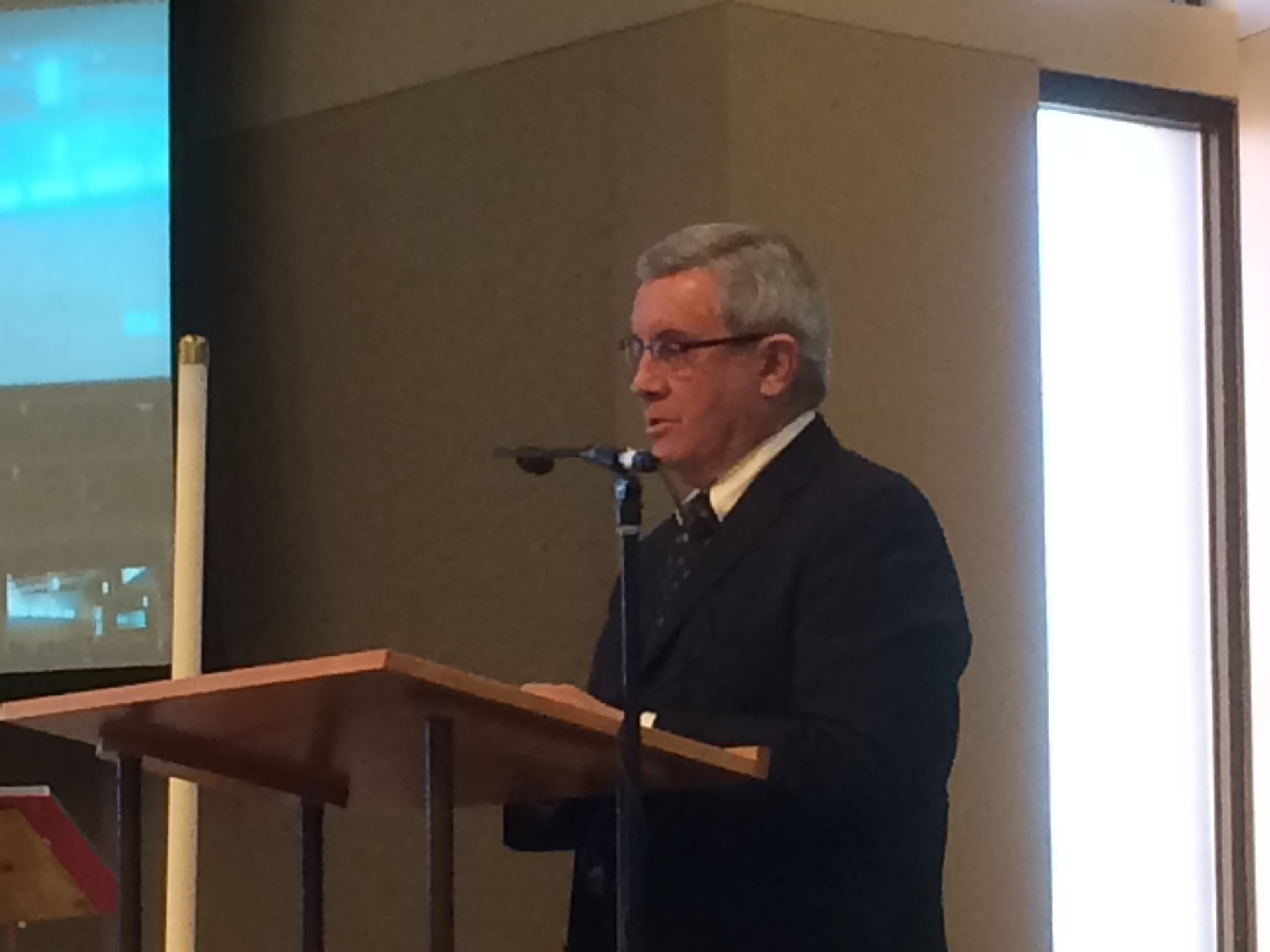
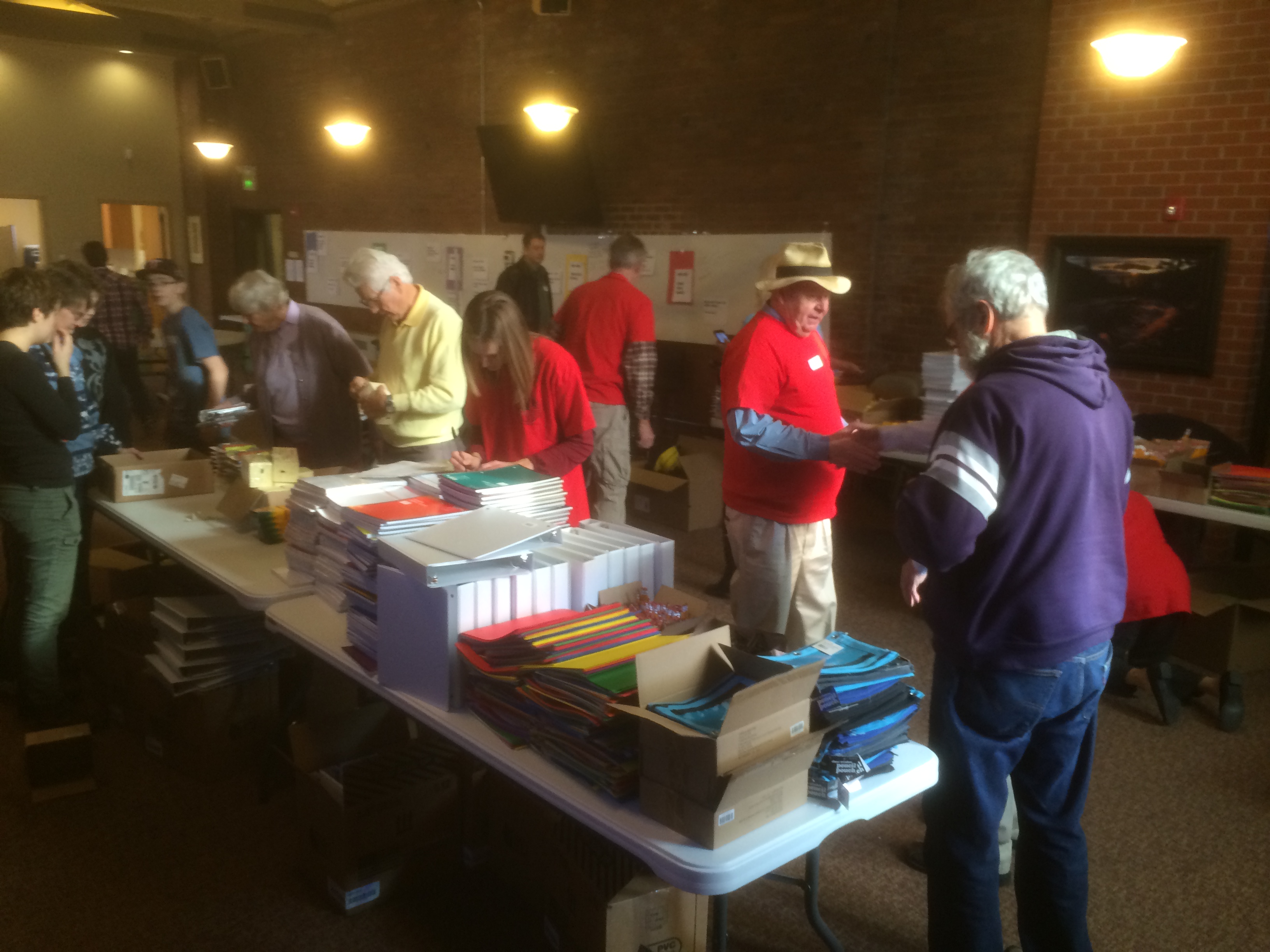
LEAN MLK Day event sheds light on urgent Nevada needs

Lutheran-Episcopal Advocacy in Nevada thanks everyone who helped with our event on Martin Luther King, Jr. Day — all who attended, all who responded to our appeal for donations, all who stuffed backpacks, and the businesses and individuals who provided food. We especially thank our outstanding speakers, and Office Depot for the generous discount on school supplies.

Nevada Chief Justice James Hardesty speaks at LEAN's Martin Luther King Jr. Holiday event at Lutheran Church of the Good Shepherd in Reno, Jan. 19, 2015.

Nevada Chief Justice James Hardesty speaks at LEAN’s Martin Luther King Jr. Holiday event at Lutheran Church of the Good Shepherd in Reno, Jan. 19, 2015.

Volunteers prepare school materials for backpack stuffing at Lutheran Church of the Good Shepherd, Jan. 19, 2015

Volunteers prepare school materials for backpack stuffing at Lutheran Church of the Good Shepherd, Jan. 19, 2015

LEAN’s event on the King holiday was to learn about issues that will be coming up in the 2015 legislative session, and to do the “Backpack Challenge,” designed to demonstrate to legislators that our schools need proper funding. Those who attended heard speakers, some in Las Vegas, some in Reno, connected by video cast.

James Hardesty, Chief Justice of the State Supreme Court, was the featured speaker. He began by giving credit to the faith community for its advocacy in past years for rehabilitation and re-entry programs. He said it has had the effect of changing the culture at the Nevada Department of Corrections. Justice Hardesty described the work of the Nevada Commission on Administration of Justice, and shared some items the Commission will propose to the Legislature. Among those are uniform assessment tools, so that regardless where in the state one is, the same criteria will determine whether a person is fit to release on bail, or whether that person should be paroled. The Commission would like more money allocated to Drug Court and Mental Health Court.

Mr. Mike Raponi spoke about education. He is director of the State of Nevada Office of Career Readiness, Adult Learning, and Educational Options. Some exciting programs are gearing up to train Nevada’s workforce for the technical jobs of the future. Built into the program are incentives to stay in school and graduate on time.

Mr. Shane Piccinini spoke in Reno on behalf of the Food Bank of Northern Nevada. As the public policy advocate for the Food Bank, his agenda is ensuring that federal funding for food programs is not cut. It might be surprising that at the state level, there is sometimes resistance to federal food programs. There are start-up costs and matching-funds requirements that some legislators reject. Who knew there is a Governor’s Council on Food Security? This group is working with the Legislature to remove barriers to federal help for hungry people, especially school children.

The Reverend Lionel Starkes, chair of the Union of Black Episcopalians, spoke in Las Vegas. He recalled some of the inspiring words of Dr. Martin Luther King, Jr. He linked Dr. King’s words and actions to the biblical charge to proclaim freedom to the captives. He noted that many remain captive today—to racism, economic and educational inequality, and that it is incumbent on us in the faith community to continue to work for equality for all.

Do Lutherans Do Revivals?

On October 1, 2014, a press release went out from the ELCA News Service, which is part of the national ELCA.   The release announced a “Prayer Revival” to be held the next day, on the opening day of the annual Conference of Bishops. Since when do Lutherans do revivals? When did you last see a bunch of bishops at a revival? And why now?

The body of the press release explained that the Revival was intended to be a public statement by the church in response to violence generally, but the timing suggests it was mostly a response to the violence in Ferguson, Missouri just a few weeks before. The format was mostly a prayer service, but featured the anointing of hands, as each participant made a commitment to some particular action to enhance peace and justice in his/her own community.

Revival organizers explained that the goals of the event were to “demonstrate that the ELCA is deeply concerned about the violence happening in Chicago and other American cities and the need for improved relations between police and the communities they serve, and to come together as people of faith and pray with each other about these issues.”

The Bishop of the Metropolitan Chicago Synod noted that while the church does not have the power by itself to stop violence, it must take every opportunity to “announce in the public square that we stand in opposition to violence as an acceptable way to resolve human conflict.” He added that collaboration among law enforcement, community organizations, medical and social service providers, political and business leaders and ordinary citizens is essential to address violence.

Advocacy is about making statements in the public square, and ordinary citizens can get involved with just a few clicks of a computer mouse. Although the next Legislative Session doesn’t start until February 2, 2015, individuals can begin to learn about the issues. There is something called a “Bill Draft Request” which is an outline or proposal for new legislation. These “BDRs” are given to the Legislative Counsel Bureau, whose job is to draw up the legal language. Ultimately the bill is introduced into the Legislature. Bill drafts typically are not made public before they’re introduced, but it’s possible to get an idea what a bill is about by its working title.

There are already over 500 bill draft requests, many relating to violence. There are proposals about firearms, bullying, abuse of children and animals, and more. Other subjects for BDRs include education, mental health, economic development, the environment, and even a proposal to allow dogs in bars! A survey by LEAN last spring suggested that our advocacy agenda should focus on education and mental health, but that can change, depending on what we hear from parishioners.

To see the list of Bill Draft Requests, go to www.leg.state.nv.us. This is the home page for the Nevada Legislature. At the top right, under “78th (2015) Session” look for “BDR List.” If you choose “Divided List” you will get a search window where you can put in a topic and get a list of all the BDRs related to that topic. The search tool only looks for words in the BDR title, so scanning the full list will bring in more. The Legislative website has so much information, and it’s quite user-friendly, so anyone who wants to learn how the legislative process works or follow particular issues should definitely spend some time on the website.

LEAN will continue to publish “how to” information as we move through the Session. There are a couple of easy ways to express your views through the website.

LEAN has been working to get the message out that the concerns of individuals and congregations are the foundation of our advocacy agenda. We’ve asked to meet personally with parishioners in order to learn these concerns. So use the website, but please talk to your Parish Communicators as well.

— Sheila Freed

LEAN Joins Nevada Prayer Breakfast

As many are aware, Lutherans and Episcopalians in Nevada recently joined to do social justice advocacy together at the state level. Lutheran-Episcopal Advocacy in Nevada (LEAN) is the first joint venture in the history of the two denominations, and is expected to be a model for similar efforts elsewhere in the country. It builds on strengths of both churches: Lutherans have a centuries-long tradition of advocacy, and have done advocacy at the state level for many years. Episcopalians, through their nationwide Episcopal Public Policy Network, have a sophisticated communication network which makes excellent use of electronic media. The two churches bring these complementary backgrounds and skills together to build an advocacy effort that uses the principles of community organizing to identify and address concerns at the state, as opposed to federal, level.

Lutherans and Episcopalians are connected in another way as well. Both are part of the Nevada Clergy Association. The Association is a non-profit interfaith network of religious and spiritual leaders in Nevada. The Nevada Clergy Association recently hosted its annual Prayer Breakfast. This year’s event focused on recognition of Nevada’s 150th anniversary. (The “Sesquicentennial” celebrates Nevada’s entry as a State of the United States of America in 1864, 150 years ago.)

As part of the recognition, the Nevada Clergy Association presented an oversized quilt to the State of Nevada. The “150 Commission” is the official committee that has organized events around the state, and the Commission has been collecting artifacts which will be displayed around the state and eventually reside in the State Historical Museum. The quilt which the association presented has fifteen unique squares, each representing a different faith tradition. Each was designed and made by members of that tradition. The Lutheran and Episcopal quilt squares are next to each other, perhaps by Divine design.

The quilt symbolizes the work of the Nevada Clergy Association, which is so well expressed in their explanation of the breakfast: “The Nevada Prayer Breakfast is a gathering of citizens—as well as civic, business, and community leaders—who wish to pray on behalf of our State and bring the spiritual resources of the community together to bear on issues that face Nevadans. Although members of the community may believe differently in their approach to the Divine, we gather at the Nevada Prayer Breakfast as equals. Together, we devote our energies to the good of the State of Nevada. Together, we pray.”

The Invocation for this year’s Prayer Breakfast was delivered by Rabbi Ethan Bair of Temple Sinai in Reno. Rabbi Bair’s prayer is a wonderful statement about Advocacy—why we do it, and what we hope to accomplish. He has most graciously allowed us to reproduce his Invocation here:


A Prayer for Nevada

Ribbono shel Olam, Master of the Universe, the One God who goes by so many different names and forms, we pray today for the health, well-being and future of our great state of Nevada. May the next 150 years be greater than our first. God, help us to recognize holiness in our own spiritual traditions, and in the religions of others as well. Give us the strength, dear God, to grow, to become better at being human. Give us the capacity to love ever-more deeply, to create ever more healthy habits of the heart in how we treat one another. Teach us again, the simple power of civil discourse. Give us hope and strength that overpowers cynicism and fear.

Help us to be pursuers of peace and wholeness in our communities, the strength to repair our justice system and education system and human systems. Help us to change our wasteful ways when it comes to the Earth. Give us the chutzpa, the holy tenacity, to stand up to the Pharaohs and adversaries in our midst who would put corporate profits before people; special interests before people’s basic needs. And help sustain each of us to become informed and engaged public citizens, people of values and vision. People who live in the present in a way that says, we have a future worth working towards and we know it. God, please inspire the work of our hands, hearts and lips. That we may see a day when the Earth is not prisoner to our greed, but industry and government are protectors of the Earth. We have failed to be good stewards of the precious Earth you have given to our care. We have failed to protect, educate and give our children a world more perfect than we found it. Help us to change course, that our children’s future may be filled with promise, not pollution and peril.

We pray for the politicians of our state, to realign their priorities with a long-term perspective for prosperity, fairness, justice and environmental stewardship. And we ask for Your blessing to give us the peace that comes with a sound direction. May our path lead us to a more sustainable, equitable, and conscious society. May we forever value and spread the light of the diversity and harmony contained within this room. May diversity be our strength as we uproot ignorance, bigotry and hatred in all its forms. And may our fate forever bend toward justice through the depth, the spirit and the wisdom of our shared humanity.

And together we say, Amen.

As we Lutherans and Episcopalians build our joint Advocacy effort, let us strive for the goals set forth in this prayer, and join, whenever possible, with other faiths, to speak out for the least among us.