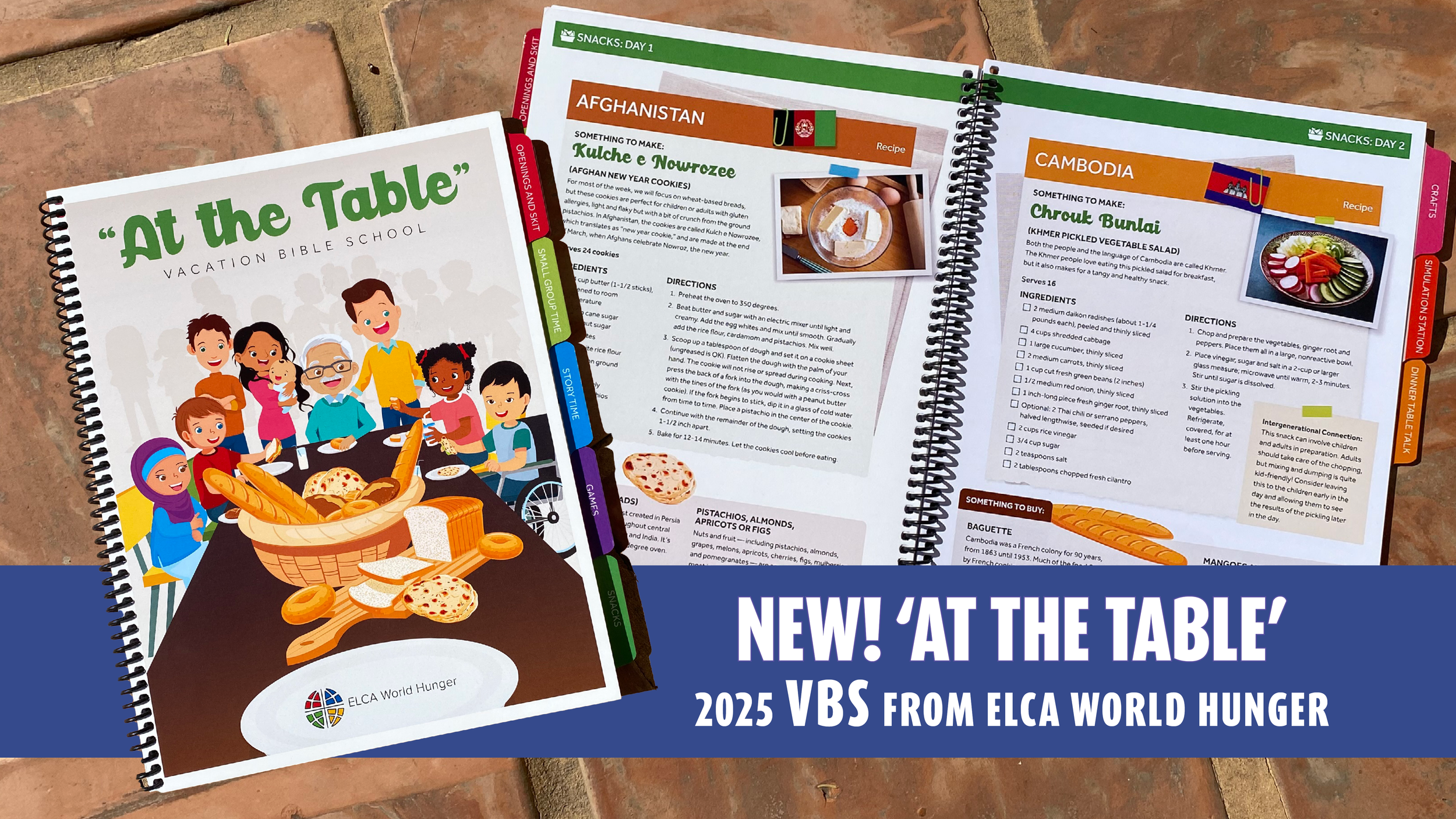
“At the Table” is ELCA World Hunger’s 2025 Vacation Bible School curriculum, inviting your community to learn how storytelling can make a difference in your neighborhood and the world. “At the Table” is designed to be either a traditional VBS or an intergenerational program. Each day offers large- and small-group activities, crafts, games, snacks and more.
The colorful 90-page spiral-bound guide is loaded with ideas, and features 8 tabbed sections:
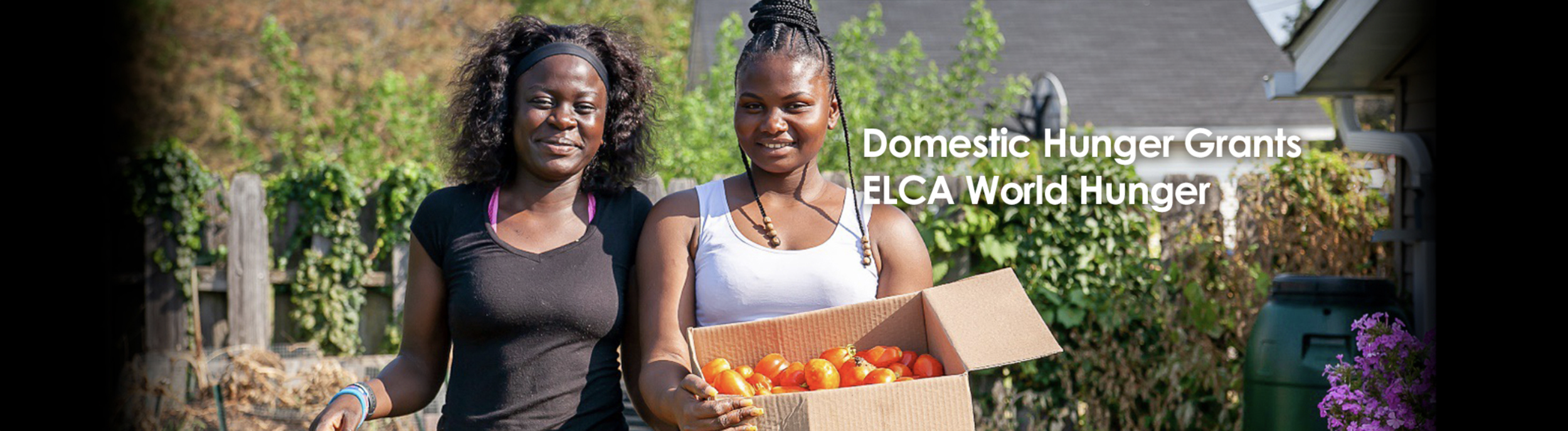
ELCA World Hunger gives thanks for the 147 domestic ministries that will be putting $1,533,936 to work through ELCA World Hunger grants domestically in 2024:
46 ministries across this church have been awarded 2024 Domestic Hunger Grants for a total 3- year (2024-2026) investment of $1,279,590 with an average 3-year award of $9,272 per ministry(*).
52 ministries awarded 2023 Domestic Hunger Grants and 37 ministries awarded 2022 Domestic Hunger Grants will receive continued funding in 2024 for a total investment of $1,233,936 in ministry through Domestic Hunger Grants.
Big Dreams don’t happen overnight or in a year, so in a move toward more sustainable funding for our partners we are extending the awards for up to three years, depending on the needs of the ministry, and to match our Domestic Hunger Grant model. The 12 original 2022 Big Dream Grant partners are designated with a (†). Our total three-year investment will be $1,948,144.
Prior to submitting a full grant proposal, grant applicants are asked to fill out a letter of inquiry (LOI) which briefly describes the project proposal. Registering on our granting portal, ELCA GrantMaker, is not required at this step. LOI Link.
Our DHG application Zoom webinar on Thursday, May 1, 2025 at 2:00 p.m. CST will offer more information about the process. We will review granting priorities and the grant application process, how to submit an LOI, and answer questions from grant applicants. To join us for this virtual event, please register here. Participants will be provided with a link once registered. The webinar will be recorded and accessible via the Domestic Hunger Grant FAQ page.
The Domestic Hunger Grant application for 2026 awards opens April 23, and we look forward to your collaboration in promoting the opportunity to ministries! Please refer to the new application cycle below and spread the word.
Letter of inquiry form open: April 23–July 2, 2025
Letter of inquiry review: July 10–September 10, 2025
Response to the letter of inquiry (decline or accept): October 3, 2025
Invited applicants to complete grant application in ELCA GrantMaker: October–December 2025
Review and communication between ELCA World Hunger staff and grant applicants on proposal: October–December 2025
Award notifications shared with applicants: January 2026
2026 Domestic Hunger Grants start date: March 1, 2026
Let us not succumb to the divisiveness of our world but rather join together to fight the great injustice that is having some of us fed and others who are not. Thank you for your creative, courageous work toward a just world where all are fed. If you have any questions, please contact us at hunger@ELCA.org
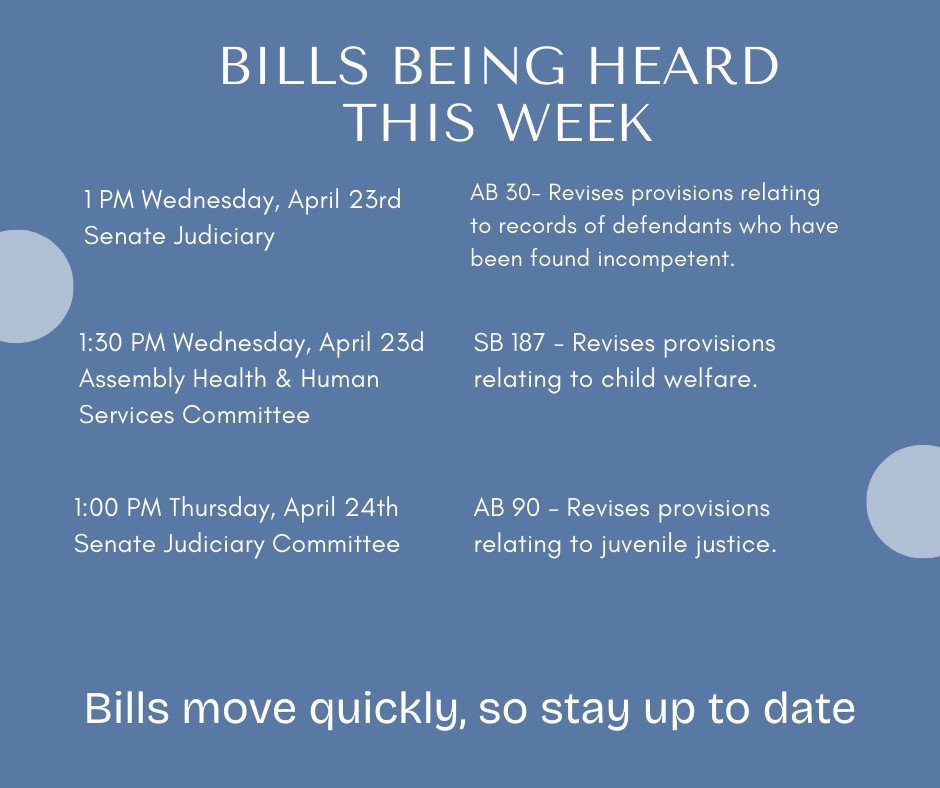
A.B. 30 – This bill extends existing law to include local detention facilities alongside the Department of Corrections in providing records to assist in evaluating and treating defendants found incompetent to stand trial.
S.B. 187 – This bill revises procedures for child protective custody, requiring child welfare agencies to approve or deny medical or mental health treatment within 14 days and clarifying placement decisions based on the child’s best interests. It also modifies timelines for searching for relatives, sibling placement exceptions, and termination of parental rights to align with federal requirements.
A.B. 90 – This bill expands the definition of “detention facility” to include regional facilities for the treatment and rehabilitation of children and requires juvenile courts to make specific findings before committing a child to such a facility, in addition to state facilities. It also mandates that detention facilities inform children and their parents or guardians of their rights under the Juvenile Justice Bill of Rights.
S.B. 52 – This bill requires school districts to report the percentage of immigrant, refugee, English learner, and other related pupil groups, and it modifies the definition of “long-term English learner.” It also allows third-grade students to qualify for a good-cause exemption from retention by demonstrating mastery of grade 3 reading standards through a portfolio of their work, rather than requiring mastery beyond grade 3 standards.
S.B. 424 – This bill requires county or city clerks to recruit election board officers for polling places on Indian reservations or colonies unless the tribe declines. It also mandates at least one training class for election board members staffing these locations, either in person or remotely, unless the tribe opts out.
S.B. 84 – This bill requires the Division of Public and Behavioral Health to ensure that programs for the treatment of domestic violence offenders use evidence-based curriculum and instructional materials as part of their certification and monitoring regulations.
S.B. 352 – This bill expands existing non-discrimination laws by prohibiting both public and private health insurance policies, including Medicaid, from discriminating against individuals based on race, color, national origin, sex, age, disability, or gender identity/expression. It also prohibits healthcare providers from discriminating based on these characteristics and grants regulatory bodies the authority to adopt specific anti-discrimination regulations and discipline violators.
As people of faith, we advocate for tax policies that reflect our values of compassion, justice, family and care for the least of these. Congress is currently considering budget legislation that will shape our tax system. We encourage lawmakers to:
Make the Child Tax Credit (CTC) fully refundable so low-income families can access the full credit.
Increase the CTC amount to account for inflation and make the credit permanent.
Ensure tax reforms do not come at the expense of other vital safety net programs like SNAP or Medicaid.
Maintain or strengthen the charitable tax deduction that allows churches and nonprofits to continue serving their communities.
Join us in calling on Congress to prioritize families and children by supporting a more robust and inclusive Child Tax Credit.
During our last week of the Lenten Action Series, contact your member of Congress today.
The Department of Education (DOE) faces a 50% staff reduction and potential dissolution under the new administration. Recent budget cuts in a continuing resolution have already reduced K-12 innovation and improvement funding by $88 million, with proposals for future cuts in a reconciliation bill – up to $330 billion – over the next decade for education programs (additional clarifications on cuts are available from ELCA Schools & Learning Centers). Critical offices including Civil Rights, Free Application for Federal Student Aid (FAFSA) student loans, and data collection have been severely impacted. “Because children are God’s gifts to society and the Church as well as to parents, society through government also has responsibility and authority to provide for young people’s education,” says the ELCA social statement Our Calling in Education. Also, “All people share the need and responsibility to be educated in civil righteousness and the matters of earthly life,” which affirms our human dignity and contributes to community well-being. Our ELCA social teaching emphasizes that quality education must be accessible to all people regardless of socioeconomic status.
Additionally, consider learning more about our theological grounding on education with the newly published resource, “Vocation as a Balancing Act,” affirming Lutheran values in higher education. The publication is the Spring 2025 issue of Intersections, a publication by the Network of ELCA Colleges and Universities (NECU).
During this Lenten Action Series reflecting on national budget priorities, contact your member of Congress to oppose these harmful cuts and advocate for robust educational support for all communities. Send a customized letter with your local experiences and convictions.

 Lutheran Engagement and Advocacy in Nevada