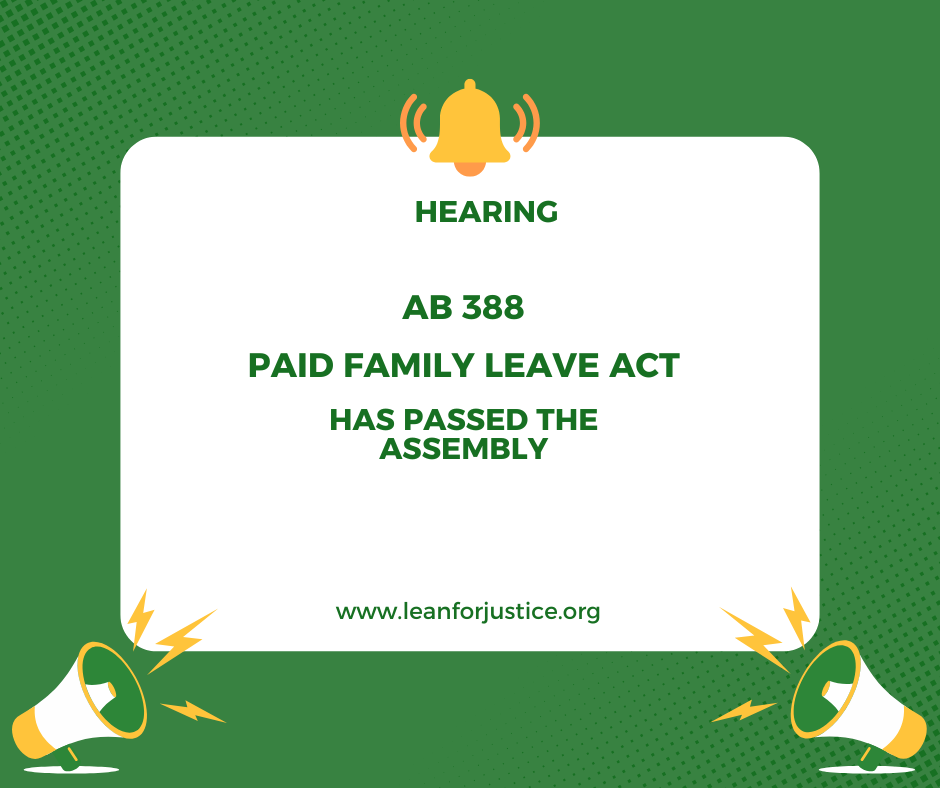
On Thursday, the Nevada Assembly passed AB 388, which would change Paid Leave in Nevada from 8 weeks to 12 week, reduces employment requirements from 12 months to 90 Days, and brodens to include Foster Parents. The bill moves next to the Nevada Senate Please contact your Senator and Governor Lombardo.
A number of bills have now passed both chambers of the Nevada Legislature and are awaiting action from Governor Joe Lombardo. In the last legislative session, Governor Lombardo set a record for the number of vetoes. Will he follow the same path this year—or will he choose to sign the record number of bipartisan bills currently on his desk?
Make Your Voice Heard! Call Governor Lombardo’s office today at (775) 684-5670 and urge him to sign legislation that reflects the will of the people and bipartisan cooperation.
May is Mental Health Awareness Month. Though the month is almost over, it’s never too late to take a moment and notice the effect that mental illnesses have on us. As we do so, we can also reflect on how God acts in the midst of mental illness.
In its most recent complete data from 2022, the National Institute of Mental Health reported that 23.1% of U.S. adults experienced some mental illness in the previous year. By contrast, 2021 data report that 14.7% of U.S. adults have diabetes. Though mental illness is 63% more common than diabetes, you’d hardly know it by the way people talk about it. People account for diabetes. There are low- or no-sugar options for dessert. If someone asks for half a slice of cake with the explanation, “I’m diabetic,” we cheerfully accommodate them.
Unfortunately, we don’t often extend the same gracious flexibility to mental illness. If someone says that their bipolar disorder is making it hard to get out of bed in the morning, do we reschedule our early meetings? If someone shares that their anxiety affects their participation in an event, do we make accommodations? If someone points out their depression as the reason they haven’t returned our calls, do we kindly let them off the hook? I hope the answers to these questions would always be yes, but often people receive judgment instead of understanding when they share their mental illness diagnosis.This can be especially complicated in church, where we hear words like the ones from Jesus above. “Don’t worry” can feel like just another impossible expectation to a person with a persistent anxiety disorder. “You are worth so much more than birds!” might make someone with depression wonder if Jesus really meant them, too.
But there’s a funny little bit where Jesus calls the disciples “people of weak faith” (you might have read a translation that says “you of little faith”), right as he’s assuring them that God will do good things for them. It turns out that Jesus isn’t actually all that worried about how good we are at not worrying or how worthy we feel compared to birds and lilies. This isn’t a mental health to-do list from Jesus. It’s a promise: even when we worry, even when we feel worthless, even when we have the tiniest bit of faith: God’s delight is to give us everything, even the whole kingdom of heaven. The promise doesn’t ride on whether or not we get our act together or produce enough serotonin.
The promise is simple: have no fear; don’t be afraid, little flock, because your Father delights in giving you the kingdom. Since God gives the kingdom and all its riches to us (that’s forgiveness, mercy, love, belonging, faith, to name a few), all of us, whatever our mental health might be at any moment, can rest in that promise.
I invite you to reflect on God’s promises and how we can share them for the sake of nurturing mental health as you listen to this hymn, “Have No Fear, Little Flock.”
We of the Evangelical Lutheran Church in America join our ecumenical and interreligious partners in expressing deep concern and sadness over the deadly shooting of two Israeli Embassy staff outside an event in Washington, D.C. This is yet another example of the rising, deadly scourge of anti-Semitism in our society.
As a church, we have declared that “we recognize in anti-Semitism a contradiction and an affront to the Gospel, a violation of our hope and calling, and we pledge this church to oppose the deadly working of such bigotry, both within our own circles and in the society around us” (“A Declaration of the ELCA to the Jewish Community,” 1994).
We are profoundly disturbed that these killings occurred in the context of an event hosted by the American Jewish Committee that featured speakers from the Multifaith Alliance and the humanitarian organization IsraAID. These speakers were discussing avenues for ensuring that humanitarian aid reaches Gaza, precisely the kind of collaboration that is needed, and that the ELCA supports, as the people of Gaza face starvation and intentional mass displacement.
We join in praying for the families, colleagues and communities of Yaron Lischinsky and Sarah Milgrim, for the Jewish people in our communities who live in fear, and for the people of Gaza, who desperately need humanitarian aid to stay alive. We continue to call for a ceasefire, for the release of hostages and those being detained, for access to humanitarian aid, for rejecting violence as a means of solving the ongoing destruction of the Holy Land, and for recommitments to dialogue, reconciliation and humanization. Above all, we pray for God’s peace and justice to prevail for all people.
In Christ,
The Rev. Elizabeth A. Eaton Presiding Bishop Evangelical Lutheran Church in America
 Lutheran Engagement and Advocacy in Nevada