Lutheran Engagement and Advocacy in Nevada (LEAN) invites congregations across the state to participate in our 2026 Policy Priority Poll. Your input will help guide LEAN’s advocacy work during the upcoming Nevada Legislative Session.
As people of faith, we are called to listen deeply to our neighbors and lift up issues that reflect God’s justice, compassion, and peace.
Congregations are encouraged to discuss and complete the poll together — discerning where the Spirit is leading us to act boldly for the common good.
Topics include:
Housing & homelessness
Healthcare access & mental health
Education equity
Immigrant and refugee support
Environmental justice
Criminal justice reform
Economic fairness
Voting rights
Together, we listen, learn, and advocate for justice in Nevada.
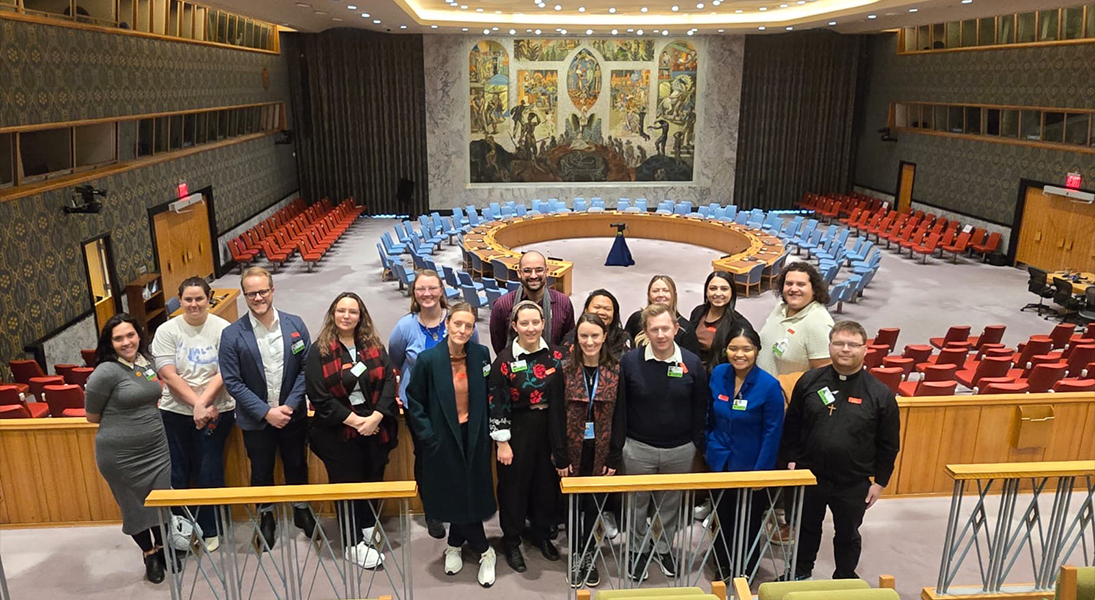
Prepared with what they wanted to say and passionate about saying it, 10 young-adult Lutherans spent time in Washington, D.C., and New York City advocating for climate action as part of the Young Adult Climate Immersion program. Opportunities to speak about care for creation at the corporate, federal and international levels built up their advocacy skills and experience.
In December 2024, young people with diverse life experiences and perspectives took part in the most recent immersion trip, co-hosted by ELCA Witness in Society and ELCA Young Adult Ministry. In part one, held in Washington, participants were primed with information about policy impact and message refinement before advancing to Capitol Hill, where they spoke with their representatives about a range of climate policies: international climate finance, clean-energy transition, disaster relief and the Farm Bill, among others.
Gabrielle Irle, who traveled from Washington state, said the experience left her feeling as if she “could do advocacy, because I could talk to people. Despite the importance of the places where we do governance and make decisions, the people doing that are just people!”
The young adults then traveled to New York City for part two of the program. Facilitated by staff of the Lutheran Office for World Community and ELCA Corporate Social Responsibility (CSR), the group learned about the United Nations (U.N.) and the Lutheran World Federation (LWF) and participated in an exercise on CSR through the lens of stakeholders.
As participants headed home, they unpacked their lessons learned and actions taken so that they might encourage others. “To see the work and community that Lutherans have cultivated through the LWF was inspiring and a gift to communicate to our local churches,” said Emmanuel J. Correa Vázquez. “I also had a meaningful moment when I was able to visit the U.N. building and experience the ‘Room of Quiet,; conceptualized by a fellow Lutheran, Secretary General Dag Hammarskjold. It reminded me of how our spirituality is an asset to advocacy and social justice.”
“I came away from the national and global pieces of the immersion feeling empowered to do direct advocacy work in my local community,” said Hannah Limbong, a college student and Kentucky resident. “I feel immensely proud of my church and all the creative ways that Lutherans are working for the sake of their neighbors at every level of community.”
Here I Pod kicks off Season 3 with “Immigration, Sensitive Locations, and Faithful Actions,” featuring special guests from ELCA Ammparo, The Border Church / La Iglesia Fronteriza and ELCA advocacy. Listen in wherever you get your podcasts or from our YouTube channel – and invite others to check it out!
I wonder… have I ever acted like the unjust judge? It’s not a comfortable question, but Jesus’ parables rarely let us stay comfortable.
In this Sunday’s reading, a poor widow refuses to give up her cry for justice. She keeps knocking, keeps showing up, keeps believing that something can change. Her persistence isn’t about being pushy, it is about faith. It’s hope that refuses to die, even when the world seems stacked against her.
And the judge? He finally gives in, but not out of compassion or mercy, but because her persistence exposes his indifference. His contempt for others. That’s the power of holy persistence: it can awaken even hardened hearts.
As we lean into this week, may we listen for the voices still crying out for justice in our world—the widow’s voice echoing in new forms. And may we have the courage not to turn away, but to join her holy persistence.
Where are you being called to keep showing up? Where is God calling you to not lose heart?
Years after the U.S. refugee program began to recover, new changes threaten to shut the door on those most in need. Reports suggest the Trump Administration plans to cap resettlement at just 7,500—leaving thousands stranded abroad without safe haven.
Faith communities have long been pillars of support in refugee resettlement. Here’s how they’re responding to this alarming shift:
Washington, DC – Recently, it was widely reported that the Trump administration is planning to reduce the refugee admissions goal for Fiscal Year 2026 to a historic low, excluding tens of thousands of at-risk refugees waiting abroad.
Reports indicate that the administration intends to set the new refugee admissions target–or Presidential Determination on Refugee Admissions (PD)–at just 7,500 and reserve most refugee admissions capacity to resettle white South Africans. Crucially, the PD process cannot be finalized or implemented until the administration completes a legally required consultation with Congress. This reporting comes as the cruel and indefinite refugee ban remains in place, leaving tens of thousands of refugees who were already approved for resettlement stranded overseas.
Guided by our diverse faith traditions, we share collective alarm that the Trump administration intends to foil the spirit of the U.S. Refugee Admissions Program by drastically slashing the program and abandoning refugees fleeing persecution and war. We stand against the exclusion of any refugee simply because of who they are, where they come from, or what they believe.
We urge Members of Congress to call on the administration to continue the time-honored and legally-required consultation with Congress. We also urge President Trump and all of our elected officials to reaffirm America’s longstanding commitment to protecting people fleeing persecution through a refugee program that reflects and aligns with humanitarian values and concerns.
Over 100,000 refugees who were approved for resettlement as the refugee ban took effect remain in limbo. After years of waiting and preparing to rebuild their lives, it’s likely most would be excluded by the administration’s plans for the program. Each day offers a chance for President Trump to reverse course and welcome all refugees—without discrimination—advancing both our humanitarian values and U.S. geopolitical interests.
Rick Santos, President & CEO of Church World Service said: “Forty-five years ago, Republicans and Democrats came together to show the world that American ideals take precedence over party politics. In a fraction of that time, this administration has abandoned the program they created—and left thousands of already-approved refugees stranded overseas in increasingly dangerous conditions. We call upon the administration to reverse course and uphold the proud tradition of the refugee program by prioritizing those most at-risk, including Afghans, Sudanese, Congolese, Somalis, religious minorities, unaccompanied refugee children, families awaiting reunification, and others.”
Krish O’Mara Vignarajah, President and CEO of Global Refuge, stated: “To drastically lower the admissions cap and concentrate the majority of available slots on one group would mark a profound departure from decades of bipartisan refugee policy rooted in law, fairness, and global responsibility. Despite shifting policy, the spirit of welcome continues to endure in church basements, community centers, schools, and living rooms across the country. Time and again, the American story has been renewed by those who seek shelter here and give back tenfold. That promise is still within reach, but only if political leaders choose courage over fear and inclusion over isolationism.”
“Jesus aligns himself with the marginalized and persecuted. The Presidential Determination on Refugee Admissions has historically been an indicator of our nation’s willingness to do the same,” said Rukshan Fernando, Associate Executive Director of Mennonite Central Committee U.S. “We urge this administration not to abdicate that responsibility nor hinder the ability of U.S.-based churches to engage in the faithful work of refugee resettlement.”
“Setting refugee admissions to 7,500 is a moral failure as people of faith and a betrayal of who we are as a nation. For decades, under both Republican and Democratic administrations, our nation has been a beacon of hope for people seeking safety–regardless of faith, race, or country of origin,” said Kristyn Peck, CEO of Lutheran Social Services of the National Capital Area (LSSNCA). “As an organization rooted in faith, we are called to welcome the stranger and serve our neighbors in need. We urge elected officials and community members who share these values to join us in speaking out. We have a moral and legal obligation to ensure refugees can seek safety in our communities.”
“For decades, the United States stood as a global leader in refugee admissions, offering hope and safety to those fleeing war, persecution, and violence,” said Rabbi Jonah Dov Pesner, Director of the Religious Action Center of Reform Judaism. “As Reform Jews, our commitment to protecting refugees is guided by Jewish text and tradition, including the Torah’s commandment to welcome the stranger, for we were strangers in the land of Egypt. The presidential determination reducing refugee admissions to a historically and dangerously low level violates our moral obligation to protect the vulnerable, and reflects a shameful retreat from our nation’s historic leadership in refugee resettlement. Given our own experiences of persecution and refugeehood, we are acutely aware of how each person admitted can represent a life saved; indeed, as the Talmud teaches, ‘Whoever saves a single life is considered to have saved an entire world.’ As Jews and as Americans, we call on the administration and Congress to reverse course and recommit to a refugee policy rooted in compassion, fairness, and the fundamental dignity of every human being.”
“We are deeply troubled by the administration’s recent approach to refugee policy, which seems willfully blind to racial injustice experienced by residents of the global south, and unfair to refugees already in the pipeline, mid-process, seeking entry or relocating to the U.S,” said Pablo DeJesús, Executive Director of Unitarian Universalists for Social Justice. “Now is an urgent time for Congress to side with refugees and the resettlement program that supports them. Our U.S. program should focus on the most at-risk refugees and those already in the established process.”
“One hundred thousand vetted refugees fleeing persecution and war are ready to become a part of America’s tapestry and make their new communities great,” Fran Eskin-Royer, Executive Director of the National Advocacy Center of the Sisters of the Good Shepherd said. “The National Advocacy Center of the Sisters of the Good Shepherd is greatly disappointed at the insensitive record low number of 7,500 refugees that this presidential administration has announced it will accept for the 2025-2026 fiscal year. We call on President Trump to admit at least the 100,000 vetted refugees this fiscal year. Americans are not afraid of people from other countries. We are stronger and better when we welcome them. Let’s prove it and open our doors to refugees once more.”
Laurie Carafone, Executive Director of NETWORK Lobby for Catholic Social Justice stated: “NETWORK Lobby for Catholic Social Justice was founded by Catholic Sisters in 1971 and has a longstanding commitment to the humane treatment of refugees. As people of faith, we are proud that our country has long served as a beacon of hope and freedom for those fleeing persecution. This core national value has remained consistent under Republican and Democratic administrations for decades. The U.S. stands for freedom and fairness, and this includes admitting refugees based on humanitarian need and extensive and unparalleled vetting by UNHCR, the Department of Homeland Security, the Department of Defense, and the FBI, and long waiting periods in line for resettlement. There are over 100,000 refugees who have passed all these steps and are already approved for resettlement in the U.S. but are currently in limbo due to the Trump Administration’s refugee ban. These men, women and children are next in line and fairness dictates that they be processed first. We call on President Trump and lawmakers to ensure our refugee program continues to reflect the Gospel values of human dignity, fairness, and care for those in need of protection. No president should play political games with people’s lives.”
“The President’s plan to drastically reduce refugee admissions and prioritize Afrikaners or any other groups other than the most at-risk populations is both a moral failing and a humanitarian catastrophe,” said Rev. Michael Neuroth, Director of the United Church of Christ Office of Public Policy and Advocacy. “The dream and uniqueness of the United States lies in our diverse population, many of whom are refugees. The decision to leave one’s home country is far from easy, and refugees have waited bravely and patiently for their opportunity. We, as followers of Christ, urge the President to restore the refugee admissions program and welcome refugees from all nations. When we welcome refugees, we all thrive and prosper together. As the United Church of Christ, we affirm refugee resettlement as an expression of our civic duty and sacred call to love our neighbor, to uphold dignity for all God’s people, and to build a just world for all.”
Rev. Amy Reumann, Senior Director of Witness in Society for the Evangelical Lutheran Church in America said: “As Lutherans, many of our ancestors faced the pain of having to flee their home countries and the joy of being welcomed in new communities across the United States. Building on this tradition, for over 80 years, Lutherans in the United States have united in response to God’s call to love our neighbors who come to us seeking refuge. Welcoming refugees is a true expression of our faith, and also a continuation of an American tradition of providing a home to those facing persecution because of who they are or what they believe. We urge the administration not to abandon this tradition, but to set a refugee ceiling that is in keeping with the significant need globally and the more than 100,000 individuals who have already passed strict vetting and are ready to make their home in the United States. We also call for a refugee admissions process that does not discriminate based on race, religion, or nationality, but that welcomes all based on need. Each of these people, we know, is a beloved child of God; each of them bears the image of God.”
Sister Marie Lucey, OSF, Associate Director of Franciscan Action Network (FAN), stated: “We Franciscans, firm in following the teachings and example of Jesus Christ, St.Francis of Assisi, and Catholic Church leaders, urge the President to uphold the U.S. moral and humane tradition of opening our doors to refugees who have fled their home countries seeking life and safety in this country. Tens of thousands of at-risk refugees who were stringently vetted have been waiting in refugee camps, some for years, to be admitted to the United States. If the Trump administration sets the admissions goal for FY26 at an unbelievably low number of 7,500, with majority slots reserved for white South Africans, thousands of deserving refugees will have been betrayed by the U.S. government. For decades, presidents of both parties have set the annual admissions goal no lower than 60,000 and often at 125,00 or more. Congress must urge President Trump to change course and live up to the highest ideals of this democracy.”
Elket Rodriguez, Global Migration Advocate for the Cooperative Baptist Fellowship and Faithworks said: “I lament the Administration’s determination to set the FY 2026 refugee admissions goal at the historic low of 7,500. This decision reflects a true abandonment of our nation’s calling to protect those facing persecution—including Christians and Baptists around the world. It departs from the bipartisan spirit of the 1980 Refugee Act and the vision embodied in the Carter administration, when the United States opened its doors as a place of refuge and hope for the persecuted. Even in the face of this drastic reduction, our field personnel, missionaries, and congregations remain steadfast. We have whole communities ready to receive, resettle, and love those who will still be welcomed.”

 Lutheran Engagement and Advocacy in Nevada