ACLU is hosting on Thursday at 1:30 p.m. PT, Building a Firewall for Freedom. Join the ACLU of Nevada and the national ACLU on Instagram Live to discuss the launch of our Firewall for Freedom campaign
We’re bringing legal action, advocacy, and public engagement to defend the rights that keep Nevada free: free speech, immigrant rights, voting rights, and equal protection for all.
What does advocacy look like? For the Southeastern Synod ELCA, it can be as bold as taking part in a lawsuit and as simple as listening to others. In our most recent SPPO Spotlight, “Grateful Response to Grace with Advocacy,” the Rev. Justin Eller explores the advocacy work of the ELCA-affiliated state public policy office (SPPO)
If advocacy means loving our neighbors and working for justice with the “least of these” (all who are hungry, thirsty, newly arriving, vulnerable, sick or imprisoned – Matthew 25:40) then advocacy can be both general and particular.
The Southeastern Synod of the ELCA consists of congregations and faith communities across four states: Alabama, Georgia, Mississippi, and Tennessee. Each state has their own unique particularities and priorities, state legislative session dates and rhythms, and contextual challenges and opportunities. Instead of being a single ELCA-affiliated state public policy office (SPPO), we strive, as a four-state synod, to journey with residents, congregations and leaders as we navigate a wide variety of challenges.
OUR APPROACH TO ADVOCACY
In lieu of attempting to respond to every particular state legislative item, our Southeastern Synod’s advocacy work usually focuses on broader issues impacting our entire synod territory. Whether it’s marriage equality, food and medical insecurity, or supporting immigrant and refugee communities, our approach to advocacy, loving our neighbors, and working for justice, is to engage, equip, and empower.
Engage: We work with our congregations and leaders to engage in advocacy action and understand how advocacy is part of our baptismal growth in Christian faith and life, “to care for others and the world God made, and to work for justice and peace” (ELW, p.228).
Equip: We work to equip our congregations and leaders with quality information and training on advocacy-related issues as well as how to advocate at the local, state, and federal level. We have an Advocacy Policy Committee with representatives from our four states who help us put into motion ways we can advocate across our synod.
Empower: We work to empower our congregations and leaders to be active advocates in their context, to contact their elected officials and to speak with communities who are vulnerable and not speak for them.
The Southeastern Synod grounds our advocacy work in:
Scripture that calls people of faith to care for the most vulnerable;
Values of Accompaniment in the ELCA: mutuality, inclusivity, vulnerability, empowerment and sustainability; and
It looks like working with congregations and communities in our four states in emergency/disaster preparedness, whether from a hurricane, tornado or immigration enforcement action.
It looks like the Southeastern Synod being the lead plaintiff in a lawsuit against the state of Tennessee over a new law that could put rostered ministers and congregations at risk for providing food, shelter or resources to undocumented immigrants.
It looks like hosting virtual Lunch-and-Learn events, “Know Your Rights” and “Support Your Community” workshops and trainings to address root causes of systemic injustices.
It looks like creating a network of congregations who have Matthew 25-like community-engaged ministries (such as ministries of feeding, clothing and shelter).
It looks like participating as speakers at public witness events like the “Witness for Creation” event organized by Creation Justice Ministries
THE EXPERIENCE OF ADVOCACY
As we have experienced it, advocacy can be big and bold and as simple as showing up, listening to an adversely impacted community, and committing to walk with them in solidarity and love as they address their challenges. Advocacy can be expressions of social action and practices of faith.
Yet, in all of this faithful work, advocacy is what we get to do together and is our grateful response to God’s grace in Jesus Christ to love and serve our neighbor.
Critical programs that protect the integrity of our air, soil, water, and the habitats that sustain all living creatures are at risk. Take action today to advance this comprehensive legislation.
As Congress considers a budget for 2026, proposals across the government would make deep cuts to theAs Congress considers a budget for 2026, proposals across the government would make deep cuts to the Environmental Protection Agency (EPA), Clean Water and Drinking Water State Revolving Funds, Superfund cleanup and environmental justice programs—rolling back progress on safeguarding public health and creation care. These cuts could result in increased pollution of our air, contamination of our water and degradation of the habitats creation calls home. As people of faith, we are called to steward creation so that all life may flourish. Programs that protect clean air, restore soil health, provide safe drinking water and safeguard habitats for wildlife are essential for the well-being of our neighbors, human and nonhuman alike.
As the ELCA social statement Caring for Creation: Vision, Hope, and Justice cautions, “Our current practices may so alter the living world that it will be unable to sustain life in the manner we know.”
Join us in asking Congress to ensure their budget negotiations reflect the vision of creation flourishing! What do you see locally? Customize this message to increase its effectiveness.
From ELCA Advocacy, October 10, 2025. As of this day in October 2025, the Farm Bill has expired, leaving critical hunger networks and many in rural communities in policy limbo. It was last reauthorized in 2018 and temporarily extended through September 30, 2025. This comprehensive legislation traditionally governs SNAP nutrition assistance, rural infrastructure, agricultural research, and farm-to-food bank connections that many of our congregations and social ministry organizations depend upon to serve those in need.
With the Farm Bill’s expiration, lawmakers have the opportunity to craft new legislation that strengthens our ability to support the hungry and those of us in the greatest need. We urge our representatives to support a renewed Farm Bill that prevents upcoming barriers to SNAP benefits, recognizing that these programs are lifelines for struggling families in our communities—including many in rural America facing mounting economic pressures from tariffs, declining commodity prices, and rising production costs.
The expiration has particularly impacted “orphan” programs, which have lacked reliable funding since 2023 – including agricultural research programs, scholarships for young farmers, and oversubscribed conservation programs. International feeding initiatives, such as Food for Peace and the McGovern-Dole school feeding program—which provide meals to hungry children worldwide—face uncertain futures. Domestically, farm-to-food bank programs that connect agricultural abundance with hungry neighbors have lost critical support, straining food ministries operated by Lutheran Social Services, church food pantries, and other faith-based hunger relief ministries already stretched thin by increased demand.
Congregations often witness firsthand how families who steward the land and feed our nation are themselves struggling. Through Action Alerts and federal advocacy, we ask lawmakers to restore these vital programs and support policies that uplift both rural communities and the vulnerable populations our faith compels us to serve.
The Farm Bill
The Farm Bill, which guides much of U.S. agriculture, rural and food policy, is currently being debated in Congress. The ELCA urges Congress to pass a 2024 Farm Bill that promotes:
food for hungry neighbors at home and abroad,
healthy rural and farming communities,
inclusion of people of all backgrounds,
care of creation to feed future generations
In a world of abundance, we strive for an end to hunger and poverty, and towards a just world where all are fed. Additionally, we are to work with each other and the environment to meet needs without causing undue burdens elsewhere. The Farm Bill is one of the most influential pieces of legislation affecting hunger and conservation in the U.S. and around the world.
Our social statements call for policies that provide adequate nutrition for all and create livelihood opportunities that are genuinely sustainable. We urge lawmakers to pass a 2024 Farm Bill that reflects these faith-based values.
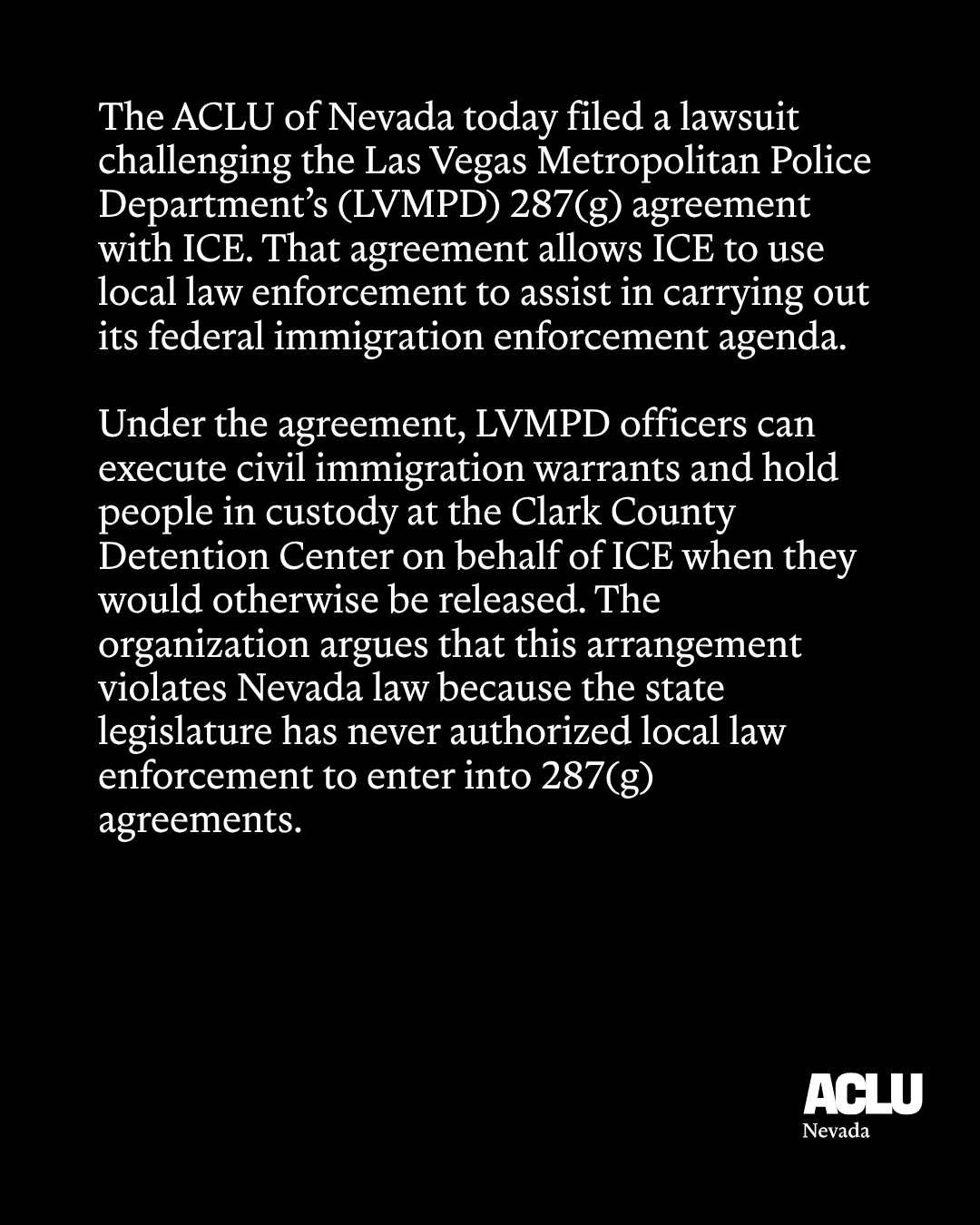
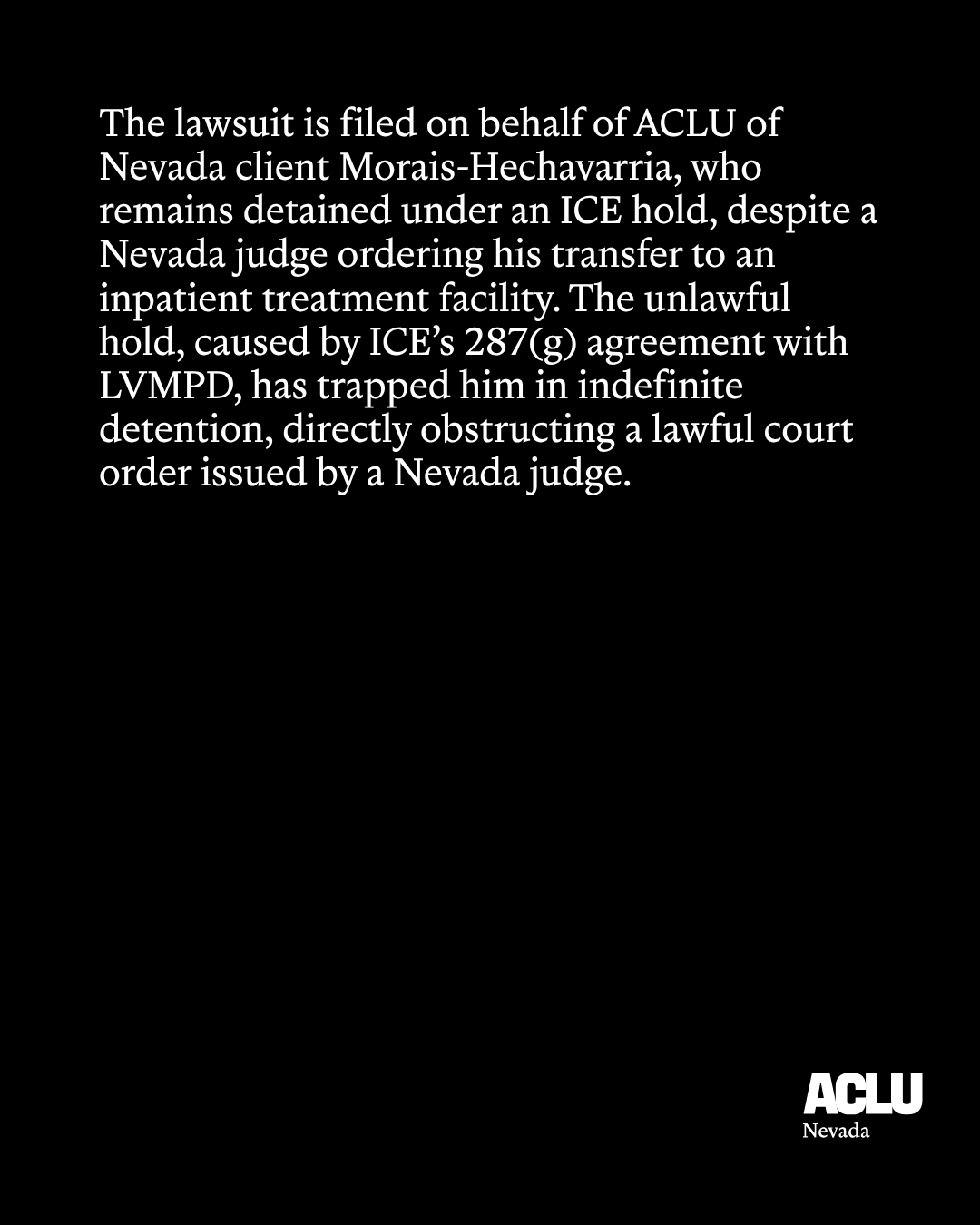
The ACLU of Nevada has filed a lawsuit challenging ICE’s misuse of Nevada’s law enforcement to carry out its federal immigration agenda.
This unlawful 287(g) agreement between the Las Vegas Metropolitan Police Department (LVMPD), and ICE undermines Nevada’s justice system, obstructs state court orders, and wastes taxpayer dollars. Nevada’s law enforcement should serve our communities – not act as agents of federal immigration enforcement.


 Lutheran Engagement and Advocacy in Nevada