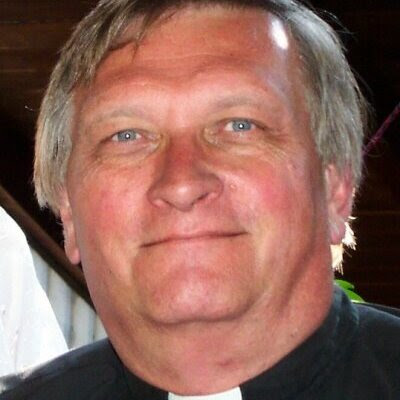
In Memoriam: The Rev. Ronald M. Rentner

Ronald M. Rentner died on November 15, 2025, at the age of 80 in Grass Valley, CA., with family. Yes, he died. As a Lutheran pastor, it was important for him that we understand death is a reality and we can use the word “death”, with the confidence that we will be called home to a new life in God’s presence. He was born on November 26, 1944, and baptized in April 1945, in Milwaukee, WI. Ron was the first child born to Malcolm A. C. Rentner and June (nee DeVoll). He was close to his three siblings, Marlowe, Rich, and Melissa.

Much of Ron’s early life was lived in Southern California. At age 15, he followed the call to Lutheran ministry, studying first in Oakland, CA, and then at Concordia Senior College, Ft Wayne, IN, and Concordia Seminary, St. Louis, MO. Academic achievements included a Master of Arts in medieval history (St. Louis University) and a Master of Divinity Degree (Concordia Seminary), both in 1971. 

In the first year of college, Ron met the love of his life, Miriam Yvonne (nee Borkey). They were married in 1967 and enjoyed raising a family of three children and two foster daughters who became family. They also invited over 80 international immigrants, students, and friends into their home during their lives, including two unofficial foster boys who joined the family for a time. 

Ron served as a pastor of the Evangelical Lutheran Church in America (ELCA) at Grace Lutheran, River Forest, IL, Grace Lutheran, El Cerrito, CA, Lutheran Community of the Resurrection, El Cerrito, Lord of Mercy Lutheran, Sparks, NV, missionary to the Iglesia Luterana Agostina de Guatemala, All Saints Lutheran, Novato, CA, St. Stephens Lutheran, El Dorado Hills, CA, and the International Church of Copenhagen, Denmark. He also spent time researching in Hungary. 

Ron took great pleasure in serving non-profit ministries, including as executive director of Kairos Unlimited, Inc (a residential treatment facility for abused teen women), president of El Cerrito Senior Homes, board chair and president of Elder Care Alliance (a large California operator of assisted living, SNF, and memory care facilities), executive director and legislative advocate for Lutheran Advocacy Ministry in Nevada and Religious Alliance in Nevada, member of the synod council of the Sierra Pacific Synod of the ELCA, chair of Nevada Voluntary Organizations Active in Disaster (the umbrella group for Red Cross, Salvation Army, and church groups responding to disasters), the Nevada Preliminary Disaster Assessment Team, Habitat for Humanity (Reno, NV), treasurer of Bethel Housing (Sparks, NV), and treasurer of Spokane Urban Ministries (a builder/operator of low income rental housing in WA).

One of Ron’s great passions was designing new models in affordable housing for low income and immigrant residents. With Yvonne as a cherished companion, they also fought tirelessly to bring awareness and relief to devastating political and economic strife in Central America, starting in the 1980’s. 

Ron leaves behind his very special wife, Yvonne, and children Jill Valdez (Anthony), Joel Rentner (Jennifer), and Gwen Brandenburg (Justin), along with 10 grandchildren. Foster daughters Akberet Negash and Luwam Yifter became members of the family, as well. His three siblings survive him, along with a large extended family and his many church families. But Ron’s earthly family is not limited to this short list.

A memorial service was held on Dec. 13, 2025, at Peace Lutheran Church, Grass Valley, CA 95945. In lieu of flowers, gifts would be appreciated for Lutheran World Relief (give.lwr.org) or International Rescue Committee (help.rescue.org).
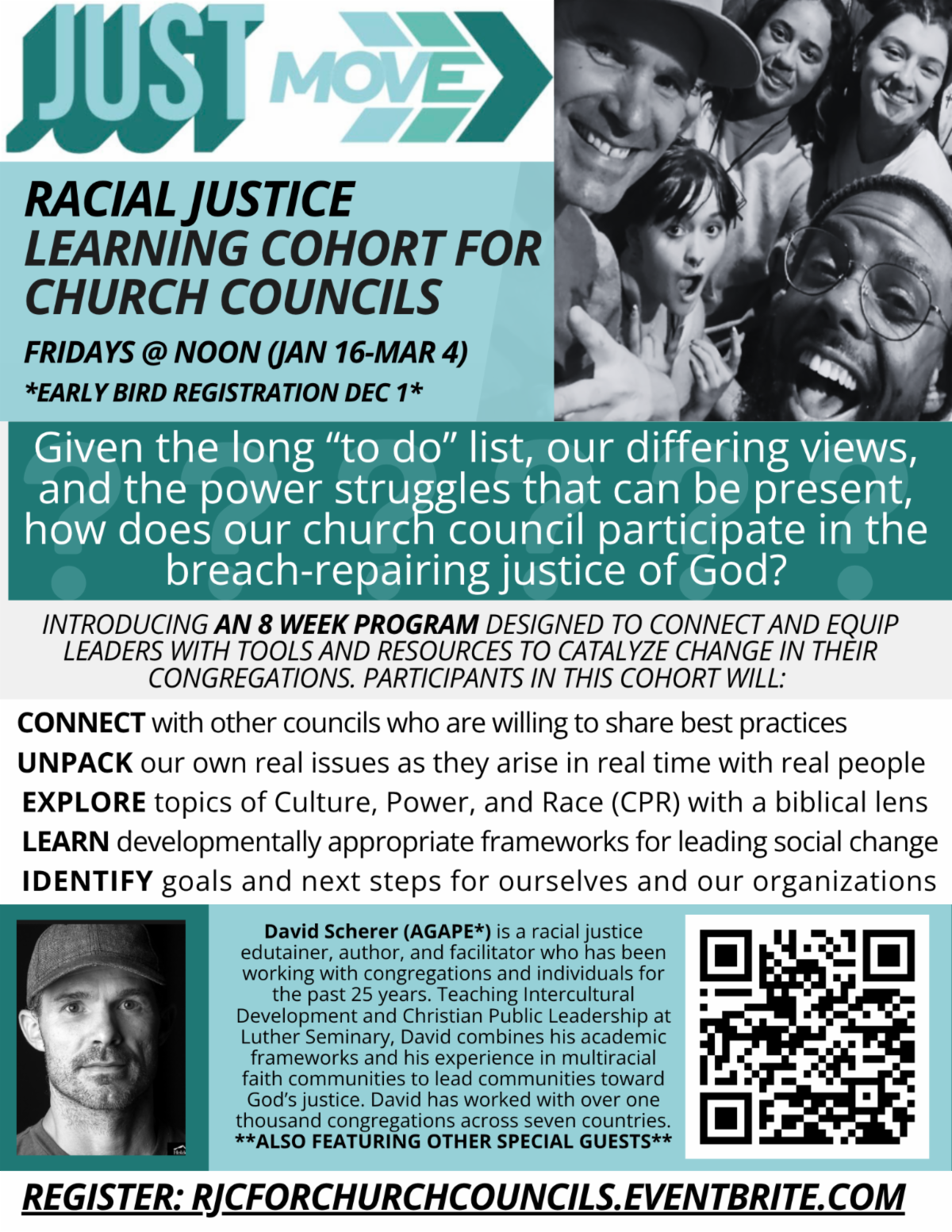

Racial Justice Learning Cohort for Church Councils, Pastors, & Youth Leaders

Church councils carry big responsibilities—navigating differing views, complex decisions, and the call to lead with courage. This winter, church leaders are invited to join a transformative 8-week Racial Justice Learning Cohort designed specifically for congregational councils. The cohort will meet on Fridays at 10 AM PST from January 16 to March 4.

  • This cohort will equip council members with tools to engage Culture, Power, and Race (CPR) through a biblical lens and to participate in the breach-repairing justice to which God calls us. 

Alongside the Church Council Cohort, there will also be dedicated tracks for Youth Leaders and Pastors who want to deepen their leadership, expand their racial justice capacity, and engage these conversations with their communities in meaningful ways.

Facilitated by David Scherer (AGAPE)*, racial justice educator, author, and facilitator with over 25 years of experience training leaders across the country—along with other special guests.

Register at: RJCFORCHURCHCOUNCILS.EVENTBRITE.COM

RJCFORPASTORS.EVENTBRITE.COM (Tuesdays at 10 am PST)

RJCFORYOUTHLEADERS.EVENTBRITE.COM (Thursdays at 10 am PST)

Apply for Prince of Peace’s Mission Endowment Fund by December 31

The Prince of Peace Lutheran Church Mission Endowment Fund provides financial awards to individuals and organizations that emphasize on extending the life and mission of the church, which would include but be not limited to: 

  • Mission outreach – local/national/international faith-based organizations that are meeting basic human needs 
  • Innovative new programs or ministries 

All people are welcome to apply on behalf of an organization, endeavor, or project that furthers the mission and outreach goals of the congregation. Grants typically range from $1000-$5000. 

For more details and to apply, please visit: https://www.propeace.org/endowment.html 

Hurry! Applications close December 31, 2025

Comment on Proposed Federal Rule Affecting Immigrant Status

Our friends at the ELCA federal public policy office shared an advocacy opportunity to respond to a new federal rule that would give immigration agents broad discretion on how to make “public charge determinations” — allowing agents to deny entry or a green card to an immigrant they deem to be likely to become primarily dependent on the government for subsistence or long-term care. 

“Public charge” determinations previously had a high bar and didn’t consider use of means-tested benefits. Under the new proposed rule, immigration agents might consider previous or anticipated use of any government benefit — both for applicants and even potentially their family members. The lack of specificity could lead to a chilling effect and disenrollment from critical services like Medicaid or the Children’s Health Insurance Program (CHIP). 

What can you do?

Submit a public comment here by midnight EST Dec. 19, opposing the proposed rule. You can read ELCA’s public comment here, and you can find additional detailed background and templates here (we recommend using the templates for reference only, and drafting your own comment from scratch). 

Who can submit a public comment?

You may submit a comment as an individual or on behalf of an organization. You may also submit your comment anonymously, but this is less influential. 

Why submit a public comment?

Federal agencies require public feedback on many of their policies posted on the federal register. Federal law requires agencies to consider and address these comments when making final decisions. Comments may also be considered in future court challenges to the rule. 

What should a public comment look like?

Here is one guide to writing an effective public comment. You don’t need to touch on every aspect of the policy, and your comment doesn’t need to be longer than a paragraph or two. The most effective part of your comment is its uniqueness and its insight on the rule’s impact on your community. 

If you write a public comment on this ruling, please let us know, paullarson@leanforjustice.org.

A Season to Make Room

The Christmas story is one we return to again, especially in this Advent season as we prepare for our Messiah.

Mary travels to Bethlehem exhausted, pregnant, and afraid, forced to move under the decree of a tyrant, Caesar Augustus. She and Joseph arrive only to hear the words so many still hear today: there is no room for you. The vulnerability they face is profound. And yet, it is there, in a manger, surrounded by God’s creation, in a simple and unexpected place, that Christ is born.

Soon after, King Herod, threatened by rumors of a child who might challenge his power, enacts a horrific policy of violence, ordering the slaughter of children in and around Bethlehem. To survive, the Holy Family becomes refugees, fleeing to Egypt in search of safety.

This story feels painfully relevant.

Today, fear grips so many communities, immigrants and refugees, transgender Americans, people of color, people with disabilities, and those living on the margins. Once again, entire groups are scapegoated, treated as threats, told they are less worthy, less human, less deserving of care and protection.

That is why I am always drawn back to the Christmas story. Jesus is born in a manger, not a palace. God comes into the world amid displacement, poverty, and rejection. The nativity is not just a sentimental decoration, it is a story of vulnerability. A story of needing a place to rest when the world says, we do not have room.

And yet, Christmas calls us to make room.

This month at St. Paul’s, we are living into that call by serving as a warming shelter for neighbors experiencing homelessness in Carson City. Each night throughout the winter, churches across the city open their doors as part of a shared ministry, supported by local congregations, a non profit, and the Sheriff’s Office, to ensure that people have warmth, safety, and dignity during the coldest months. We continue to hold hope for a permanent shelter in Carson City, a long-term solution rooted in compassion and justice. Until then, we make room.

This is what the gospel looks like in action.

I was reminded of this during the recent Special Session when the Windsor Park neighborhood in North Las Vegas, after nearly thirty years of fighting for dignity and justice, finally saw an end to their struggle. Their story is a powerful witness to the importance of treating one another with respect and honoring the inherent worth of every community.

Housing affordability will be a priority for Lutheran Engagement and Advocacy in Nevada in 2026 because the crisis is affecting our congregations and our neighbors alike. Rents continue to rise, and too many families are being pushed to the brink. During the Special Session, LEAN advocated for a cap on the amount of housing that out-of-state corporations can purchase in Nevada. During the 83rd Legislative Session, we supported tenant protections, an Affordable Housing Fund, and policy changes to allow greater flexibility and equity in housing development.

The Christmas story reminds us that God shows up where the world least expects, and often least welcomes. In a time when fear and exclusion are loudly proclaimed, we are called to embody a different story. A story of welcome. A story of dignity. A story of making room.

May this season remind us that caring for our neighbor is not optional—it is the very heart of the gospel.

Grace and peace,

Rev. Paul M. Larson