A Holiday Guide: Debunking 5 Myths about Immigration in the U.S.

As families gather around the dinner table during the holidays, political debates are bound to come up—with immigration being no exception.

To counter the misinformation on this contentious topic and keep the conversation productive, the American Immigration Council is here to bust five common myths about immigrants in the United States.

1. Do undocumented immigrants commit more crimes?

False narratives about immigrants bringing crime to the United States are not new and have been exacerbated by claims that recent immigration enforcement efforts are focused on “the worst of the worst.” But the data is clear: noncriminals are increasingly being detained by U.S. Immigration and Customs Enforcement (ICE). People without any criminal record now make up the largest population in immigration detention.

Welcoming immigrants into American communities can actually strengthen public safety. In fact, immigrants—including those without legal status—are less likely to commit crimes than their U.S.-born counterparts.

  • Data from 1980 to 2022 shows that as the immigrant share of the U.S. population grew—from 6.2% to 13.9%—the crime rate declined by 60.4%. The violent crime rate fell by 34.5%, and the property crime rate fell by 63.3%.
  • Nineteen separate research reports published between 2017 and 2024 have found that the portion of immigrants in an area did not impact either the violent crime or property crime rate in that area. Increased shares of immigrants were actually associated with lower violent or property crime rates.
  • Despite President Trump claiming that immigration enforcement is focused on going after “the worst of the worst,” government data show that the majority of people detained by ICE have no criminal convictions. Read more: Debunking the Myth of Immigrants and Crime.

2. Can undocumented immigrants vote?

Increasingly, politicians are changing voting systems under the guise of stopping noncitizens from voting. There is no evidence, however, that noncitizens are voting in any significant way at all.

  • A database from the Heritage Foundation going back to the 1980s identifies 1,546 cases of alleged voter fraud. Only 68 cases pertain to noncitizens. Despite significant efforts to document noncitizen voting, proven incidents of noncitizen voting over a 40-year period were below 0.0001%.
  • Most cases of noncitizen voting involve lawful permanent residents—many who ended up voting due to bad information, being encouraged to vote by a government official, or being falsely told they were eligible to vote.
  • Read more: Unpacking Myths About Noncitizen Voting — How Heritage Foundation’s Own Data Proves It’s Not a Problem.

3. Do undocumented immigrants pay taxes?

The value of immigrants to the U.S. economy is under increased scrutiny, especially regarding their tax contributions. This is despite immigrant households—including undocumented immigrant households—contributing billions of dollars in federal, state, and local level taxes each year.

4. Can undocumented immigrants get Medicaid and SNAP?

Who qualifies for specific federal public benefits can be complicated. Complex eligibility rules and political rhetoric have fueled confusion and misinformation. The passage of President Trump’s One Big Beautiful Bill Act has further muddied the waters, but the truth about immigrants and public benefits is simpler.

  • Undocumented immigrants are ineligible for federally funded programs like Medicaid, Medicare, or the Children’s Health Insurance Program (CHIP). They do not receive Social Security benefits (despite paying into the program), cannot purchase healthcare coverage through the Affordable Care Act Marketplace, and are ineligible for SNAP benefits. Undocumented parents can apply for SNAP on behalf of their U.S. citizen children, but benefits can only be calculated based on the number ofeligible household members.
  • Lawfully present immigrants, including green card holders, can receive some public benefits, but must wait five years before they can apply, with limited exceptions.
  • Many immigrants avoid applying for benefits they may otherwise be eligible for due to confusion and fear stemming from a prior “public charge” rule—something the Trump administration is considering bringing back—leading to mixed-status households unenrolling from public benefits for which they are entitled.
  • Read more: Can Undocumented Immigrants Get SNAP or Medicaid? The Truth About Federal Benefits and Immigrants Help Fund Our Public Programs.   

5. Do immigrants take American jobs?

Immigrants are frequently portrayed as competitors for American jobs. In reality, immigrants are complementary to the U.S.-born workforce. They are job creators, fill labor shortages in key industries like agriculture and healthcare, and are vital to the long-term health of the U.S. economy.

While this is not an exhaustive list of myths, it highlights the widespread misinformation and confusion surrounding immigrants in the U.S. These myths not only affect our immigrant neighbors but also impact the well-being, safety, and prosperity of all Americans.

As we gather with our loved ones during the holidays, it’s important to remember that not only are we a nation built by newcomers, but we are a nation sustained and made prosperous by immigrants.

Needing Advent by Acting Bishop Rev Mike Girlinghouse, Grand Canyon Synod of the ELCA

Every year I grumble about how early the Christmas shopping season starts (usually at “Christmas in July” sales!). We skip from Halloween to Christmas in a heartbeat. Thanksgiving barely gets honorable mention anymore. Except maybe in grocery stores.

Advent? Do people outside the church even know what that is anymore apart from advent calendars that serve as a “countdown to Christmas?” But, in today’s world where everything is fast, immediate and instantly available 24-7, I think we need the themes of Advent: waiting, watching and getting ready.

Advent is important to counter-balance the frantic pace of the “Holiday Season.” Zechariah had a hard time believing the good news that he and Elizabeth would have a son. As a result, he was rendered silent during those long months of waiting. In the process he learned something not only about waiting, trust and faith, but about the power and promise of God.

We need Advent to help us hear, really hear, above the din of the world, the good news of God coming among us on that first Christmas night. Of God’s great gift to us, of God coming among us, for you and for me and for all those yearning for a savior.

Peace,

Pastor Mike Girlinghouse
Acting Bishop 
Grand Canyon Synod of the ELCA

Perspective: Peace without justice is a cover for injustice

Reprinted from Living Lutheran article posted November 20, 2025.

Living Lutheran Editor’s note: On Sept. 6, Khader Khalilia, program director for ELCA Arab and Middle Eastern Ministries, addressed the church’s Multicultural Young Adult Event in New Orleans. Presented by the ELCA Ministries of Diverse Cultures and Communities (MDCC) team, the gathering was held to build community and communicate to the churchwide organization the needs of the affiliated Indigenous, racial and ethnic ministries. MDCC is sharing Khalilia’s remarks in hope of highlighting ministry concerns and engaging the wider ELCA in what continues to be a critical conversation.

I am a Palestinian Christian. My family has followed Christ for generations. Our roots are deep in the land and culture of the Bible, Palestine.

That is where I was born and raised and where my identity as a Christian and a Palestinian was formed. But my childhood, like those of millions of Palestinians, was [defined not only] by my family and church but also by Israeli occupation and ethnic cleansing.

I lived under Israeli occupation throughout all my childhood. My family tried to lead a “normal” life, as many Palestinians do—going to school, celebrating holidays, attending church, studying, working. But under occupation, even the most basic routines often become acts of resistance.

You never know what will happen. At any moment, a curfew can be declared. A road can be blocked. Your electricity or water can be cut. Your cousin can be arrested without charge. Your neighbor’s house can be bulldozed.

This kind of uncertainty is itself a form of violence.

This kind of uncertainty is itself a form of violence. You cannot plan your future. You cannot dream freely. Every part of your life exists under the shadow of someone else’s control.

When I was a teenager, the second intifada erupted. One day, Israeli soldiers stormed our home and turned it into a base. They confined my entire family to a single room while they used our house as a strategic position. We eventually had to abandon it and live with my grandmother for three months.

Another time, we spent over six hours lying on the floor, bullets flying outside, praying they wouldn’t come through the windows. I kept moving my little brother from corner to corner, trying to shield him with my body.

These are not unusual stories. These are the daily lives of Palestinians.

And while the world tells us to be patient, to wait for negotiations, to trust the so-called peace process, our reality remains unchanged.

Peace cannot grow where there is no justice. And justice cannot come from the silence of those with power.

The world watches

The past two years have been among the most horrific in living memory for Palestinians—especially in Gaza.

But let’s be clear: this did not begin on Oct. 7, 2023. That date has become a convenient starting point for media narratives, but it is not the beginning of the story. It is the continuation of 77 years of displacement, dispossession and dehumanization.

In Gaza, more than 70,000 people have been killed since Oct. 7. Among them, over 17,000 children. Let me say that again: over 17,000 children.

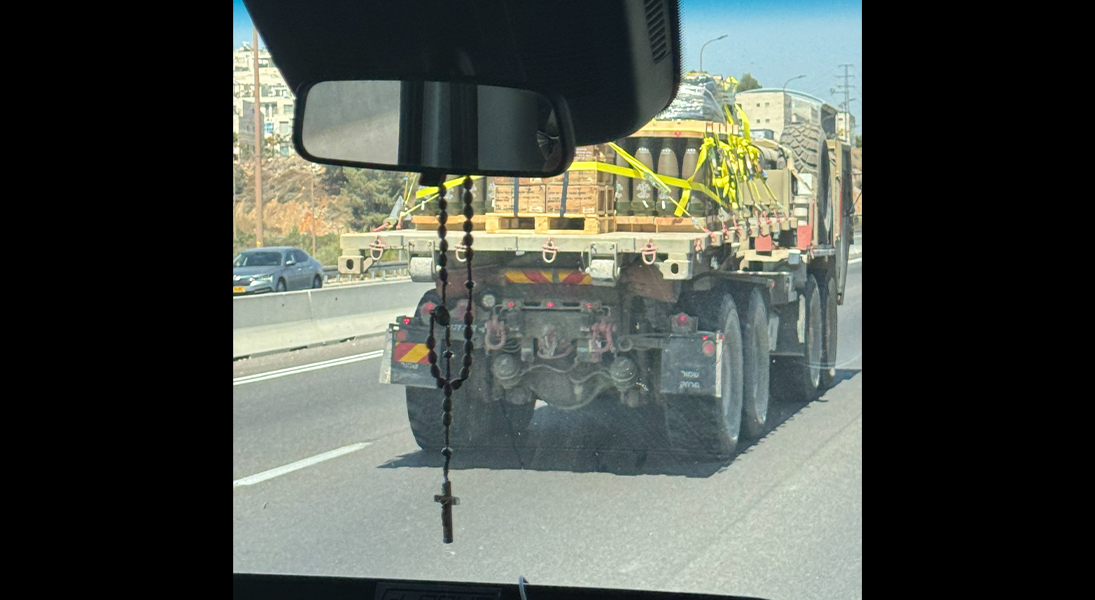
And still, the killing continues. With American-made bombs. With full U.S. diplomatic cover. With the silence or inaction of the majority of Western churches.

Gaza today is not a war zone—it is an annihilation zone.

A place where families are bombed in their sleep. Where babies are born and die within days because there is no incubator, no electricity, no clean water. Where entire apartment blocks are wiped out with a single airstrike.

Even hospitals have become targets. Schools have become graves. U.N. shelters have become death traps.

This is not a war.

Gaza has no army. No air force. No navy. Gaza is the site of an ongoing genocide, home to over 2 million people, half of them children, all of them besieged by land, sea and air. Every day and every night for two full years.

The church has largely gone quiet.

The world watches. And the world—especially the powerful parts of it—does nothing. Worse than nothing: It funds it. It arms it. It excuses it. It enables it.

And the church? The church has largely gone quiet. We hear a few timid prayers. We see a few calls for peace. But peace without justice is just a cover for injustice. Silence is not neutral; silence is complicity.

And let me be even more specific: Silence about the genocide in Gaza is a betrayal of the gospel. Let me name something hard: the Western church has been in denial about what is happening in Palestine.

We like to speak of human rights in general terms. We like to quote prophets like Amos and Isaiah when it’s convenient. We like to say “justice” from the safety of our pews.

But when it comes to Palestine? We hesitate. We soften.

Why? Because too many churches have been discipled not by Jesus but by empire. They’ve inherited a theology shaped more by Western exceptionalism and white supremacy than by the Sermon on the Mount.

Many of the same churches that spoke boldly during apartheid in South Africa now shrink in the face of Israeli apartheid and ethnic cleansing. Many of the same voices that marched for civil rights are now mute when Palestinian homes are bombed.

And yet the facts are clear. As Mitri Raheb, president of Dar al-Kalima University in Bethlehem, said in his book Decolonizing Palestine: The Land, the People, the Bible (Orbis Books, 2023), “We are the people of the land—the living stones of the holy places—and yet we are disappearing because the world has baptized our displacement.”

Compassion, courage and truth

Friends, Palestine is the land of Christ. And the church is complicit in its crucifixion.

Now we must confront a theology that lies at the root of much of this silence: Christian Zionism. Let me be clear: Christian Zionism is not Christianity. It is a heresy.

It replaces the cross with a tank and F-16. It replaces the Beatitudes with bulldozers. It turns God into a real estate broker and Jesus into a colonizer.

It says, “Bless Israel at all costs,” and in doing so, it abandons every Palestinian Christian, every Palestinian child and every truth of the gospel.

Christian Zionists claim that to criticize the state of Israel is to go against God. But we know that God does not endorse occupation. God does not bless genocide. They quote Genesis—“I will bless those who bless you”—but forget that the New Testament redefines the people of God not by ethnicity or borders but by faith and justice.

The gospel of Jesus is not about domination. It is about the kingdom of God breaking through in compassion, in courage, in truth.

This is a moment of reckoning.

Christian Zionism is a political ideology wrapped in spiritual language. And it must be rejected—not only for its theological error but for its role in enabling violence, genocide and ethnic cleansing.

This is a moment of reckoning. Not just for politicians. Not just for nations. But for the church, who claim the name of Jesus.

This genocide is not just a political failure—it is a spiritual one. A theological one. A moral one. And we must repent.

We must repent for every sermon that mentioned “justice” in abstraction but said nothing of Gaza. We must repent for every mission trip that came to the Holy Land to see ancient stones but not living Palestinians. We must repent for every prayer that cried for peace in Ukraine but ignored the bombs falling on Rafah and Gaza City.

We must repent for reading the Bible as if it belonged only to the powerful, the Western. We must repent for forgetting that Jesus was not a Roman. He was not a European. He was not American. He was a brown-skinned, colonized Palestinian.

He was born under empire. He lived under occupation. He died by state execution. And if he were born today, he would be in Gaza, under siege and under the rubble.
Read HERE.

Oppose 2025 Offshore Leasing Plan

Right now, the administration is accepting public comments for a new proposal to expand offshore drilling into the Atlantic, Pacific, and Gulf of America. This puts God’s marine creation at risk due to the implicated dangers of oil and gas drilling. Join us in urging the administration to protect these waters. 

These ecosystems are already under threat of plastic pollution and runoff from on-land activities such as farming. Oil and gas drilling would only increase the likelihood of pollution via oil spills, in addition to the dangers of exploration through seismic blasting, which have extreme negative effects on charismatic marine mammals, and important fisheries. 

The oceans provide food for billions of our neighbors in the US and around the world. Our surrounding waters are also essential to coastal communities who depend on them for jobs as well as people who enjoy them for recreation.  

36th Special Session Concludes

LEAN has concluded its work during the Nevada Legislature’s recent Special Session, which focused on several key issues impacting our neighbors. All bills that passed both Houses during the Special Session have now been signed into law.

Here’s a look at what passed that LEAN actively supported:

  • SB 2 – Silver State General Assistance Program
  • SB 3 – Appropriations Bill
  • SB 5 – Health Care Worker Recruitment
  • SB 6 – Windsor Park Relocation

LEAN also advocated against AB 4, which ultimately passed.

As this Special Session comes to a close, our work now shifts toward laying the groundwork for the 84th Regular Session, convening in February 2027.

Now is the time to get involved.
Is there a bill or issue you would like to see introduced or prioritized next session? Your voice helps shape our shared future.