Urge a bold, efficient Farm Bill which supports both hungry families and vital rural communities.
The House Agriculture Committee passed a new Farm Bill on Mar. 5, 2026. The bill includes some welcome provisions, such as restoring farm-to-foodbank programs, offering policy stability to farmers, boosting nutrition incentives that directly support the communities our ministries serve, and reauthorizing key international food aid programs. But it falls short in critical areas that must be addressed before it is sent to the president’s desk.
At a time when houses of worship, food pantries, global partners and ELCA World Hunger affiliates report alarming new rates of food requests in our communities, Congress should not use this moment to codify cuts which advanced during the budget reconciliation process last year. The Supplemental Nutrition Assistance Program (SNAP), for example, is now subject to imposed new work requirements, cost shifting to strapped state budgets, and elimination of benefits for refugees. The advancing Farm Bill also requires that at least 50 percent of Food for Peace aid, an international food assistance program authorized through the Farm Bill, be sourced from the United States and shipped on U.S. vessels. This will negatively impact how much funding is left for food aid programming in countries where it’s needed the most.
After years of temporary extensions, farmers and families need a bold, efficient Farm Bill that reflects our Lutheran commitment to promoting vitality to rural communities and hungry families. Read more on the ELCA Advocacy Blog.
Please contact your members of Congress today and urge them to strengthen hunger provisions in the Farm Bill.
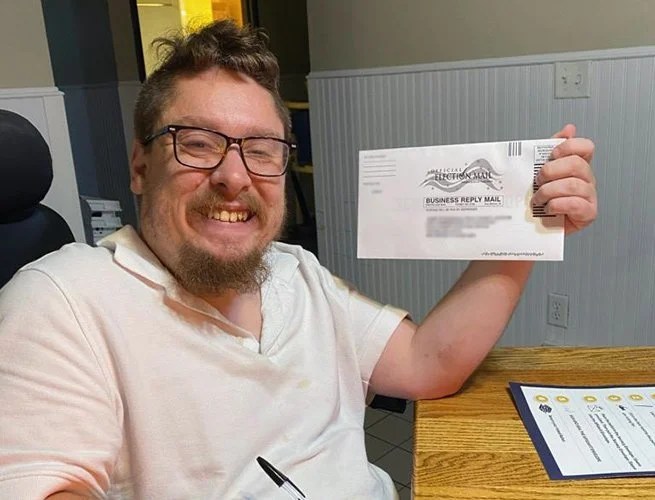
Barriers to voting for people with disabilities have existed for a long time. Federal laws helped address some of the challenges by setting accessibility requirements and reinforcing voter rights.
In our latest blog, read how a fundamental piece of the puzzle that doesn’t require new laws or regulations—the support to vote— helped Nathan cast his ballot. The post The Right Support Can Help People with Disabilities Vote appeared first on Mosaic.
In a time of deep division, we gathered for a nonpartisan prayer service to lament violence, pray for our leaders and neighbors, and seek a just peace among nations. As followers of Christ, our hope is not in power, but in God’s peace.
The proposed SAVE America Act would impose stricter voter ID requirements than those used in most states. (Adam Kaz/Getty Images)
Reprinted from National Conference of State Legislators (NCSL) staff blog post, March 23, 2026.
The law would preempt state voter registration processes and impose strict voter ID requirements.
Editor’s note: This article was updated March 23, 2026, to reflect changes to the SAVE America Act, which was passed by the House in February. The Senate version of the bill, S 1383, amends the House version.
Congress and many state legislatures are focusing on the same thing: ensuring that only U.S. citizens can vote.
The U.S. House passed the Safeguard American Voter Eligibility (SAVE America) Act on Feb. 11. On March 17, the Senate began debate on an updated version of the bill approved by the House. The bill would require voter registration applicants to provide documentary proof of U.S. citizenship and impose strict photo identification rules to vote in federal elections. The House passed similar bills with proof of citizenship requirements in 2024 and 2025, but both stalled in the Senate. The latest version is largely similar but adds requirements related to voting in person and by mail and well as exceptions to documentary proof of citizenship requirements for prospective voters who have changed their names.
Verifying citizenship for voters is the most significant trend in state elections legislation NCSL tracked in 2025, and that trend is likely to continue in 2026. Bills have been introduced offering a wide variety of approaches to ensuring only eligible U.S. citizens can vote; some ask the voter to take action, while others give state election officials tools to check citizenship status. New Hampshire and Louisiana both passed bills in 2024 requiring documentary proof of citizenship to register, and Wyoming did so in 2025. State versions of documentary proof may materially differ from the SAVE America Act. These states have not yet administered a federal election under the new requirements, though they have held lower-turnout elections.
Kansas has a statutory requirement for documentary proof of citizenship that is not in force due to a court decision, and Arizona has required proof of citizenship to register since 2004. Arizona’s law has been in and out of the courts for the last 20 years. The state currently runs a bifurcated system where voters who have provided documentary proof of citizenship can vote on all races; a smaller list of voters who have not yet shown proof of citizenship are eligible to vote in federal races only.
States are constitutionally vested with the power to regulate elections and annually consider over 3,000 bills—enacting about 300 of them—addressing various election issues.
The federal government may (and occasionally does) pass laws intended to govern how federal elections are run. The National Voter Registration Act (1993), the Help America Vote Act (2002) and the Military and Overseas Voter Empowerment Act (2009) are recent examples. These federal laws set baseline standards to which states must conform. Because states usually conduct federal and state elections concurrently, any federal law regarding elections will likely affect the details of how states run all elections and the balance of the federalist system.
If passed, the SAVE America Act, while only explicitly affecting federal elections, will preempt state voter registration processes. Its proposed voter identification requirements are stricter than those most states use.
The big-picture takeaway: The new bill would require everyone registering to vote to provide a document verifying their citizenship and implement strict photo ID requirements to vote.
What to Know About the Bill
Federal law is clear that only U.S. citizens are permitted to vote in federal and state elections. Currently, states decide how to enforce this requirement. All states require new voters to attest to their U.S. citizenship when they register, and all states conduct voter list maintenance to identify potentially ineligible voters on the rolls. How they do that varies.
The SAVE America Act would require states to collect and document proof of citizenship from voters, which few states currently do, and establish additional voter list maintenance processes. A recent University of Maryland study indicates that as many as 21 million eligible voters do not have easy access to documents proving citizenship. While prior versions of the bill would require the name on the ID to exactly match the name on the provided documentary proof of citizenship, such as a birth certificate, the most recent version would allow individuals who have changed their names to provide an affidavit attesting to the name change to prove citizenship. This provision was added after concerns about the ability of married women or others whose birth names don’t match their current legal names to register to vote.
The bill would implement a strict photo ID requirement for federal elections and specify the types of identification accepted. While 36 states currently have voter ID requirements to vote, state approaches vary. Just 10 states fall into the strict photo ID category, as defined by NCSL.
The bill’s identification requirements also specify that a voter ID document must indicate that the individual is a U.S. citizen. A handful of states denote citizenship status directly on driver’s licenses, and while applicants for REAL ID cards provide documentary evidence of citizenship status, the cards display the same gold star insignia for a citizen as for a lawfully present noncitizen. Currently, each state determines the types of ID acceptable to vote, and that often includes student IDs, hunting and fishing licenses or other state-specific identification cards.
The bill would require voters registering to vote by mail to submit documentary proof of citizenship, which states do not currently require. It is unclear how the bill would affect online voter registration, which is an option in 42 states.
The bill would require voters to submit a photocopy of their identification both when applying for and when submitting absentee/mail ballots, which most states do not currently do.
The bill does not authorize federal funding for the new state responsibilities it creates, and it includes no phase-in period. If the bill passes, the requirements imposed on states would be effective immediately.
States that can’t comply might face running state and federal elections separately, with separate procedures, or they might have to keep separate lists of voters who have not provided proof of citizenship and permit them to vote only in state or local races. Arizona already has such a “bifurcated” process, which has seen a stream of litigation dating to 2004.
The bill would require states to run their voter lists through the Systematic Alien Verification of Eligibility system to identify potential noncitizens on the voter rolls. Many, though not all, states use this system as one resource for identifying potential noncitizens, but not at the frequency this bill envisions. There are also questions about the personal voter information states would be asked to provide to run records through the database.
The bill also includes a private right of action, allowing individuals to sue if they feel the law is not properly enforced. It would establish criminal penalties for election officials who mistakenly register an applicant to vote who has not presented proof of citizenship.
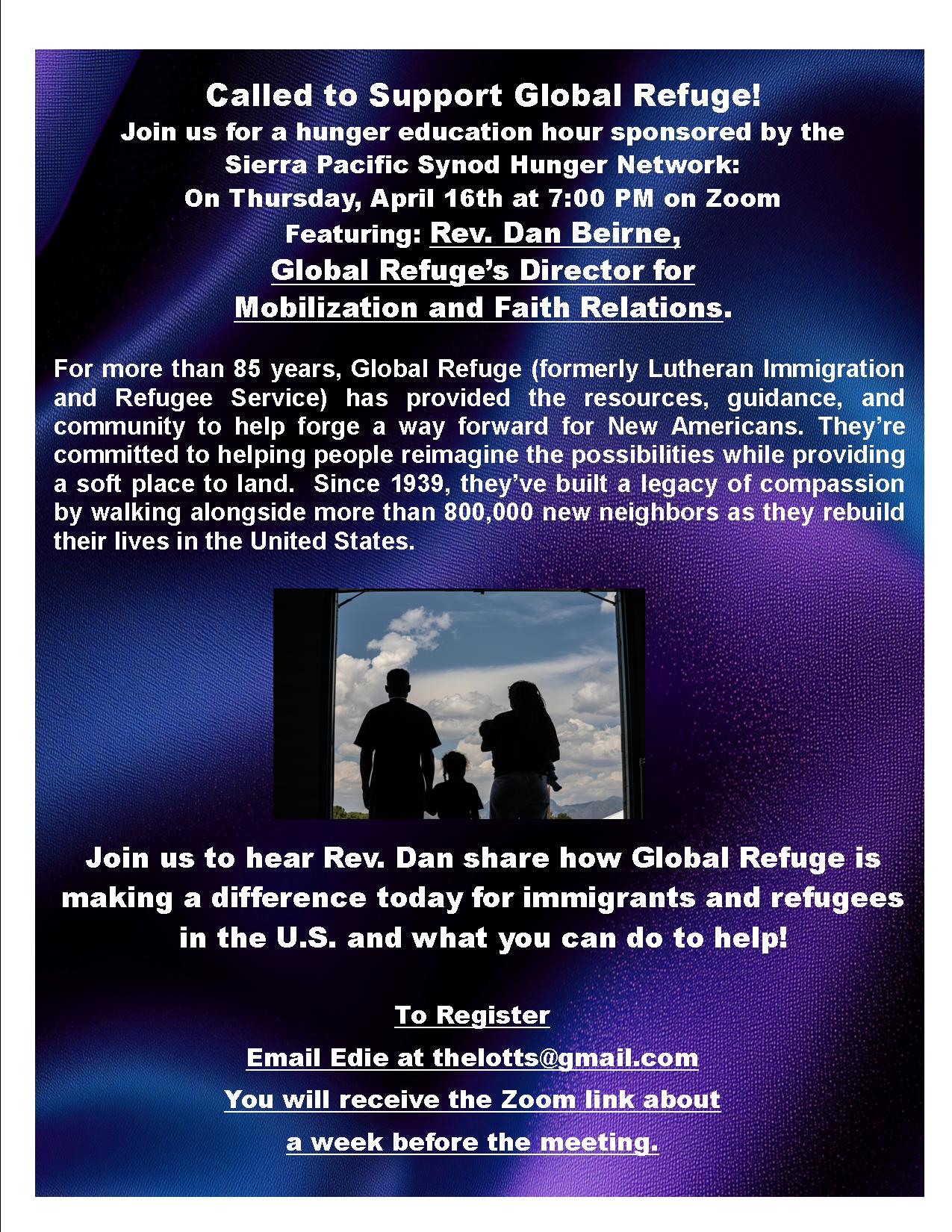
Join us for a hunger education hour sponsored by the Sierra Pacific Synod Hunger Network: On Thursday, April 16th at 7:00 PM on Zoom Featuring: Rev. Dan Beirne, Global Refuge’s Director for Mobilization and Faith Relations.
For more than 85 years, Global Refuge (formerly Lutheran Immigration and Refugee Service) has provided the resources, guidance, and community to help forge a way forward for New Americans. They’re committed to helping people reimagine the possibilities while providing a soft place to land. Since 1939, they’ve built a legacy of compassion by walking alongside more than 800,000 new neighbors as they rebuild their lives in the United States.
Join us to hear Rev. Dan share how Global Refuge is making a difference today for immigrants and refugees in the U.S. and what you can do to help!
To Register Email Edie at thelotts@gmail.com
You will receive the Zoom link about a week before the meeting.
 Lutheran Engagement and Advocacy in Nevada