What would it mean to build an economy that helps all people — and all creation — flourish?
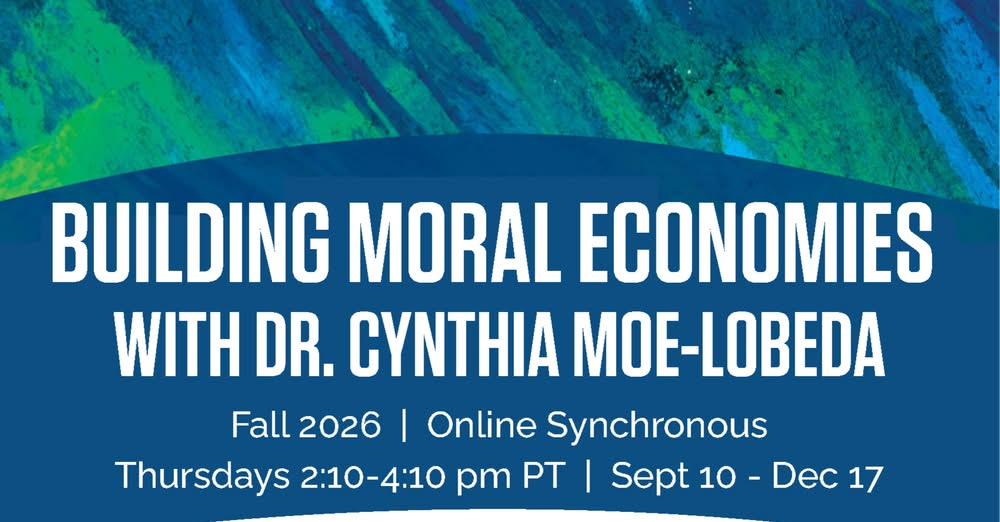
This fall, Pacific Lutheran Theological Seminary is opening its Building Moral Economies course to people who are not enrolled as seminary students. The course will be taught by Dr. Cynthia Moe-Lobeda and offered online in a synchronous format on Thursdays, 2:10–4:10 p.m. PT, from September 10 through December 17, 2026.
This is a special opportunity for lay leaders, Synodically Authorized Ministers, advocates, ministry partners, and anyone interested in the intersection of faith and justice. Participants will join the seminary course as auditors, which means they can take part in the readings, speakers, conversations, and activities without completing formal written assignments or receiving a grade. While the regular cost to audit a course is $1,088, this opportunity is being offered for $300.
The course explores the calling to build economies that allow “earth’s web of life” — including human beings — to flourish, while resisting predatory capitalism. It brings together theological reflection, practical frameworks for transformative action, and a learning community committed to hope and moral-spiritual agency in the face of overwhelming challenges.
For LEAN advocates, this learning opportunity connects directly with our public witness. Hunger, housing instability, health care access, environmental harm, racial injustice, low wages, and poverty are not isolated issues. They are connected to the moral choices embedded in economic systems. Lutheran advocacy asks not only how we can respond to immediate need, but how we can help shape communities where every neighbor has what they need to thrive.
Dr. Moe-Lobeda frames the course around two great vocations given to humanity: caring for creation and loving our neighbors as ourselves. That grounding will sound familiar to many Lutherans engaged in hunger ministry, public policy advocacy, environmental stewardship, and community organizing. The work of building moral economies is part of our calling to seek justice, practice mercy, and participate in God’s work of healing the world.
This course is also described as an experiment in rethinking traditional theological education — inviting people beyond formal degree programs into deep study, shared reflection, and faithful action. For congregational leaders, hunger advocates, creation care teams, and public policy volunteers, it offers a chance to step back, learn with others, and ask what faithful economic life can look like in our time.
Those interested may request more information through the link or QR code on the flyer, or contact Dr. Cynthia Moe-Lobeda at cmoelobeda@plts.edu.
Course: Building Moral Economies with Dr. Cynthia Moe-Lobeda When: Thursdays, 2:10–4:10 p.m. PT, September 10–December 17, 2026 Format: Online synchronous Participation: Audit-style, no grade or formal written assignments required Cost: $300 Information: admissions.callutheran.edu/register/moraleconomies
An impactful housing bill was passed by Congress. Tell your lawmakers thank you today.
On July 11, the 21st Century Road to Housing Act, one of the most consequential housing bills passed in over three decades, became law. The legislation, which bundles together several dozen bipartisan proposals, addresses a number of different measures aimed at modernizing federal housing programs and offering incentives to expand housing supply at the local level.
ELCA national and state advocacy staff, alongside ecumenical and interfaith partners, have encouraged lawmakers to pass many of the proposals included in the final bill for years. This includes policies like authorizing federal disaster housing programs supported by Lutheran Disaster Response, local resources to improve zoning codes, programs to repair aging housing stock and more. Your advocacy through ELCA Action Alerts and meetings on Capitol Hill with elected officials advanced several priorities in this important bill – thank you!
Though much of the success of this bill will depend on action at the state and local level, this bill could provide a huge meaningful lift for congregations working to build housing opportunities, care for the homeless, rebuilding of communities, and expansion of affordability options for people in greatest need.
We welcome you to join us in thanking Congress for working across party lines to advance this legislation today.
Contact your lawmakers today. Customize your message with your experiences and values.
If you would like to schedule time with your legislator, please reach out to Pastor Paul,and he is willing to work with ELCA Advocacy Partners to secure a time.
To the People of Faith in Texas and to All Who Grieve,
“When one member suffers, all suffer together.” (1 Corinthians 12:26)
On the morning of Tuesday, July 7, 2026, Lorenzo Salgado Araujo was shot and killed by an agent of U.S. Immigration and Customs Enforcement in Houston’s East End. He was 52 years old. He was a husband and the father of three United States citizen children. For nearly thirty-five years he made his home among us, rising before dawn to build houses across this city and to give honest work to others. His family knew him as “El mundo entero” – the whole world.
We grieve as neighbors, as clergy and lay leaders, and as people who confess that every human being is created in the image of God. A father was killed on a Houston street on his way to a construction site, and his citizen children learned of his death, not from any official, but from a video circulating on social media. This is a moral wound to our whole community, and we will not look away from it.
We extend our deepest condolences and our steadfast prayers to the Salgado Araujo family, to the men detained alongside him – including his brother – and to the Magnolia Park and East End communities now living in fear and sorrow.
What We Know and What We Do Not Know
Federal authorities have stated that Mr. Salgado Araujo failed to comply with commands, struck a law enforcement vehicle, and moved his vehicle toward an officer, prompting an agent to fire in what the agency describes as self-defense. His family disputes this account. They say he was a careful man who knew what to do if stopped, and that he may have feared the unmarked vehicles surrounding him belonged to those who meant him harm. Public records reflect no criminal convictions, and his family says he was actively pursuing a work permit and lawful status.
The Department of Homeland Security has now confirmed that the federal agents at the scene had not been issued body-worn cameras. It remains unclear what other federal video evidence may exist, including any footage from government vehicles or other recording systems. No comprehensive video of the moments before the shooting has been made public.
These new facts raise urgent questions. How did an operation intended to apprehend someone else lead to the stop of Mr. Salgado Araujo’s vehicle? What information did agents have before initiating that stop? What commands were given, how were the agents identified, and how did the encounter escalate to lethal force?
The Harris County District Attorney’s Office has announced that it is conducting an investigation, while acknowledging that key evidence remains under federal control. The public still has little evidence with which to evaluate the federal account of what happened.
We do not stand in judgment of any individual before the facts are known. We stand for the truth. And the truth, in a matter of life and death, belongs to the public.
What We Believe
As (ELCA) Lutherans, we are members of a church with immigrants and with roots in immigrant churches in a nation of immigrants. Our faith shows forth in hospitality for the uprooted and is a way to live out the biblical call to love the neighbor in response to God’s love in Jesus Christ: “I was a stranger and you welcomed me” (Matthew 25:35). Recalling Martin Luther’s admonition, we remember: “How do we know that the love of God dwells in us? If we take upon ourselves the need of the neighbor.”1
The use of lethal force against a human being, our neighbor, is a grave matter that must never be shielded from accountability. When it occurs in our streets, in our neighborhoods, and in the presence of our children, it demands not silence but a full and public reckoning.
What We Call For
In the name and Spirit of Jesus Christ, and out of love for our neighbors of every immigration status, we respectfully but firmly call upon federal authorities and our elected representatives to take the following actions:
1. An immediate, independent, and transparent investigation. We call for a genuinely independent investigation into the death of Lorenzo Salgado Araujo, one not conducted solely by the agency whose officer fired the fatal shot. We welcome the Harris County District Attorney’s investigation and call upon federal authorities to preserve all evidence and cooperate fully with local investigators. We also support credible external, inspector general, or congressional oversight of this case.
2. Full transparency regarding all federal evidence. We call for the prompt public release of all relevant evidence, including any vehicle-camera or other federal video footage, agent statements, radio and dispatch records, surveillance materials, the operational plan for the enforcement action, records explaining the identification and decision to stop Mr. Salgado Araujo’s vehicle, and the autopsy findings, to the fullest extent the law allows.
The Department of Homeland Security has confirmed that the agents at the scene did not have body- worn cameras. Federal authorities should now state clearly and publicly what other recordings exist, including any footage captured by government vehicles or other federal recording systems, and preserve and release that evidence as permitted by law.
The family and the public have a right to know how an operation aimed at someone else resulted in the death of Lorenzo Salgado Araujo.
3. Meaningful policy change in ICE enforcement operations. We call for concrete reforms to prevent the next avoidable death, including:
An immediate review and restriction of the use of unmarked vehicles and plainclothes agents in routine enforcement stops, which sow confusion and fear and make peaceful compliance nearly impossible;
Clear, enforced limits on the use of lethal force, and an end to vehicle-based enforcement tactics that predictably escalate to deadly outcomes;
A binding requirement that federal immigration agents wear activated body cameras and visible identification during all enforcement operations;
Prompt and humane notification of families when a loved one is injured, detained, or killed, so that no family again learns of a death through social media;
Independent oversight of ICE operations and real accountability when agents violate policy or the law.
4. A restoration of trust and an end to enforcement that terrorizes communities. We call on our leaders to reject enforcement practices that treat entire neighborhoods as targets and that make our immigrant neighbors afraid to drive to work, report a crime, or seek help. We renew our long-standing call for just, humane, and comprehensive immigration reform that keeps families together and honors the dignity of every person.
Our Commitment to Our Neighbors
To our immigrant neighbors, and especially to the Latino communities of Houston and across Texas who carry this grief and fear today: you are beloved children of God. You are not alone. Our congregations remain places of welcome, refuge, prayer, and practical support. We will continue to provide pastoral care, connect families with trusted legal resources, share Know Your Rights information, and stand publicly for your dignity and safety.
We invite the faithful across our synods to pray for the Salgado Araujo family, to accompany immigrant neighbors in tangible ways, and to lend their voices to the call for truth and justice.
May the God of the widow, the orphan, and the stranger comfort all who mourn, strengthen all who seek justice, and turn the hearts of those in authority toward mercy and truth.
“He has told you, O mortal, what is good; and what does the Lord require of you but to do justice, and to love kindness, and to walk humbly with your God?” (Micah 6:8)
In Christ’s peace and with a shared commitment to truth, justice and the dignity of every person,
As the largest Lutheran denomination in the United States, the Evangelical Lutheran Church in America (ELCA) encompasses major geographical, cultural, ideological and generational differences. We therefore ground our advocacy in our shared foundations: Scripture, the Lutheran theological tradition and, above all, our baptismal identity as belonging to God in the love of Christ and the power of the Holy Spirit.
As we work to make a difference in the shared life of our communities and our country, these values guide our witness in society.
Civic Engagement
Facilitate depolarizing conversations and relationships.
Foster cultural and political pluralism.
Support Lutheran participation in civic life and public witness.
Honor and pray for our elected officials and public servants.
Following are policy priorities discerned for ELCA federal advocacy during the 119th Congress, which convened in
Washington, D.C., in January 2025 and will end in January 2027.
Economic Policy
Support poor and working families.
Expand the supply of affordable housing.
Advance a just and sustainable tax code.
Reduce bureaucratic and administrative burden.
Care for farmers, hungry neighbors, and creation.
Migration Policy
Ensure stable families and communities.
Maintain a safe and orderly border.
Oppose mass deportation.
Respect human dignity in immigration enforcement.
Protect vulnerable women, children, refugees and asylum seekers.
Civil Rights Policy
Prevent discrimination.
Protect religious liberty for all.
Improve outcomes for disadvantaged groups.
Recognize and address historical injustices.
Support mental health of high-risk groups.
Uphold constitutional rights and promote good governance.
International Policy
Restore and support humanitarian aid.
Defend human rights and religious freedom.
Advance women and girls’ rights and equality.
Help prevent conflicts and build peace.
Model moral consistency in foreign policy.
Environment & Energy Policy
Pursue pragmatic climate solutions.
Support impacted communities.
Promote community health.
Prepare for and respond to natural disasters.
Middle East & North Africa Policy
Insist on equal rights and safety for all in the Holy Land.
Stabilize the Middle East and North Africa region.
Protect civilian life.
Defend freedom of religion and religious minorities.
EXECUTIVE SUMMARY + FULL STATEMENT OF ELCA FEDERAL POLICY PRIORITIES FOR THE 119TH CONGRESS
Find the full ELCA Federal Policy Priorities for the 119th Congress with theological foundations and policy priority details through the ELCA Resource Center, by contacting the ELCA Witness in Society staff at washingtonoffice@elca.org, or by clicking the link below. More about ELCA Witness in Society is available from ELCA.org/advocacy.
Connect with the ELCA Advocacy Network for updates and invitations to action at ELCA.org/advocacy/signup. Find resources at ELCA.org/resources/advocacy and a community with which to engage on social media @ELCAadvocacy.
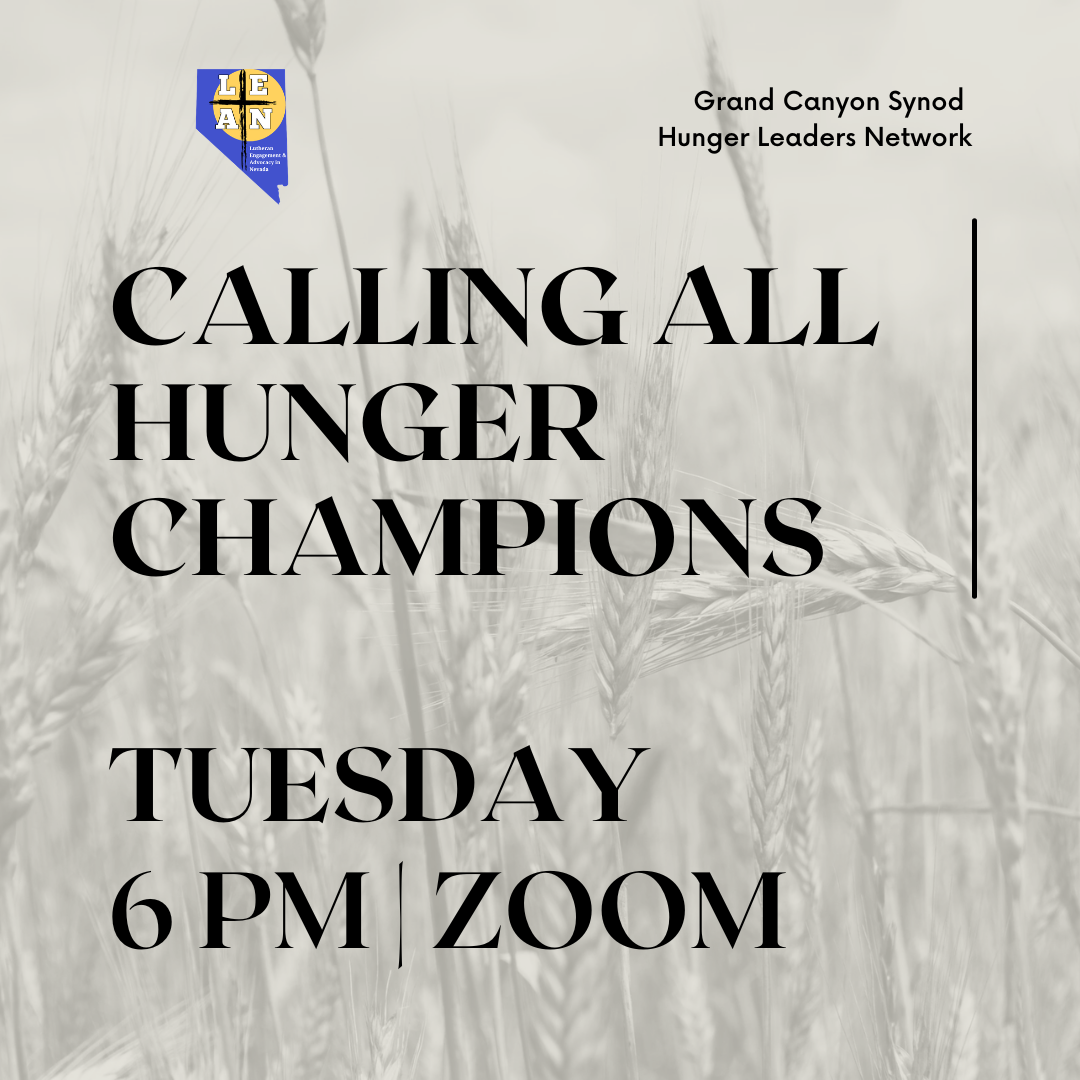
Calling all hunger champions: join this network of the Grand Canyon Synod! Meet to hear updates on national and local Hunger and Food Insecurity efforts and initiatives, to learn from one another, and to share with the group what’s happening in our congregations. Anyone interested in alleviating hunger is welcome. Prepare to be encouraged and supported! Tuesday, 7/28/2026, 6-7pm MST.
If you have any questions about this group, please contact Solveig Muus (LAMA).