
The Nevada Independent has an important piece that breaks down, which legislators were able to pass bills, and those that fell victim to the Veto Pen.
The Nevada Independent has an important piece that breaks down, which legislators were able to pass bills, and those that fell victim to the Veto Pen.
For five decades, ELCA World Hunger has been at the heart of our church’s mission—responding to hunger and poverty with compassion, justice, and hope.
This video honors the countless stories, partnerships, and lives changed through your generosity and God’s grace. From community meals to sustainable farming, emergency relief to long-term solutions, this is the church at work in the world.
Join us in giving thanks for the past 50 years—and recommit with us to the work ahead. Because a world without hunger is possible.
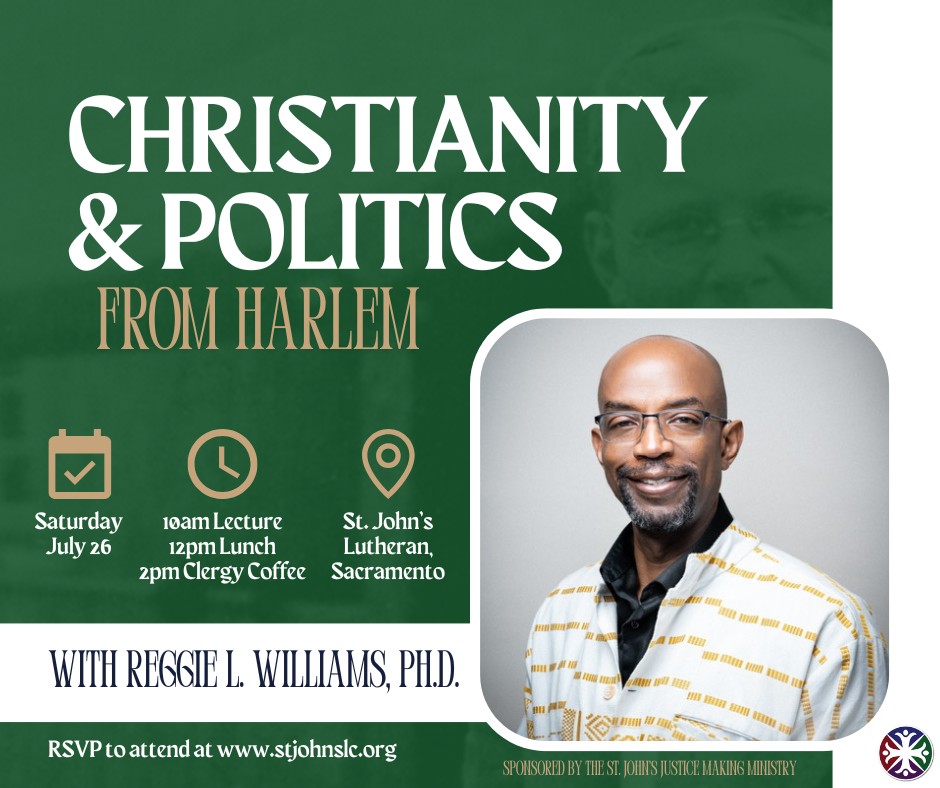
Join St. John’s Lutheran Church, Sacramento on Saturday, July 26 at 10 AM for a lecture “Christianity & Politics from Harlem” by Reggie L. Williams, Ph.D.
Reggie L. Williams, Ph.D., Associate Professor of Black Theology at Saint Louis University and author of Bonhoeffer’s Black Jesus: Harlem Renaissance Theology and an Ethic of Resistance will share about Bonhoeffer’s theology and the influence the black church had on his life and his exposure to Harlem Renaissance intellectuals and worship at Harlem’s Abyssinian Baptist during his time at Union Seminary.
A lecture will be held at 10:00 am, followed by a lunch. Clergy are invited to a coffee hour with Dr. Williams following lunch at 2:00 pm.
Please help the leaders of St. John’s prepare for this day by RSVP here: https://tinyurl.com/ReggieWilliamsSacramento! A $5 donation to help offset the expense of lunch is greatly appreciated.
Funding for this lecture is provided by the Lutheran Development Society of Sacramento and is part of an ongoing lecture series being offered by “Ecclesia” – ELCA congregations teaching the Christian faith to adults in the Sacramento Metropolitan Area.
A Practical and Pastoral Guide for Congregations Considering Shelter Ministry
Blog post by Clint Schnekloth in Lutheran Confessions (substack)
Before anything else, shelter begins with intention. Not a vague good intention, but a deep yes to God’s calling to make room in the inn. This guide is written for congregations who sense that call, and want to walk into it faithfully.
You don’t need to become a full-service agency overnight. In fact, the idea that you need to do that is probably one of the primary barriers to beginning.
And you don’t need to open your doors to everyone all the time.
You just need to begin. You probably already have what it takes to begin offering shelter to someone.
The first move is spiritual and communal: listen for God’s call and respond with intention. A church does not become a shelter by accident. Leaders, both ordained and lay, need to cultivate shared vision and prioritize shelter as a ministry of the gospel.
Turn-key Actions:
Many churches stop before they start because they assume sheltering people must mean opening doors to everyone, always. But trauma-informed, community-based shelter means starting with thoughtful boundaries, dignity, and care.
Turn-key Actions:
You likely can’t serve everyone, and that’s okay. But you can serve someone. Begin by discerning who God is already putting in your path: LGBTQIA+ neighbors? Young adults? Families in crisis? Immigrants?
Turn-key Actions:
Rather than a wide-open model, use referrals from trusted partners. This protects both the church and the people who seek shelter, and ensures support networks are already present.
Turn-key Actions:
Welcoming well is its own form of hospitality. Think beyond “providing a bed” to offering relationship, safety, and predictability.
Turn-key Actions:
Many churches already have kitchens and couches, but expanding to formal shelter may mean installing laundry machines or showers, upgrading entryway security, or fire safety adjustments.
Turn-key Actions:
A church shelter isn’t a hotel. It’s more like a home. Residents may decide to share meals, develop shower and laundry access schedules, and the inevitable beauty and tension of human proximity.
Turn-key Actions:
Don’t wait until the plan is perfect. Let the first guest in. Learn from that experience, then expand. Make mistakes. Adjust. Stay in learning mode.
Turn-key Actions:
This is not just a service, it’s shared life. Create mutual, consent-based ways for residents, volunteers, and members to get to know one another.
Turn-key Actions:
You’ll be surprised by what you and your residents can build together. Maybe someone lives in a car in your lot. Maybe someone earns their GED. Maybe joy sneaks in where fear used to live. Stay open to grace.
Turn-key Actions:
You don’t have to be everything for everyone. But you can be shelter for someone. If the church is Christ’s body, then the body has room. Start with one. Let the Spirit do the rest.
Some of our residents have said that living at the church feels like living in a mansion. And in some ways, it is. Not because it’s fancy or pristine, but because it’s spacious, quiet, safe. Because there’s light in the hallway and coffee in the kitchen.
So if you’re wondering whether this could work at your church, let me tell you: it could. And it just might change everything for the better. Not just for someone you shelter, but for you, too.

 Lutheran Engagement and Advocacy in Nevada