Bills.

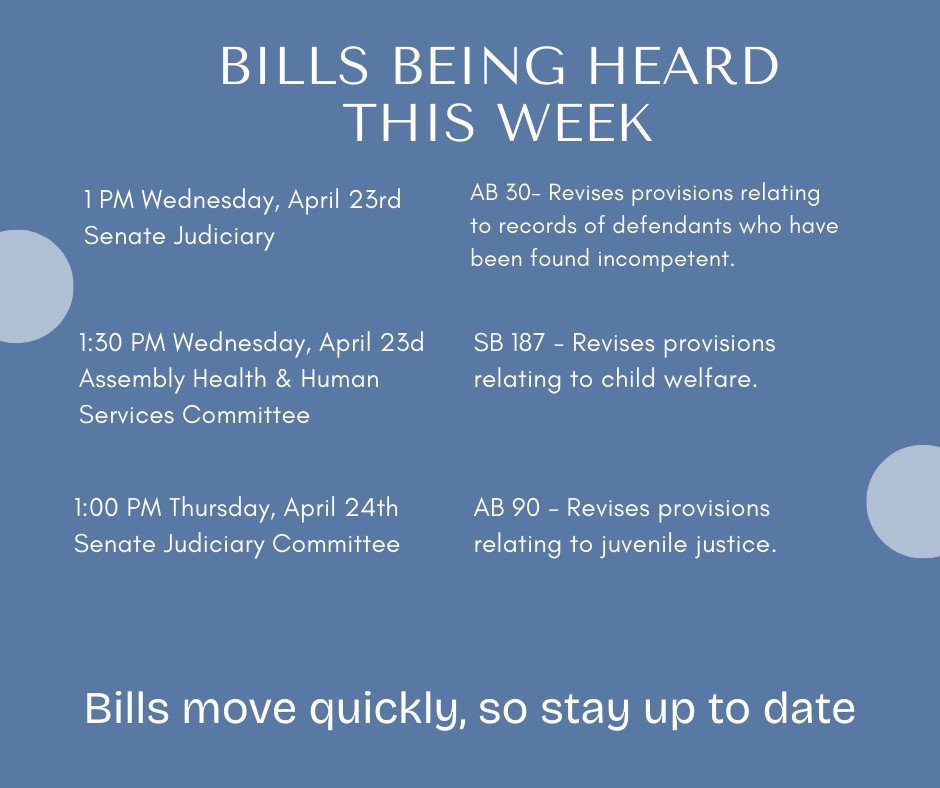
A.B. 30 – This bill extends existing law to include local detention facilities alongside the Department of Corrections in providing records to assist in evaluating and treating defendants found incompetent to stand trial.

S.B. 187 – This bill revises procedures for child protective custody, requiring child welfare agencies to approve or deny medical or mental health treatment within 14 days and clarifying placement decisions based on the child’s best interests. It also modifies timelines for searching for relatives, sibling placement exceptions, and termination of parental rights to align with federal requirements.

A.B. 90 – This bill expands the definition of “detention facility” to include regional facilities for the treatment and rehabilitation of children and requires juvenile courts to make specific findings before committing a child to such a facility, in addition to state facilities. It also mandates that detention facilities inform children and their parents or guardians of their rights under the Juvenile Justice Bill of Rights.

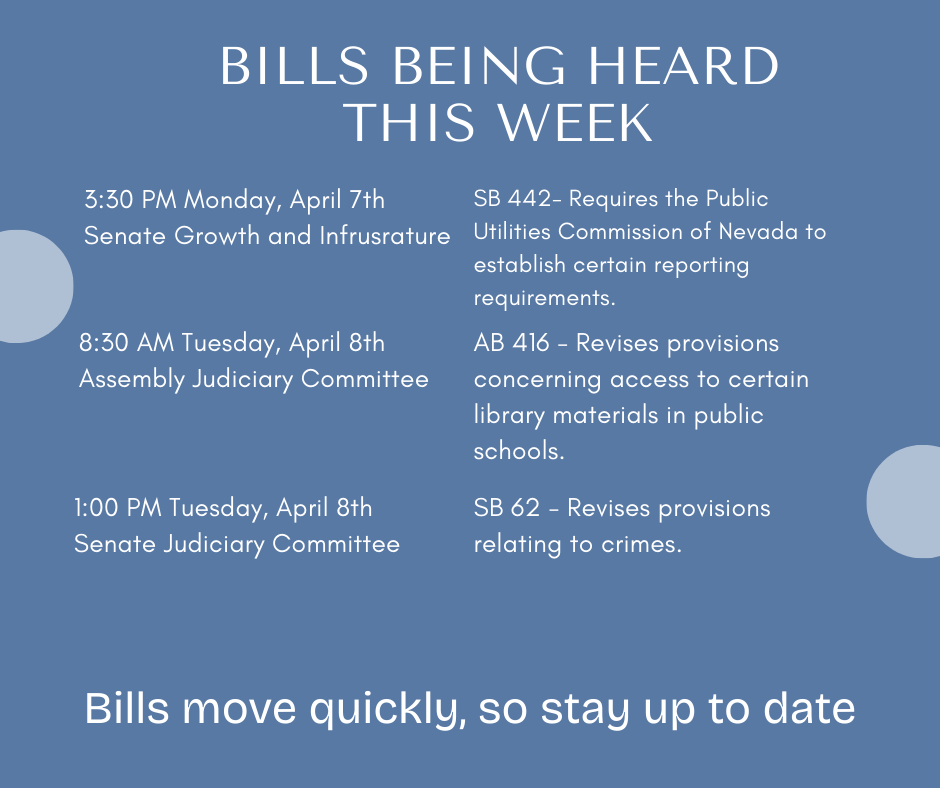
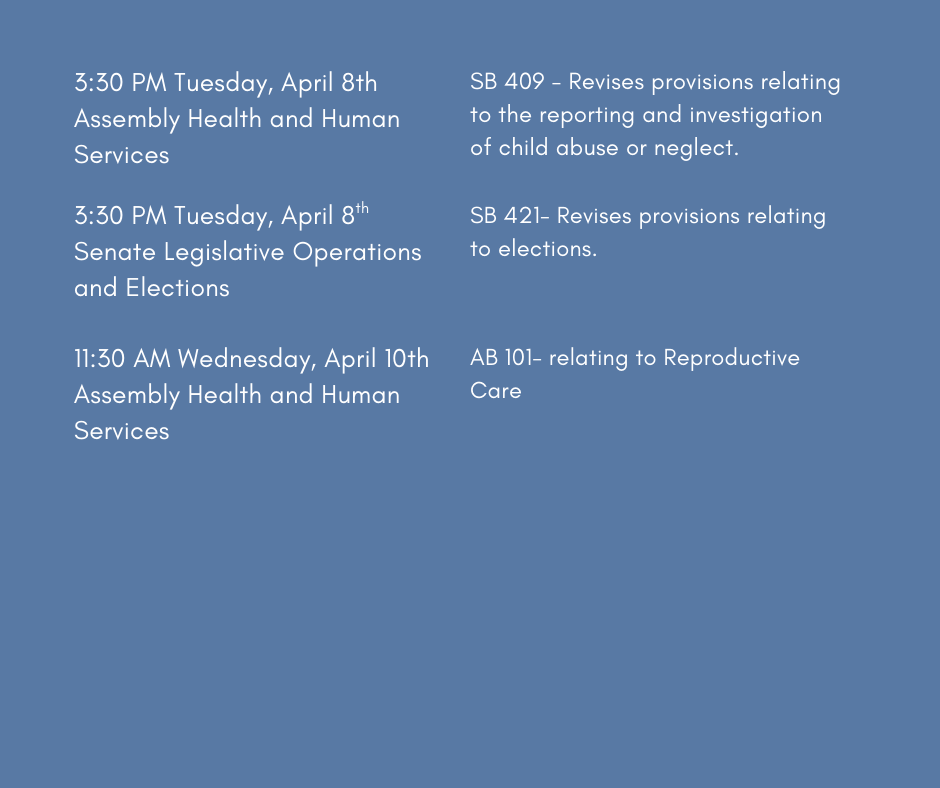
S.B. 52 – This bill requires school districts to report the percentage of immigrant, refugee, English learner, and other related pupil groups, and it modifies the definition of “long-term English learner.” It also allows third-grade students to qualify for a good-cause exemption from retention by demonstrating mastery of grade 3 reading standards through a portfolio of their work, rather than requiring mastery beyond grade 3 standards.

S.B. 424 – This bill requires county or city clerks to recruit election board officers for polling places on Indian reservations or colonies unless the tribe declines. It also mandates at least one training class for election board members staffing these locations, either in person or remotely, unless the tribe opts out.

S.B. 84 – This bill requires the Division of Public and Behavioral Health to ensure that programs for the treatment of domestic violence offenders use evidence-based curriculum and instructional materials as part of their certification and monitoring regulations.

S.B. 352 – This bill expands existing non-discrimination laws by prohibiting both public and private health insurance policies, including Medicaid, from discriminating against individuals based on race, color, national origin, sex, age, disability, or gender identity/expression. It also prohibits healthcare providers from discriminating based on these characteristics and grants regulatory bodies the authority to adopt specific anti-discrimination regulations and discipline violators.
ACTION ALERT!

As people of faith, we advocate for tax policies that reflect our values of compassion, justice, family and care for the least of these. Congress is currently considering budget legislation that will shape our tax system. We encourage lawmakers to: 

  • Make the Child Tax Credit (CTC) fully refundable so low-income families can access the full credit. 
  • Increase the CTC amount to account for inflation and make the credit permanent.  
  • Ensure tax reforms do not come at the expense of other vital safety net programs like SNAP or Medicaid. 
  • Maintain or strengthen the charitable tax deduction that allows churches and nonprofits to continue serving their communities. 

Join us in calling on Congress to prioritize families and children by supporting a more robust and inclusive Child Tax Credit. 

During our last week of the Lenten Action Series, contact your member of Congress today.

Action Alert!

The Department of Education (DOE) faces a 50% staff reduction and potential dissolution under the new administration. Recent budget cuts in a continuing resolution have already reduced K-12 innovation and improvement funding by $88 million, with proposals for future cuts in a reconciliation bill – up to $330 billion – over the next decade for education programs (additional clarifications on cuts are available from ELCA Schools & Learning Centers). Critical offices including Civil Rights, Free Application for Federal Student Aid (FAFSA) student loans, and data collection have been severely impacted. “Because children are God’s gifts to society and the Church as well as to parents, society through government also has responsibility and authority to provide for young people’s education,” says the ELCA social statement Our Calling in Education. Also, “All people share the need and responsibility to be educated in civil righteousness and the matters of earthly life,” which affirms our human dignity and contributes to community well-being. Our ELCA social teaching emphasizes that quality education must be accessible to all people regardless of socioeconomic status.  

Additionally, consider learning more about our theological grounding on education with the newly published resource, “Vocation as a Balancing Act,” affirming Lutheran values in higher education. The publication is the Spring 2025 issue of Intersections, a publication by the Network of ELCA Colleges and Universities (NECU). 

During this Lenten Action Series reflecting on national budget priorities, contact your member of Congress to oppose these harmful cuts and advocate for robust educational support for all communities. Send a customized letter with your local experiences and convictions.  

Thank you for adding your voice!

ACTION ALERT!

The Trump administration has called for mass deportations of undocumented immigrants in the United States, recently terminating historical restrictions on immigration activity at places of worship, schools and hospitals. Mass deportations would have significant emotional, health and financial tolls on impacted immigrant families as well as the broader community. Congress is preparing to allocate billions for this directive.

This Action Alert is part of a Lenten Action Series, an opportunity to take advocacy action as part of your Lenten practice. Our baptismal calling to “serve all people,” following the example of Christ, takes on urgent meaning as families across the nation face mounting challenges.

The book of Genesis underscores that “human beings are created ‘in God’s image’” (Genesis 1:27). The ELCA social policy resolution, “Toward Just, Compassionate, and Humane Immigration Reform,” acknowledges the presence of undocumented immigrants. It advocates for both good governance to protect the nation and the just and humane enforcement of immigration laws. It guides the view of this church to prioritize human dignity while upholding the law.

Now is the time to act. Congress has moved quickly to authorize hundreds of millions in new funding for immigration detention, immigration agents, border wall construction and surveillance technology along the border and is poised to authorize billions more through budget reconciliation.

In addition to new spending to be utilized for mass detention and deportation, reconciliation opens the door to cuts to hunger programs, cuts to immigrant’s limited eligibility for social services, and harmful non-fiscally related immigration policy.

Act now to tell Congress you oppose the detention and separation of immigrant families. Customize your letter with your values and local experiences.

Thank you for your advocacy.