The Association of White Lutherans for Racial Justice is excited to offer a series of Monday Webinars beginning August 10 with “The Culture We Inherit, The Community We Choose,” led by Rev. Dr. Jia Starr Brown. Receive a discount when you register for ALL four before August 10, via the code at the top of the first flyer. All will be recorded for those who can’t attend live. The regular rate is $40 each.
September 14 & 21: “Interrupting Harmful Patterns: White Supremacy Culture and Courageous Conversation in Congregational Life,” a two-part series led by Dr. Kelly Sherman-Conroy. Part 1: “Staying in the Conversation When We’re Triggered.” Part 2: Practicing Courageous Conversation: From Reactivity to Relationship.”
October 12: “Notice. Reflect. Grow. Using the IDI (Intercultural Development Inventory) to Build Beloved Community” led by Rev. Dr. Jia Starr Brown.
The Ninth Circuit Court of Appeals, which includes Nevada, has ruled that the Trump administration’s policy of mandatory immigration detention cannot be applied to most people arrested inside the United States. Instead, many immigrants will once again have the opportunity to receive an individualized bond hearing before an immigration judge.
This decision is not about ending immigration enforcement. People who are determined to be a danger to the community or a significant flight risk may still be detained. Rather, the court affirmed that detention decisions should be based on individual circumstances, not a blanket policy.
For Nevada, this is a significant ruling. Our state is part of the Ninth Circuit, meaning this decision directly affects immigration proceedings here and across much of the western United States.
As people of faith, we believe every person is created in the image of God and deserves to be treated with dignity. Justice requires both accountability and due process. Policies that recognize the humanity of each person while protecting our communities reflect those shared values.
Global Refuge is raising serious concerns that the Department of Homeland Security’s updated immigration detention standards still fall far short of protecting the dignity, safety, and humanity of immigrants and refugees.
This comes at a time when more people of faith, family members, advocates, and community leaders are gathering outside detention centers to pray, bear witness, and call for change. From Delaney Hall in New Jersey to the Dilley Family Detention Center in Texas, these gatherings reflect growing concern over conditions inside our nation’s detention facilities. Those concerns are not abstract. According to reporting cited by Global Refuge, 52 people died in ICE custody between January 20, 2025, and June 4, 2026—the highest number of deaths in more than a decade.
The updated 2026 ICE National Detention Standards do include some important improvements. They require interpretation and translation services at no cost, call for earlier mental health evaluations, direct facilities to transfer individuals when their medical or mental health needs cannot be met, and establish clearer expectations for release, including access to a phone call, legal and medical resources, weather-appropriate clothing, and transportation when needed.
Those are meaningful steps, but they do not address the deeper problems within our immigration detention system.
Children and families can still be detained. Individuals can still be held for prolonged periods without a clear timeline for release. Solitary confinement remains an option for people living with serious mental illness. Questions also remain about access to adequate medical care, communication, language services, transparency, and meaningful accountability.
As Lutherans, we believe every person is created in the image of God. Human dignity is not earned through citizenship or immigration status—it is a gift from God. Any immigration system should be measured not only by how effectively it enforces the law, but by whether it protects life, keeps families together, ensures due process, and cares for those who are medically or mentally vulnerable.
For communities across the Southwest, immigration is not a distant policy debate. It affects families, congregations, schools, shelters, legal aid organizations, and ministries that accompany immigrants and refugees every day. When detention systems lack transparency or accountability, the consequences extend far beyond detention centers and into our neighborhoods.
Global Refuge also raises an important question for policymakers. As Congress invests billions of dollars into immigration enforcement, will it also invest in meaningful oversight and accountability? Increased funding without strong safeguards risks expanding a system that continues to leave vulnerable people at risk. Congress should pair enforcement resources with independent inspections, greater transparency, stronger protections for medically and mentally vulnerable individuals, and meaningful limits on the use of solitary confinement.
As people of faith, we cannot look away.
We can urge Congress to end family detention, strengthen oversight, ensure humane release practices, protect access to legal and medical services, and hold detention facilities accountable to the standards they are expected to follow. We can also support community-based alternatives to detention, which have consistently demonstrated that families can successfully participate in immigration proceedings without experiencing the trauma of prolonged detention.
Our immigration system should reflect the values we profess: dignity, justice, compassion, and hope. The question before our nation is not simply how much we spend on immigration enforcement, but what kind of immigration system we are choosing to build.
As Lutherans, we are called to stand alongside our neighbors, especially those who are vulnerable, and to advocate for public policies that protect human dignity, strengthen families, and reflect God’s love for all people.
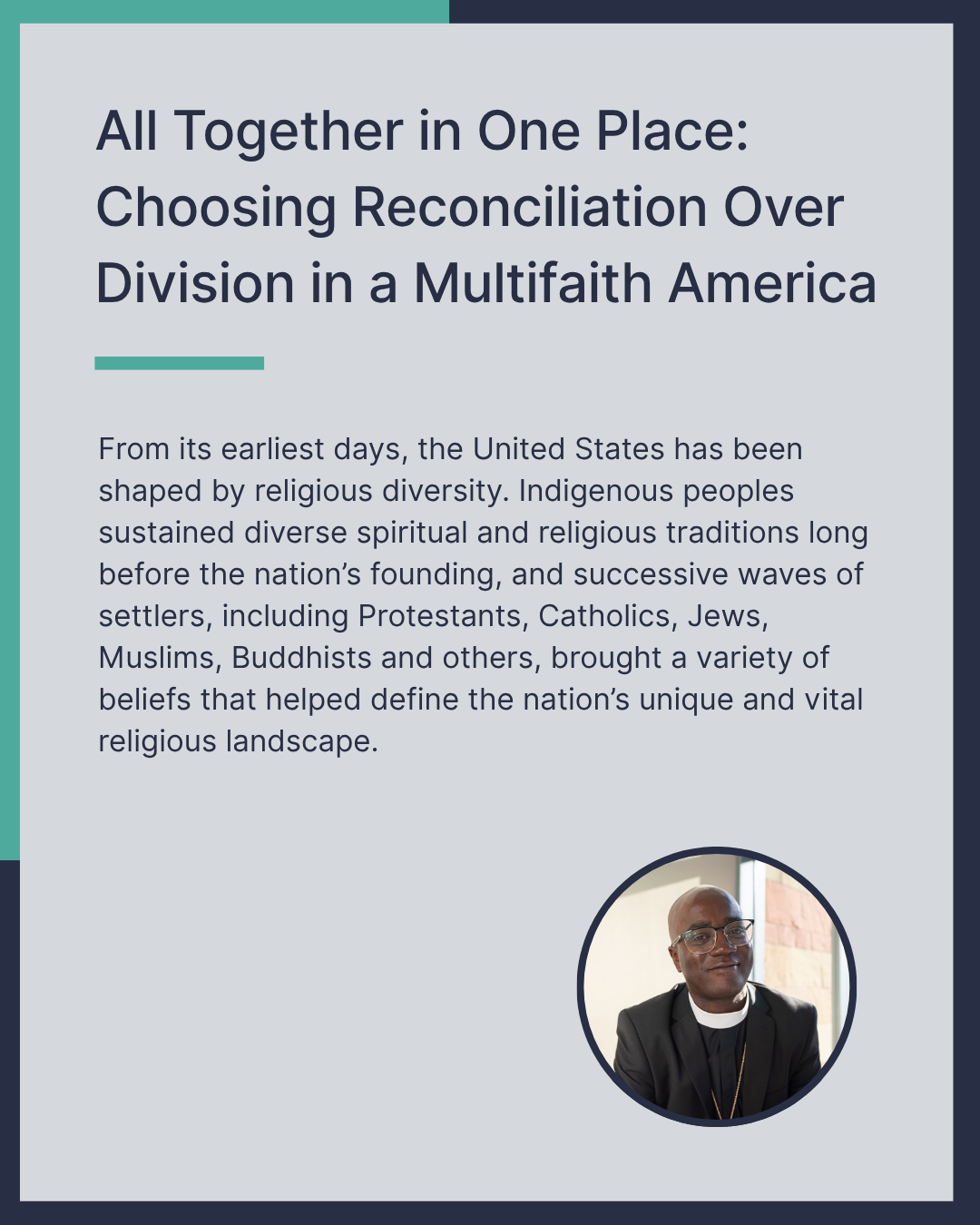
From its earliest days, the United States has been shaped by religious diversity. Indigenous peoples sustained diverse spiritual and religious traditions long before the nation’s founding, and successive waves of settlers, including Protestants, Catholics, Jews, Muslims, Buddhists and others, brought a variety of beliefs that helped define the nation’s unique and vital religious landscape.
Throughout the church today, many are struggling with debates regarding the religious identity of our nation. While religious diversity did not begin with the Constitution, the Constitution’s framers recognized an important truth: the future of our nation could not be tied to a single religious identity. By rejecting religious tests for public office, the Founders created space for people of any or no faith tradition to participate in public life together. That commitment continues to be foundational to our nation’s vitality, especially at a time when people are tempted to identify love of the nation, or the government itself, with a single religion. No one faith tradition should rule the United States, just as the framers desired.1
As the apostle Paul writes, God has given us “the ministry of reconciliation” (2 Corinthians 5:18). Reconciliation involves living in God’s future — including through renewed interreligious relationships.
Religious diversity is the reality of the world we live in. Recognizing this, the Evangelical Lutheran Church in America adopted “A Declaration of Inter-Religious Commitment,” which affirms that mutual understanding with other faith traditions can deepen our own faith. Through encountering neighbors and working side by side in shared commitments to love and compassion and community, our own Christian faith is strengthened. This conviction means that through my call as presiding bishop of the ELCA, our church develops and maintains relationships with Jewish, Muslim and many other faith communities. Like personal friendships we hold, these relationships do not require us to set aside Christian faith. Rather they reaffirm that in a nation as diverse as ours, being a good neighbor across religious differences is not optional. It’s a part of the shared American experience. It is an experience we can support as everyday Lutherans in God’s call to reconciliation.
“The ELCA will explore and encourage inter-religious friendship, accompaniment, and partnership with all who seek justice, peace, human wholeness, and the well-being of creation (ELCA Constitution, Chapter 4.03.f).” —“A Declaration of Inter-Religious Commitment,” p. 10
“The ELCA will defend the full participation of all in our religiously diverse society, ‘strengthening public space as a just place for all’ regardless of religion or worldview (‘The Church in the Public Space: A Statement of The Lutheran World Federation,’ 2016).” —“A Declaration of Inter-Religious Commitment,” p. 11
The ministry of reconciliation is both local and national. God invites us to love one another across differences. Trusting in God’s grace, we boldly form relationships with neighbors of all faiths who share a commitment to justice, peace and the flourishing of all creation. I encourage you to engage in this essential ministry, which offers a powerful opportunity to heal divisions, deepen respect across differences and strengthen the bonds of our common life.
In Christ,
The Rev. Yehiel Curry Presiding Bishop Evangelical Lutheran Church in America
Yesterday was World Day Against Trafficking in Persons. While the day has passed, the fight continues every day. Urge members of Congress to support human trafficking survivors by passing the Frederick Douglass Trafficking Victims Prevention and Protection Reauthorization Act of 2025.




 Lutheran Engagement and Advocacy in Nevada