For over a decade, locations like religious worship areas, preschools, hospitals, courthouses, domestic violence shelters, among others have benefitted from protection from immigration enforcement actions, but last year, guidelines for immigration enforcement at sensitive community locations were rescinded. As a result of the protected areas policy rescission, members of Congress have taken action, and introduced the Protecting Sensitive Locations Act in the House and Senate, with Global Refuge and over 400 other organizations having endorsed the Protecting Sensitive Locations Act.
Call on your Senators and Representatives to codify protections prohibiting immigration enforcement actions in sensitive locations today!
This season, many of our congregations celebrate the Baptism of Our Lord, the moment when Jesus steps into the Jordan River, the heavens open, and God declares, “You are my beloved.” In that moment, sacred water is not only cleansing, it becomes a sign of calling, identity, and shared purpose.
Baptism reminds us that water is never ordinary. It is where God claims us, renews us, and calls us beloved. It is life, promise, and liberation.
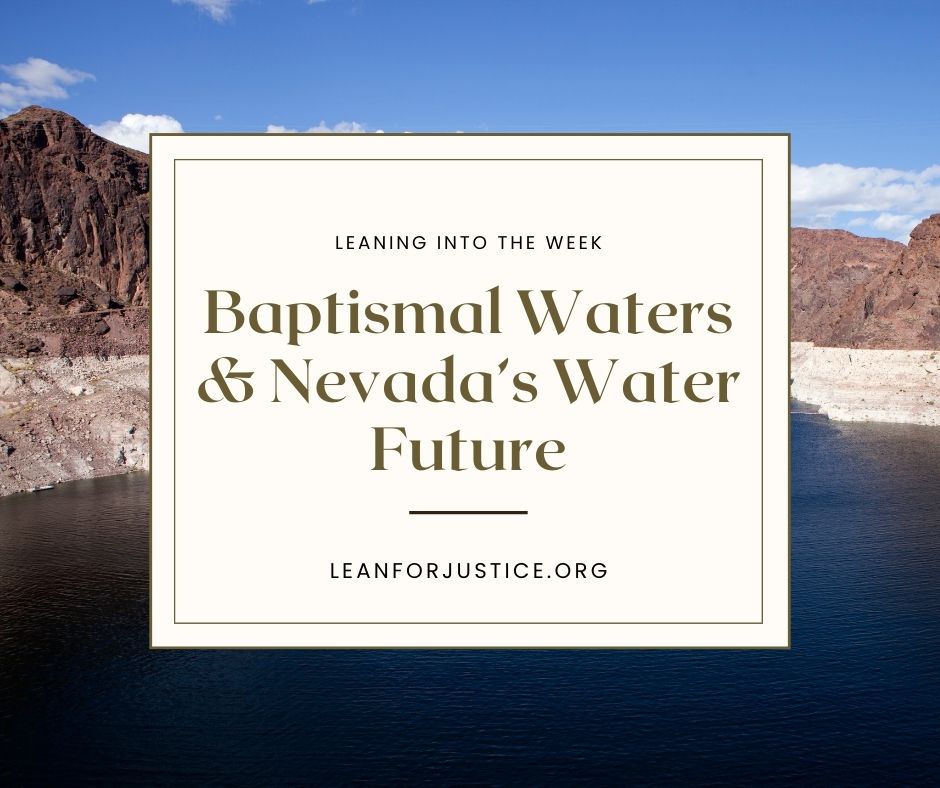
This Gospel imagery is powerful to hold alongside the realities facing our region today. For the first time in nearly twenty-six years, California is drought free—a milestone worth celebrating. Yet the long-term megadrought across the West is far from resolved.
Much of Western Nevada has temporarily emerged from drought, but Southern and Eastern regions still face significant water stress. And Lake Mead continues to hover near historic lows, signaling that the challenges beneath the surface remain urgent.
Our baptismal waters call us to remember that all water is sacred, whether flowing through the Jordan River or the Colorado River basin. Water is not a resource to be hoarded or taken for granted, but a shared gift entrusted to our care.
As Nevada’s leaders consider how water will be managed and equitably distributed in the decades ahead, LEAN stands rooted in faith:
Water is life.
Creation is a neighbor.
Stewardship is a calling, not a political option.
Just as Jesus rose from the water beloved and sent, we too rise from baptism with a purpose—to advocate, protect, and care for God’s world and every neighbor who depends on it.
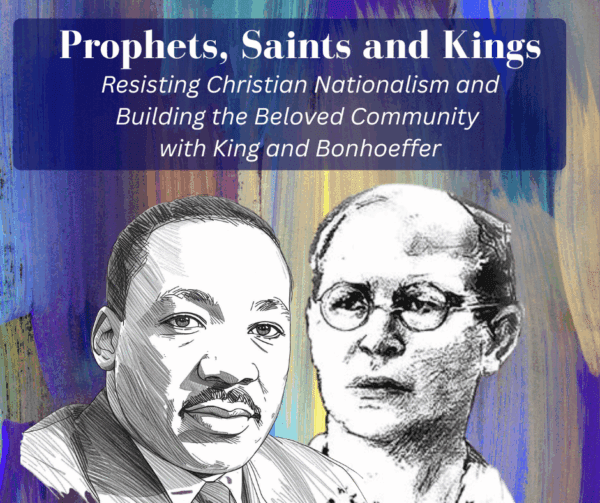
Livestreamed and in-person, on Jan. 17 of MLK weekend learn about the intersecting legacies and lessons of Dietrich Bonhoeffer and Martin Luther King, Jr., while deepening our understanding of how people of faith can confront and resist forces of authoritarianism and Christian nationalism. Antoine Cummins, ELCA Program Director for Civil Rights Policy, is among panelists. Co-hosted by Lutheran Advocacy Ministry in Pennsylvania, United Lutheran Seminary and Gettysburg College.
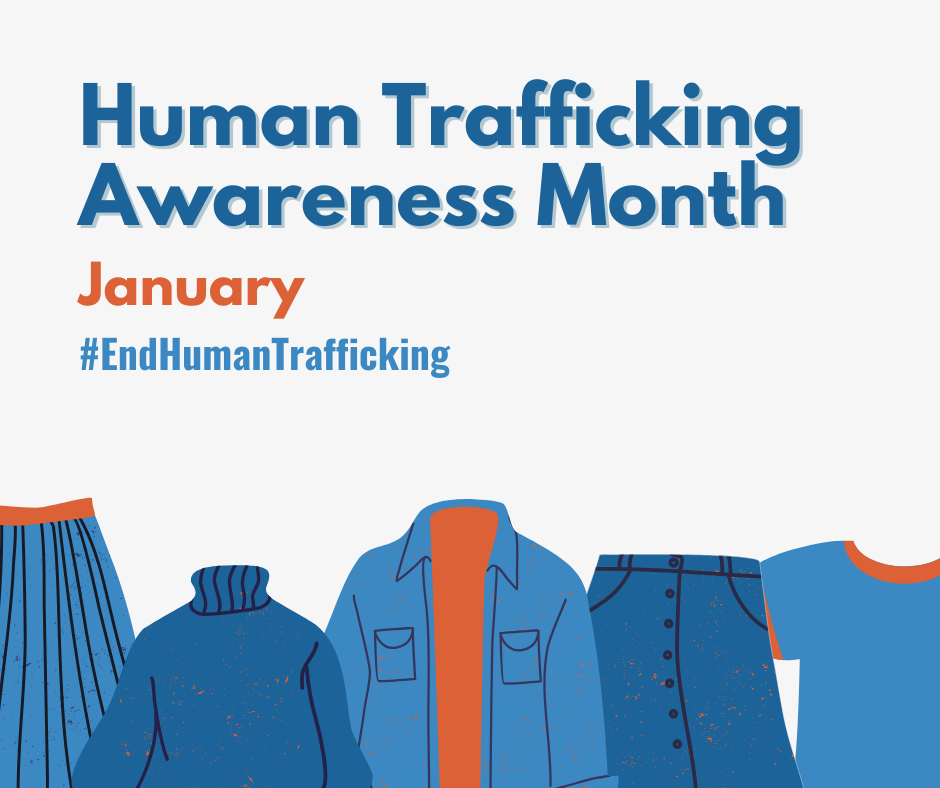
January is Human Trafficking Awareness Month, and congregations are invited to join a focused season of prayer, worship, and advocacy to help #EndHumanTrafficking. Women of the ELCA offers daily prayers, trauma-informed worship resources, and a church leader toolkit—available in English and Spanish—to support this work, especially during the four weeks leading up to the Super Bowl.
These resources equip congregations to respond faithfully through education, prayer, and action. Learn more, download materials, and find support resources at womenoftheelca.org, or contact the National Human Trafficking Resource Center at 1-888-373-7888.
WHAT CONGREGATIONS CAN DO NOW
Congregations are encouraged to use the following resources throughout January—or during the four weeks leading up to the Super Bowl—to engage this issue faithfully and thoughtfully:
Daily Prayers (English and Spanish)
Seven daily prayers invite the church to lift before God:
Those experiencing trafficking and exploitation
Those healing from trauma
Those causing harm
The church’s call to act
Our response to indifference
Each prayer is paired with a scripture verse to ground this work theologically.
Trauma-Informed Worship Resources
A full set of worship materials is available, including:
A Confessional Prayer over Consumerism (using the Beatitudes)
A template for Prayers of the People
Suggested hymns and contemporary songs, such as Let Streams of Living Justice (ELW 710) and Break Every Chain
These resources are designed to help congregations address the realities of trafficking with care, honesty, and hope.
Toolkit for Church Leaders
In partnership with Freedom Collective, congregations can download a practical toolkit that includes short educational videos and discussion resources. These materials are well-suited for adult forums, Bible studies, and fellowship groups.
Human trafficking is the exploitation of people through force, fraud, or coercion for labor or sexual purposes. It is a form of modern slavery that affects every region and community.
As people rooted in God’s grace and justice, we are called not only to pray, but to act. This January, may our congregations bear faithful witness—through worship, education, advocacy, and compassionate response—as we work together to #EndHumanTrafficking.
 Lutheran Engagement and Advocacy in Nevada