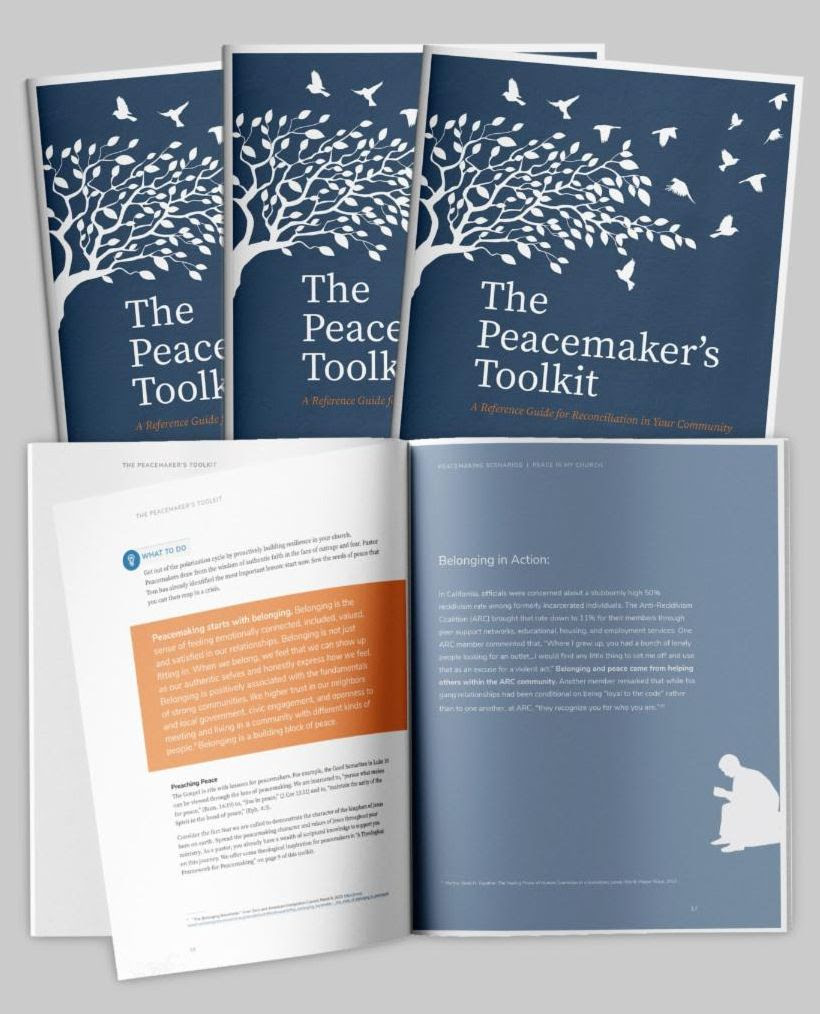
Faith leaders are among our most natural allies for peace, as they reconcile people to one another and something greater than ourselves. Common Ground USA, the Multi-Faith Neighbors Network, and PERIL at American University present the Peacemaker’s Toolkit to equip faith leaders with the tools they need to foster peace and resilience within their congregations and beyond. This free resource brings together the best in evidence from global peacebuilding, multi-faith reconciliation, and academic research.
A comprehensive resource guide for faith leaders to discern and act on the dynamics that foster peace and resilience to division. The Toolkit offers responses to common challenges: polarization affecting churches and cities, acts of hate targeting neighbors, and online extremism impacting congregants.
Email Congress now asking them to extend healthcare affordability.
The House of Representatives is expected to vote as soon as this week on extending Affordable Care Act (ACA) subsidies that help millions afford healthcare. Expanded ACA subsidies expired on December 31, 2025, leaving nearly 22 million people and many small businesses with unaffordable costs – pricing many in need of healthcare out of the market.
According to the Urban Institute, over 4.8 million people could lose coverage entirely if Congress fails to extend these premiums – and millions more could see their monthly cost increase or double. Rural communities – where Lutheran hospitals often serve as lifelines – will be hit the hardest. Many families in these areas and across the nation depend on these subsidies to access basic healthcare.
ELCA social teaching affirms that government, civil society and community all have roles in sustaining the health of the most vulnerable – highlighting that health is a critical part of the whole human person. Lutheran social ministries and hospitals exemplify this mission daily but cannot do this work alone.
The House is poised to act, but your elected officials in both the House and Senate need to hear about your values and experiences. Please urge your lawmakers to extend these subsidies and protect healthcare access for those who need it most.
There is concern across this church about the Jan. 3, 2026, U.S. military action in Venezuela and what has or will follow. I believe that this Sunday’s celebration of Jesus’ baptism, and our own, can provide understanding, guide our prayers and promote faithful action at this time. The baptism of our Lord reminds us that Jesus is God’s own beloved child, who has come to fulfill an age-old promise to bring justice and peace to the nations (Isaiah 42:1).
As God’s beloved, Christians share in Jesus’ ministry and compassion for the vulnerable. Our prayers remain with the people of Venezuela. We pray for their safety and well-being, for their livelihoods, and for reliable access to food, health care and clean water. Our church walks in solidarity with them through the Evangelical Lutheran Church in Venezuela — their people, pastors, deacons and ministries. Support is also expressed in the broader Christian community, both in Venezuela and among the Venezuelan diaspora, who have long called for and worked toward peace, democracy and human rights.
As baptized children of God, Lutherans are set free to seek the well-being of our neighbors. Over 600,000 Venezuelans in the United States face uncertainty without renewal of Temporary Protected Status (TPS), and deportations of Venezuelan migrants continue despite these anxious times in their homeland. As Venezuela navigates a tenuous situation, our nation has a responsibility for a mindful humanitarian response.
We continue our call for humanitarian support for migrant-serving organizations in neighboring countries and pathways to asylum in the United States for Venezuelans and all with credible fears of persecution.
As followers of Jesus, we seek justice for the nations. As a church in this country, we call for what transpires next to center the Venezuelan people and their right to self-determination. We, as a country, must resist any temptation to use this occasion to foster special or corporate economic interests. As Venezuela faces continued instability, more people are likely to face displacement.
Let us avoid further polarization as we respond to what is unfolding. Lutheran theology affirms that two things at once can be true. The removal of Nicolás Maduro, a corrupt authoritarian, and the end of his brutal repression are causes for celebration for many. At the same time, U.S. action in Venezuela without the constitutionally mandated authorization of the U.S. Congress violated international law and created a dangerous precedent that weakens global peace and security. Our social teaching tells us that any conflict must meet strict moral criteria rooted in the principles of “right intention, justifiable cause, legitimate authority …” (For Peace in God’s World, page 11).
In this highly complex and dangerous moment, Christians remember that Jesus is God’s beloved child. Through our baptisms, this identity and mission forms us and calls us to civic action. We are called to speak the truth in love but with clarity about accountability for any abuse of power. In this time, we can advocate boldly for a peaceful way forward and urge the U.S. Congress to exert its authority over war powers and ensure due process is followed. This action is especially critical when risking U.S. troops’ lives and the lives of civilians around the world.
As we remember the meaning of baptism for action in the world, let us be fervent in prayer for our siblings in Christ in Venezuela. Let us also support and accompany Venezuelans and their families worldwide. Born in Venezuela, Bishop Pedro Suárez of the ELCA Florida-Bahamas Synod wrote the following prayer:
By your Holy Spirit, kindle hope that does not disappoint and peace that surpasses all understanding. We entrust Venezuela, its people and your church into your loving hands, trusting not in our own strength but in your steadfast love made known in Jesus Christ, who is our peace. Amen.
In Christ,
The Rev. Yehiel Curry Presiding Bishop Evangelical Lutheran Church in America
At Lutheran Engagement and Advocacy in Nevada, we believe faith calls us to pay attention, not only to what happens here at home, but to the struggles and hopes of our global neighbors. As headlines once again turn toward Venezuela and the United States’ involvement in its affairs, we are reminded that history matters.
For many in the broader Latine community, U.S. policy in Latin America isn’t abstract, it is woven into family stories, migration journeys, and cultural memory. Colonialism, corporate extraction, coups, and displacement have shaped how generations understand power, belonging, and safety.
To engage thoughtfully and faithfully in conversations about Venezuela and Latin America, it’s important to learn from those who tell the story from within. Below are a few powerful books recommended by our Advocacy Director to deepen understanding, spark discussion, and ground our advocacy in truth.
Open Veins of Latin America: Five Centuries of the Pillage of a Continent — Eduardo Galeano A classic work of Latin American resistance literature, Galeano’s book traces the history of colonialism, imperialism, and economic exploitation in Latin America from the arrival of European conquistadors through the 20th century. It argues that Latin America’s wealth was systematically extracted by foreign powers — first European, then increasingly U.S. economic and political influence — and that this legacy shaped persistent underdevelopment across the region. The narrative blends history and political critique, centering themes of dependency, resource extraction, and resistance.
America, América: A New History of the New World — Greg Grandin (2025) Pulitzer Prize-winning historian Greg Grandin reframes the history of the Western Hemisphere through the prism of North–South relations over five centuries. Instead of telling U.S. history primarily as having “looked east” toward Europe, Grandin demonstrates how the nation’s identity and policies were shaped in profound engagement with Latin America — from early independence struggles through the Monroe Doctrine, coups, revolutions, and interventions. The book situates U.S. power and interventionism (including economic and military actions) within a larger hemispheric narrative that foregrounds Latin American agency, resistance, and influence on global institutions.
Defectors: The Rise of the Latino Far Right and What It Means for America — Paola Ramos Journalist Paola Ramos explores contemporary U.S. politics by examining the rise of far-right ideology within segments of the Latine community. Through in-depth reporting and personal narrative, Defectors looks at how historical legacies of colonialism, political trauma, identity, and cultural narratives shape voting behavior and political alignment today. It connects the historical weight of colonialism and political trauma in Latin American histories to present-day U.S. political dynamics involving Latine communities.
The above links point to Amazon merely for reference; this is not an endorsement, and as always, please shop local first at bookstores or libraries when possible.


 Lutheran Engagement and Advocacy in Nevada