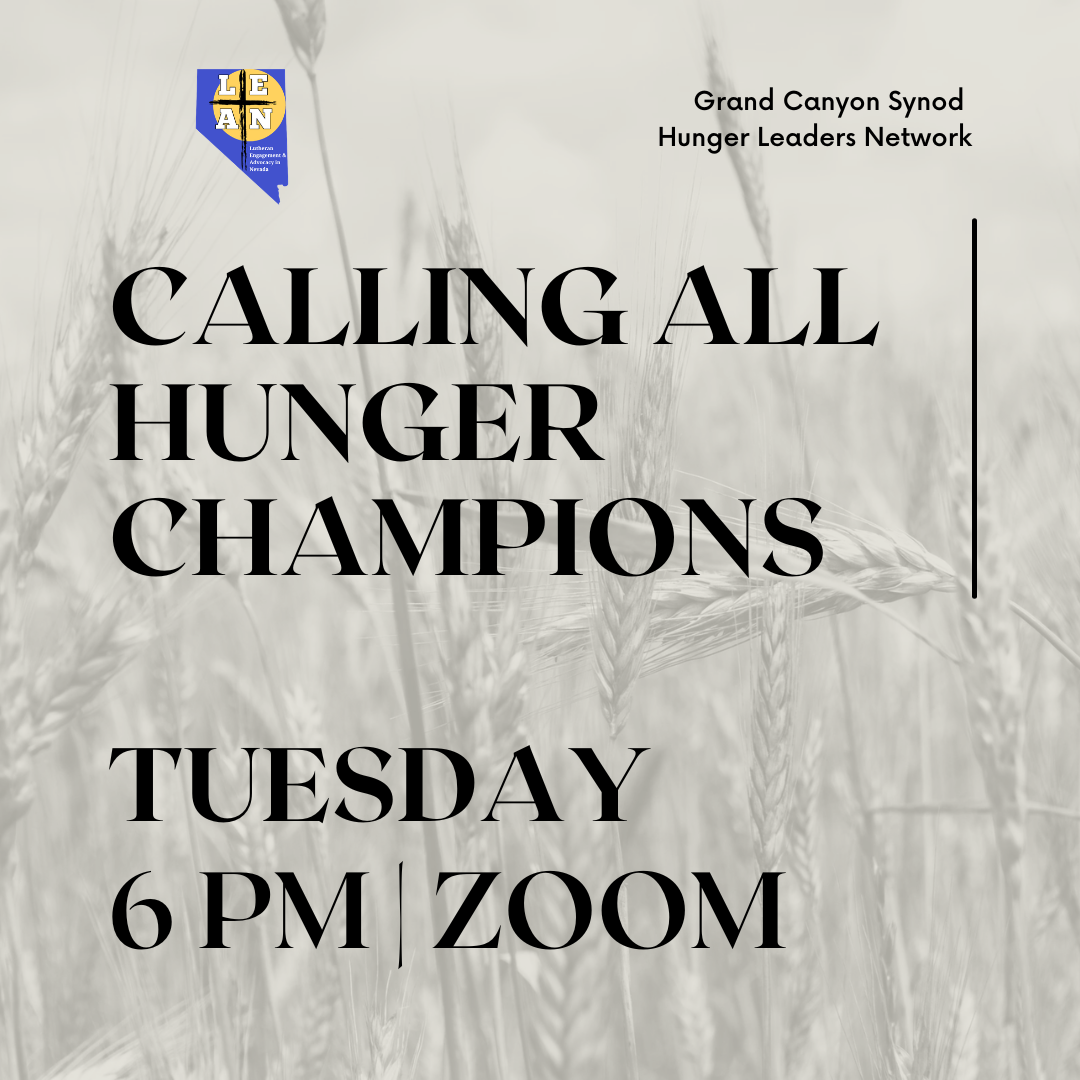
Calling all hunger champions —Join this network of the Grand Canyon Synod! Meet to hear updates on national and local Hunger and Food Insecurity efforts and initiatives, to learn from one another, and to share with the group what’s happening in our congregations. Anyone interested in alleviating hunger is welcome. Prepare to be encouraged and supported!
If you have any questions about this group, please contact Melanie Hobden (Desert Cross, Tempe) or Solveig Muus (LAMA).
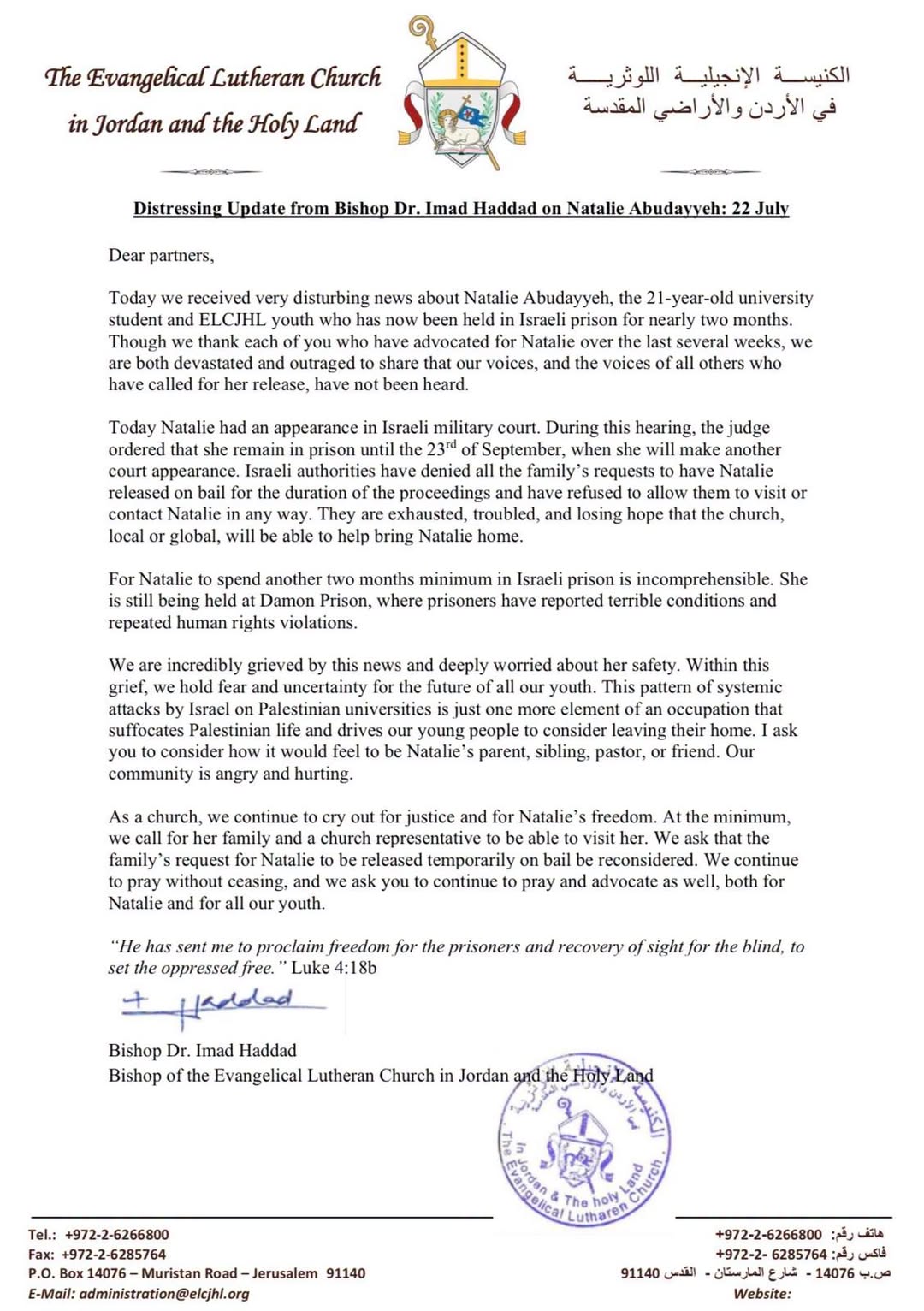
Today we received very disturbing news about Natalie Abudayyeh, the 21-year-old university student and ELCJHL youth who has now been held in Israeli prison for nearly two months. Though we thank each of you who have advocated for Natalie over the last several weeks, we are both devastated and outraged to share that our voices, and the voices of all others who have called for her release, have not been heard.
Today Natalie had an appearance in Israeli military court. During this hearing, the judge ordered that she remain in prison until the 23rd of September, when she will make another court appearance. Israeli authorities have denied all the family’s requests to have Natalie released on bail for the duration of the proceedings and have refused to allow them to visit or contact Natalie in any way. They are exhausted, troubled, and losing hope that the church, local or global, will be able to help bring Natalie home.
For Natalie to spend another two months minimum in Israeli prison is incomprehensible. She is still being held at Damon Prison, where prisoners have reported terrible conditions and repeated human rights violations.
We are incredibly grieved by this news and deeply worried about her safety. Within this grief, we hold fear and uncertainty for the future of all our youth. This pattern of systemic attacks by Israel on Palestinian universities is just one more element of an occupation that suffocates Palestinian life and drives our young people to consider leaving their home. I ask you to consider how it would feel to be Natalie’s parent, sibling, pastor, or friend. Our community is angry and hurting.
As a church, we continue to cry out for justice and for Natalie’s freedom. At the minimum, we call for her family and a church representative to be able to visit her. We ask that the family’s request for Natalie to be released temporarily on bail be reconsidered. We continue to pray without ceasing, and we ask you to continue to pray and advocate as well, both for Natalie and for all our youth.
“He has sent me to proclaim freedom for the prisoners and recovery of sight for the blind, to set the oppressed free.” Luke 4:18b
Bishop Dr. Imad Haddad
Bishop of the Evangelical Lutheran Church in Jordan and the Holy Land
As Lutherans, we believe every person is created in God’s image and deserves compassionate care throughout every stage of life. Supporting accountability in hospice care means protecting vulnerable neighbors while ensuring that legitimate providers can continue offering comfort, dignity, and hope to patients and their families. Good public policy should both safeguard public resources and strengthen access to quality care for every Nevadan.
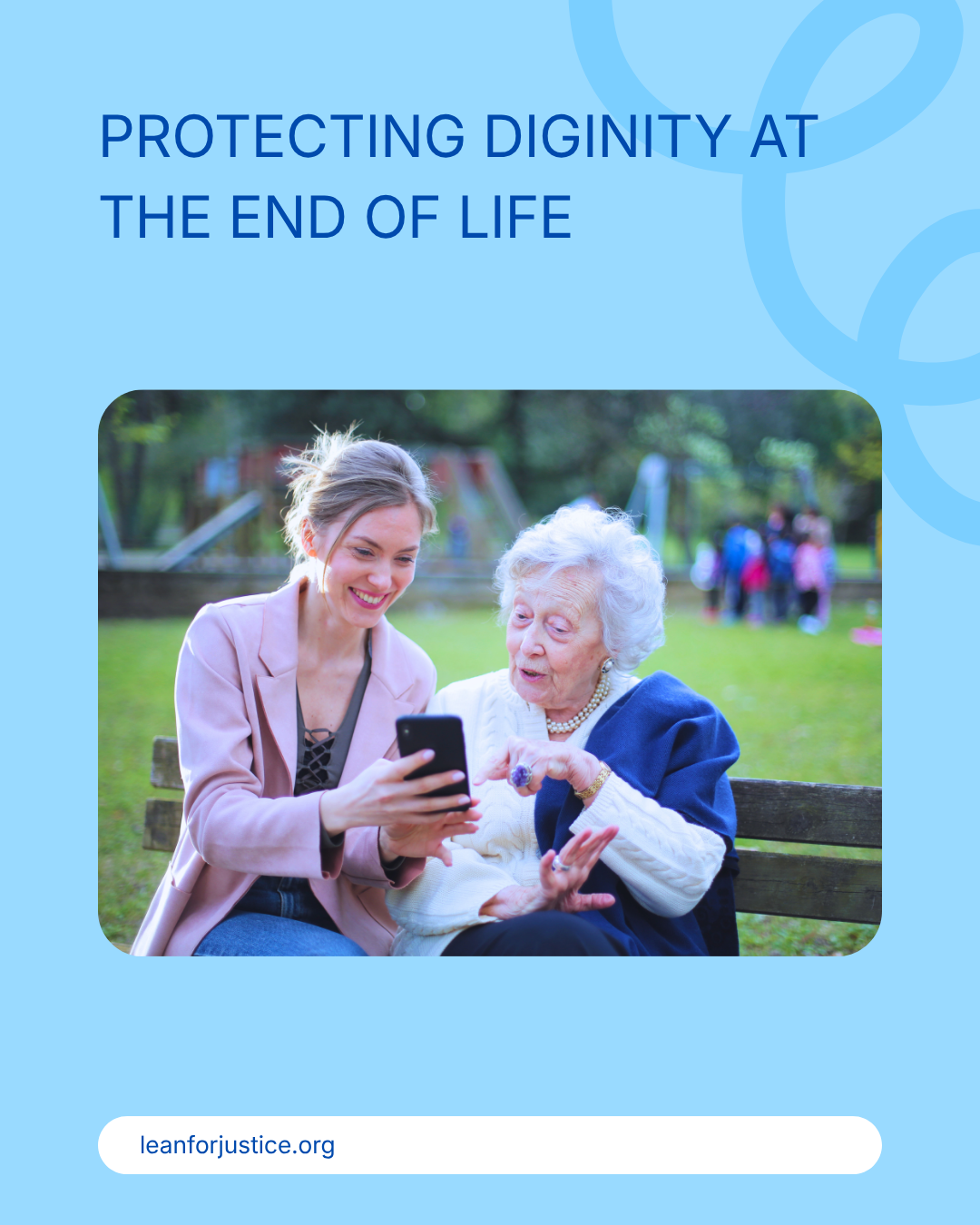
End-of-life care is one of the most sacred moments in a person’s life.
Nevada has paused licensing new hospice providers while state officials investigate fraud concerns and strengthen oversight of the hospice system. The goal is to protect patients, safeguard public resources, and ensure that Medicare and Medicaid dollars reach the people they are intended to serve.
As people of faith, we believe every person deserves compassionate, dignified care at the end of life. Accountability and access should go hand in hand. Strong oversight is important—but so is making sure families, especially in rural and underserved communities, can receive quality hospice care when they need it most.
This is a reminder that good public policy is about both stewardship and compassion: protecting vulnerable neighbors, supporting ethical providers, and building a healthcare system worthy of the trust Nevadans place in it.
“Bear one another’s burdens, and in this way you will fulfill the law of Christ.” — Galatians 6:2
Lutheran Engagement and Advocacy in Nevada Launches “Building a More Just Nevada” Campaign Ahead of the 2027 Legislative Session
Congregations Encouraged to Use August Recess and Fall Election Season to Advocate for the Common Good
CARSON CITY, Nev. — As members of Congress return home for the August recess and Nevada lawmakers continue preparing for the 2027 Legislative Session, Lutheran Engagement and Advocacy in Nevada (LEAN) is inviting congregations across the state to embrace this season as Building a More Just Nevada, a time to advocate faithfully, strengthen relationships with elected officials, and prepare for the public policy conversations that will shape Nevada’s future.
While the Nevada Legislature will not convene until February 2027, much of the work is already underway. Interim legislative committees continue to study the state’s most pressing challenges, developing recommendations and bill draft requests that will become legislation next year.
At the same time, the August congressional recess provides a unique opportunity for people of faith to meet with their federal representatives while they are home in their districts.
“Faithful advocacy is not limited to one legislative session or one level of government,” said Rev. Paul M. Larson, Advocacy Director for Lutheran Engagement and Advocacy in Nevada. “This August and throughout the fall, we have an opportunity to build relationships, tell the stories of our communities, and advocate for policies that reflect our shared values of justice, compassion, and human dignity.”
As part of its Building a More Just Nevada campaign, LEAN is encouraging congregations to engage around five key advocacy priorities during the August recess:
Protect SNAP and strengthen the Farm Bill so every family has reliable access to nutritious food.
Protect Medicaid and expand access to affordable health care, ensuring that children, older adults, people with disabilities, and working families receive the care they need.
Address housing insecurity by supporting affordable housing, tenant protections, and solutions to homelessness.
Welcome immigrants, refugees, and asylum seekers with policies that uphold human dignity and strengthen communities.
Strengthen democracy and civic participation by encouraging voter engagement, protecting access to the ballot, and promoting respectful civic dialogue.
These priorities complement the issues Nevada lawmakers are already examining through interim committees, including affordable housing, behavioral health, youth mental health, workforce development, election administration, infrastructure, and environmental sustainability.
Throughout the fall, LEAN will provide congregations with educational resources, legislative updates, advocacy training, and opportunities to connect with elected officials before the start of the 2027 legislative session.
“Our advocacy is rooted in our baptismal calling to strive for justice and peace in all the earth,” Larson said. “Whether we are speaking with a member of Congress during the August recess or preparing testimony for the Nevada Legislature, every faithful conversation has the power to strengthen our communities and bring hope to our neighbors.”
LEAN encourages congregations to host community conversations, invite elected officials to visit their ministries, organize voter engagement efforts, and participate in upcoming advocacy events as Nevada prepares for the 2027 legislative session.
About Lutheran Engagement and Advocacy in Nevada
Lutheran Engagement and Advocacy in Nevada (LEAN) is the joint public policy ministry of the Sierra Pacific Synod and Grand Canyon Synod of the Evangelical Lutheran Church in America. LEAN equips Lutherans and partners across Nevada to advocate for policies that advance justice, compassion, and the common good through education, relationship-building, and faithful public witness.
Your congregation doesn’t need to have all the answers. It can be the place where neighbors gather to ask faithful questions and listen to one another.
Host a community conversation on topics that matter in your community:
Housing
Hunger
Mental health
Child care
Voting and civic participation
Creation care
Invite community organizations, local leaders, and neighbors to share their experiences. Focus on listening before solving.
Listening is one of the most faithful forms of leadership.
When churches create spaces for honest conversation, trust grows, relationships deepen, and communities become stronger.
Call to Action: What conversation does your neighborhood need? Open your doors and start listening.