New ELCA Resources Show How Our Church Responds to Hunger, Disaster, Migration and Hope

The ELCA has released several new 2026 resources that help tell the story of how Lutherans are working together to address hunger, disaster, displacement, poverty and community need — in the United States and around the world. For LEAN advocates, these resources are useful reminders that public witness, congregational ministry and generous giving are all connected ways we serve our neighbor.

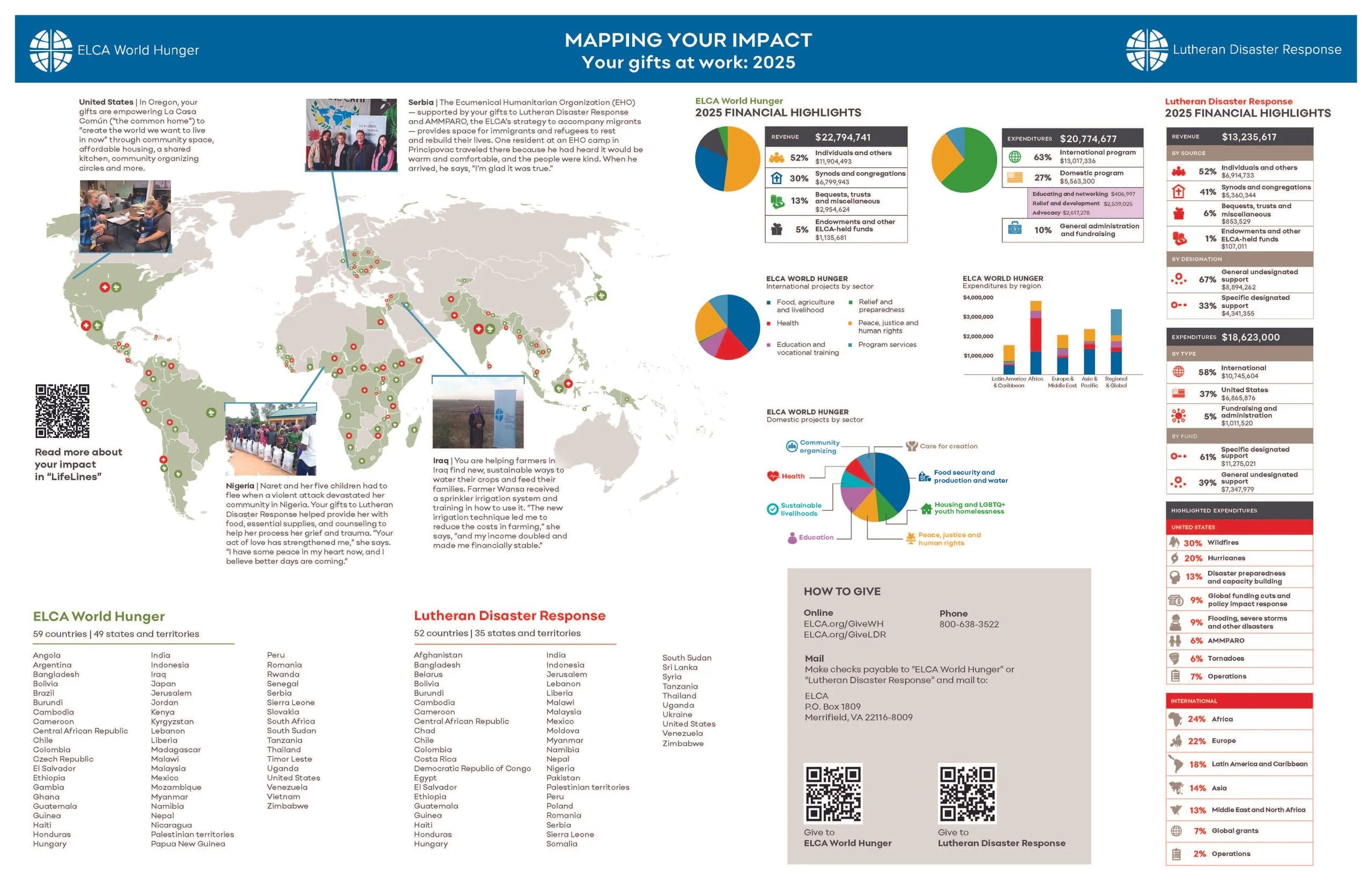
The spring 2026 issue of LifeLines shares stories from ELCA World Hunger and Lutheran Disaster Response, showing how Lutheran gifts help communities and families in the United States and around the world. Paired with the 2025 Year in Review poster, it offers a clear picture of the scope of ELCA World Hunger and Lutheran Disaster Response: grants, accompaniment, disaster recovery, food security, sustainable livelihoods, health, education, care for creation and advocacy all woven together as part of one church’s witness.

These resources are especially helpful for congregations looking for temple talks, adult forum topics, newsletter articles or mission moments. The 2025 Year in Review shows ELCA World Hunger work in 59 countries and 49 states and territories, and Lutheran Disaster Response work in 52 countries and 35 states and territories. It also highlights domestic hunger work in areas such as food security, housing, LGBTQ+ youth homelessness, care for creation, health, education, sustainable livelihoods and community organizing.

The Leadership Circle Newsletter highlights the relationships that make this churchwide ministry possible — from local congregations to global mission partners, from new-start communities to Daily Bread grants responding to food insecurity. It reminds us that consistent support helps fill food pantries, rebuild communities, accompany global partners and form new leaders for the church.

The winter 2026 issue of Boundless offers vivid stories of Christ’s abounding love and grace through ELCA ministries. Readers meet an ELCA missionary serving migrants and refugees in Cairo, girls in Serbia pursuing education with support from ELCA World Hunger partners, and ministries experimenting with new ways to build belonging and community. These stories help us see the human face of the work: people seeking safety, students pursuing dreams, congregations listening to their neighbors and communities finding hope.

For us as Lutherans, these resources can strengthen our advocacy and our ministry. Hunger is local and global. Disaster response is immediate and long-term. Migration is both a border reality and a global reality. Community organizing, housing, health, education and care for creation are not separate from faith; they are part of how we love our neighbors in public.

LEAN encourages congregations, hunger leaders, social ministry teams and adult education groups to explore these ELCA resources and share them widely. Use them to tell stories in worship, invite offerings for ELCA World Hunger or Lutheran Disaster Response, inspire new local partnerships, and connect service with advocacy for policies that help every neighbor thrive.

Explore the resources:

Together, these resources remind us that we are part of a larger church working for a world where people are fed, communities are restored, migrants are welcomed, young leaders are formed and hope is made visible.
LEAN Statement: Welcomes Supreme Court Decision Protecting Nevada’s Mail Voting System

FOR IMMEDIATE RELEASE

Carson City, NV – Today, the United States Supreme Court, in a 5-4 decision in Watson v. Republican National Committee, held that federal election laws do not prevent states from counting absentee ballots that are postmarked by Election Day but received afterward within deadlines established by state law. The Court concluded that federal law sets the deadline for when ballots must be cast, but not when election officials must receive them.

The decision is particularly significant for Nevada. During the 2024 election, more than 44 percent of Nevada voters cast their ballots by mail, and 11,875 ballots that were postmarked by Election Day were counted after arriving within Nevada’s statutory four-day grace period.

“Today’s decision in Watson v. Republican National Committee provides important certainty for Nevada’s election system as we prepare for the 2026 elections. A different outcome could have disrupted longstanding election procedures and created unnecessary confusion for voters and election officials across our state.

Lutheran Engagement and Advocacy in Nevada is committed to ensuring that every eligible Nevadan has a meaningful opportunity to participate in our democracy. This includes military members serving overseas, voters with disabilities who may be unable to vote in person, and Nevadans living in rural communities where voting centers may be many miles away.

Nevada’s vote-by-mail system helps ensure that eligible voters who follow the law are able to have their ballots counted. Today’s decision affirms that states retain the authority to establish reasonable procedures for counting timely cast ballots. While this ruling preserves Nevada’s current election process, we will continue working alongside our coalition partners to protect fair, accessible, and secure elections for every eligible voter in our state.” said Rev. Paul M. Larson, Advocacy Director.

Lutheran Engagement and Advocacy in Nevada remains committed to advancing policies that strengthen civic participation, protect the constitutional right to vote, and ensure every eligible voter can fully participate in our democracy.

For Media Contact:

Rev. Paul M. Larson
Advocacy Director
Lutheran Engagement and Advocacy in Nevada
paullarson@leanforjustice.org

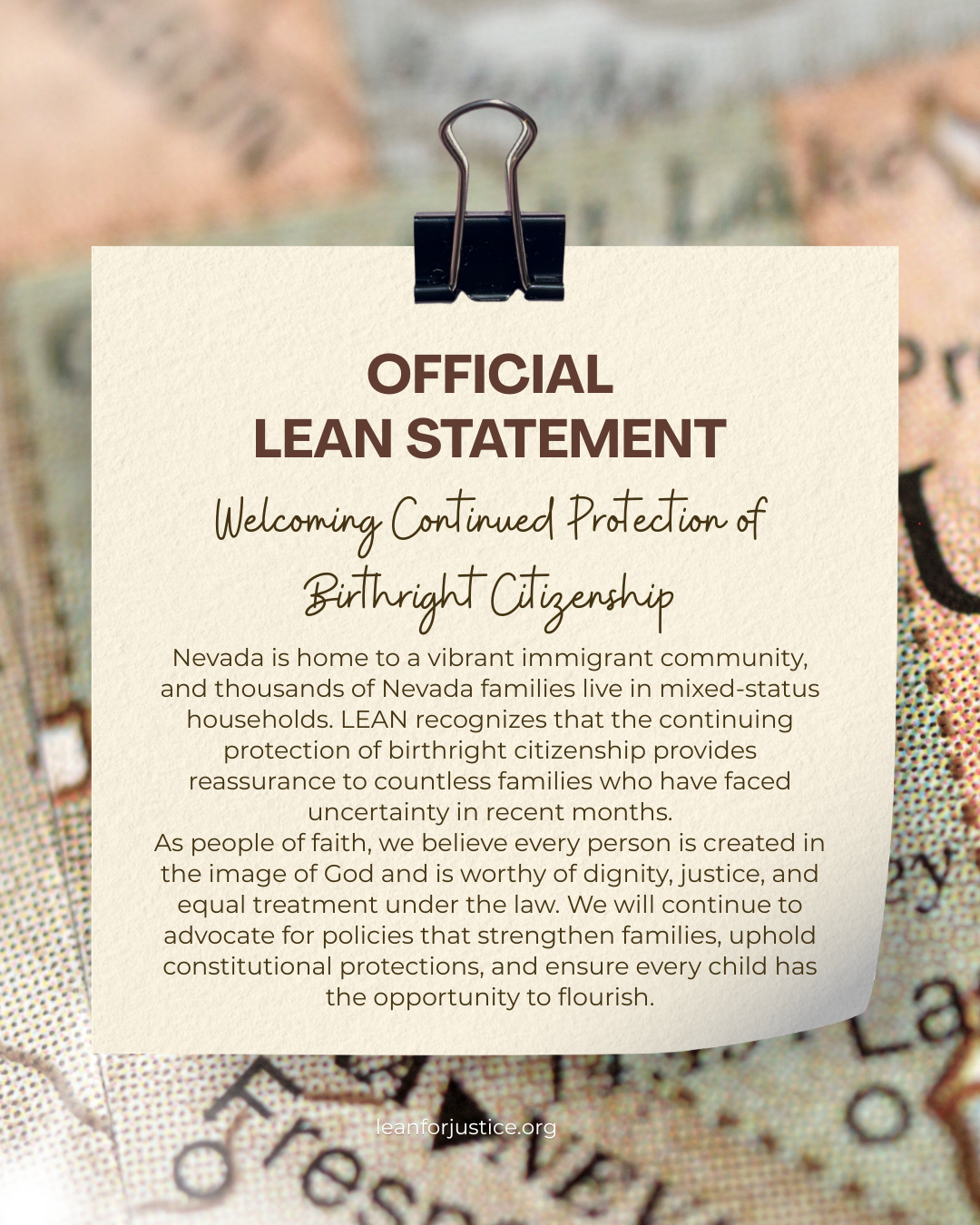
LEAN Statement: Lutheran Engagement and Advocacy in Nevada Welcomes Continued Protection of Birthright Citizenship

FOR IMMEDIATE RELEASE

Carson City, NV – Lutheran Engagement and Advocacy in Nevada (LEAN) welcomes the fact that the constitutional guarantee of birthright citizenship under the Fourteenth Amendment remains in effect. While the Supreme Court’s recent decision did not resolve the underlying constitutional question, the longstanding principle that children born in the United States are citizens regardless of their parents’ immigration status continues to be recognized and protected.

For more than 125 years, birthright citizenship has reflected one of our nation’s foundational promises: that every child born on American soil is entitled to equal protection under the law and has the opportunity to fully participate in the civic, economic, and social life of our country.

“The Fourteenth Amendment has long protected the principle that citizenship is determined by birth on American soil, not by a parent’s immigration status. We are grateful that this constitutional guarantee remains in place while the legal process continues.

One of Nevada’s greatest strengths is its diversity. Every child born in the United States deserves the same rights, the same opportunities, and the same chance to succeed. No child should have their citizenship questioned because of the circumstances of their parents,” said Rev. Paul M. Larson, Advocacy Director for Lutheran Engagement and Advocacy in Nevada.

Nevada is home to a vibrant immigrant community, and thousands of Nevada families live in mixed-status households. LEAN recognizes that the continuing protection of birthright citizenship provides reassurance to countless families who have faced uncertainty in recent months.

As people of faith, we believe every person is created in the image of God and is worthy of dignity, justice, and equal treatment under the law. We will continue to advocate for policies that strengthen families, uphold constitutional protections, and ensure every child has the opportunity to flourish.

For Media Contact

Rev. Paul M. Larson
Advocacy Director
Lutheran Engagement and Advocacy in Nevada
paullarson@leanforjustice.org

LEAN Statement: Responds to Supreme Court Decision on Transgender Student-Athletes

FOR IMMEDIATE RELEASE

Carson City, Nev. — Lutheran Engagement and Advocacy in Nevada (LEAN) expressed deep disappointment following today’s Supreme Court decision affecting transgender student-athletes, while reaffirming its commitment to advocating for the dignity, safety, and inclusion of every young person in Nevada.

“Today’s decision is heartbreaking for transgender student-athletes and their families,” said Rev. Paul M. Larson, Advocacy Director for Lutheran Engagement and Advocacy in Nevada. “No child should be denied the opportunity to learn, grow, and be part of a team simply because of who they are.”

While the Court upheld state authority in this case, LEAN emphasized that the decision does not provide states or school districts with unlimited authority to discriminate against transgender students in every aspect of school life. Nevada remains free to adopt inclusive policies that ensure all students are treated with dignity, respect, and fairness.

Research and the experiences of school districts across the country demonstrate that inclusive athletic policies have allowed transgender youth to participate in school sports for years without widespread disruption. LEAN believes that broad prohibitions excluding transgender students from every sport, at every age, and at every level of competition do not advance fairness in athletics.

“Rather than targeting a small number of young people, policymakers should focus on the real challenges facing girls’ athletics,” Larson said. “That means expanding opportunities, ensuring equitable funding and facilities, addressing harassment, and investing in programs that allow every student to thrive.”

Last week, Governor Joe Lombardo announced that his proposed ballot initiative addressing transgender participation in school sports failed to qualify for the ballot after not receiving enough valid signatures. The Governor indicated he intends to pursue the issue during Nevada’s 84th Legislative Session.

“Lutheran Engagement and Advocacy in Nevada will continue to stand alongside transgender young people and their families as we advocate for policies that ensure every student can live openly, safely, and authentically—both on and off the playing field,” Larson said. “As people of faith, we believe every child is created in the image of God and possesses inherent dignity and worth. Our calling is to build communities where every young person belongs and has the opportunity to flourish.”

Lutheran Engagement and Advocacy in Nevada will continue working with faith communities, educators, policymakers, and coalition partners during the upcoming legislative session to promote policies that protect the dignity, safety, and well-being of all Nevada children.

Media Contact:

Rev. Paul M. Larson
Advocacy Director
Lutheran Engagement and Advocacy in Nevada
paul.larson@lutheranengagement.org

Partners in Ministry: LAMA reflects on The Declaration of Independence: A Lutheran Perspective

The Declaration of Independence: A Lutheran Legacy of Gratitude, Humility, and Public Responsibility

When the Declaration of Independence was signed in 1776, Lutherans in North America likely did not all hear it the same way. Some German-speaking Lutheran colonists, especially in Pennsylvania and the Mid-Atlantic, would have heard in the Declaration a bold claim against tyranny and a hopeful vision of self-government. Others may have been cautious, conflicted, or even loyal to the Crown, shaped by Lutheran concern for order, authority, and the dangers of rebellion.

That complexity is part of our Lutheran inheritance. Lutherans have long taught respect for civil authority, but not blind obedience to injustice. Government is understood as one way God works in the world to protect life, restrain harm, seek justice, and serve the neighbor. When government fails in those purposes, Christians must ask hard questions about conscience, public responsibility, and the common good.

Colonial Lutherans embodied that tension. The Muhlenberg family alone shows how complex the moment was: Henry Melchior Muhlenberg, often remembered as the patriarch of American Lutheranism, served immigrant Lutheran communities with pastoral care and caution during a time of political upheaval, while his son Peter Muhlenberg became a Revolutionary War general and later served in public office. Their story reminds us that Lutherans have never had only one simple way to think about faith and nation.

Today, ELCA Lutherans can receive the Declaration of Independence with both gratitude and humility. We can be grateful for its soaring language about equality, rights, consent of the governed, and resistance to tyranny. Those ideals have inspired generations of people seeking freedom and fuller participation in civic life. At the same time, we must tell the truth: the promises of the Declaration were not extended equally in 1776. Enslaved people, Indigenous peoples, women, and many others were excluded from the freedom the document proclaimed.

Presiding Bishop Yehiel Curry has invited the ELCA to hold this anniversary with both celebration and confession. The Declaration, he notes, proclaims a vision of equality, and we can be grateful for that vision. Yet with “contrition and humility,” we also acknowledge the many ways our nation has failed to embody it. That is a deeply Lutheran posture: naming both gift and sin, promise and failure, aspiration and repentance.

The ELCA’s social teaching gives us language for this work. Faith and Civic Life: Seeking the Well-being of All calls Lutherans to “pray, participate in, and advocate for civic life” that reflects God’s call toward the well-being of all people and a creation marked by justice and peace. It also reminds us that civic engagement is not optional for people of faith. Our baptismal vocation sends us into the world to serve the neighbor, seek justice, and participate in public life for the common good.

The Declaration’s legacy for Lutherans today is not national self-congratulation. Nor is it cynicism. Its legacy is a call to faithful public responsibility. We can honor the Declaration best not by pretending its promises were fulfilled from the beginning, but by working so those promises are more fully realized now: in voting rights, racial justice, Indigenous justice, immigrant welcome, hunger relief, health care access, housing, education, care for creation, and dignity for every neighbor.

For LAMA, this matters because advocacy is one way Lutherans live out love of neighbor in public. We do not confuse the United States with the reign of God. We do not worship nation, flag, party, or ideology. But we do believe that civic life matters, because our neighbors’ lives are shaped by public decisions.

The Declaration of Independence is part of our nation’s story. Lutheran faith gives us a way to read that story honestly: with gratitude for real gifts, repentance for real harms, and courage to continue the unfinished work of justice. As ELCA Lutherans, we can mark this anniversary by asking not only what the Declaration meant in 1776, but what love of neighbor requires of us in 2026.

Additional grounding: The National Archives describes the Declaration as expressing the ideals on which the United States was founded, while noting that it is not legally binding but remains powerful; ELCA’s 2026 worship resources for the U.S. Semiquincentennial say congregations may need to both celebrate and lament national history and avoid conflating church and country. Historical grounding on Lutheran complexity comes from sources on Henry Melchior Muhlenberg and Peter Muhlenberg, including the National Park Service and the U.S. House history profile of John Peter Gabriel Muhlenberg.