DATA CENTERS, AI & A FAST MOVING LANDSCAPE

In just a few months, data centers have gone from a relatively wonky land-use and economic-development issue to one of the most consequential policy debates heading into Nevada’s November election and the 2027 Legislative Session.

In a previous post, we explored a timeline leading up to June 2026, and since then the times have vastly changed and evolved.

And this conversation isn’t really just about data centers.

It’s also about the extraordinarily fast development of artificial intelligence and the physical infrastructure required to power it: electricity generation, transmission lines, water, land and enormous industrial facilities. It is about the collective amount of water use, environmental, and the impacts on the very communities these data centers occupy.

Nationally, the issue has also reached Congress. On September 16, the U.S. House overwhelmingly passed legislation addressing whether data centers should bear the infrastructure costs associated with their enormous electricity demands rather than shifting those costs to other utility customers.

Here in Nevada, the politics have changed quickly too.

Attorney General Aaron Ford, who co-sponsored Nevada’s original 2015 data center tax-abatement legislation while serving in the Legislature, now says the industry has changed significantly since that law was enacted. As a candidate for governor, Ford has proposed pausing new abatements while reviewing their performance and requiring data centers to bear costs associated with their electricity demands.

Governor Joe Lombardo has continued to describe data centers as an important economic opportunity for Nevada, but on September 18 he signed an executive order imposing new conditions on companies seeking state abatements—including requirements involving school taxes, utility costs, water and grid reliability.

And perhaps one of the most interesting developments is how difficult this issue has become to fit neatly into our normal political boxes.

Concerns about electricity bills, water, tax incentives and local control have generated opposition to data center development from people and organizations across the political spectrum. Nationally, Republicans and Democrats have both introduced proposals addressing the industry’s costs and impacts.

So how did we get here?

Over the past several months, data centers have moved from a local land-use question to a major statewide policy conversation.

During Nevada’s legislative interim, lawmakers heard testimony about their potential impacts on electricity demand, water, utility rates, tax revenue, public lands and local communities.

Since then, communities have begun taking action.

RENO

Reno adopted a moratorium on new data center applications while the city develops regulations addressing water, electricity, noise, land use and community impacts.

HUMBOLDT COUNTY

County commissioners adopted a temporary moratorium while officials develop standards addressing electricity, water, noise and appropriate locations for future facilities.

WHITE PINE COUNTY

Commissioners adopted a temporary moratorium on data center land-use applications while the county studies potential impacts.

NYE COUNTY

Nye County went further, moving from a temporary pause to restrictions prohibiting data center development.

TRIBAL NATIONS

Tribal governments, including the Fallon Paiute-Shoshone Tribe and Pyramid Lake Paiute Tribe, have taken action restricting data center development on Tribal lands.

HENDERSON

Henderson considered a moratorium but chose instead to pursue changes to its development code and review future projects through development agreements.

AUGUST 26 — THE CONVERSATION REACHES THE LEGISLATURE

The Legislature’s Joint Interim Standing Committee on Revenue voted 6–2 o request legislation that would repeal Nevada’s existing data center tax abatements and establish a statewide moratorium on constructing or expanding data centers.

That proposal now becomes part of the conversation heading into the 2027 Nevada Legislature.

SEPTEMBER 18 — LOMBARDO ESTABLISHES NEW CONDITIONS

Governor Lombardo signed Executive Order 2026-005, establishing what his administration calls the Nevada Standard for Responsible Data Center Development.

For companies seeking state data center abatements, the order requires developers to:

  • Pay the Local School Support Tax in full
  • Bear project-related costs rather than shifting them onto other utility customers
  • Meet applicable local water standards
  • Address electrical-grid reliability and emergency conditions
  • Enter into a Nevada Community Support Commitment before an abatement application moves forward.

The order also directs development of a Responsible Speed to Power Plan examining the infrastructure necessary to serve Nevada’s growing large electric loads through 2036.

But that isn’t the end of this conversation.

The governor’s framework continues to allow qualifying data center development under additional conditions.

Meanwhile, lawmakers have requested legislation contemplating a statewide moratorium and repeal of existing data center abatements.

And proposals are emerging around utility regulation, electricity infrastructure and who ultimately pays for the power necessary to operate these facilities.

That leaves Nevada with some major questions heading into 2027:

  • How should Nevada protect limited water resources?
  • Who should pay for new generation and transmission infrastructure?
  • What public benefit should Nevada require when granting tax incentives?
  • How should data center policy interact with funding for schools and other public services?
  • How should environmental and climate impacts be considered?
  • What protections should exist for neighboring communities?
  • How should Tribal governments participate when projects affect water, land and cultural resources?
  • And which decisions belong with cities and counties—and which require statewide standards?

There is another question underneath all of them:

As artificial intelligence drives demand for increasingly large amounts of physical infrastructure, how does Nevada capture potential economic benefits without shifting the costs onto communities, ratepayers and future generations?

Those questions are now being debated at the local, state and federal levels, which means decisions made by elected officials at each level will help determine Nevada’s approach.

This issue is evolving quickly.

LEAN will continue following the proposed legislation, local moratoriums, utility proceedings, tax policy and other developments as Nevada moves toward the 2027 Legislative Session.

Because decisions about our water, electricity, schools, public revenue, land and communities are decisions about our neighbors—and those decisions deserve public attention.

What is the new “public charge” policy?

Nevada has joined 21 other states and Washington, D.C., in challenging a new federal immigration policy that could make it harder for some people to receive a green card or enter the United States.

Under the policy, immigration officers may consider whether an applicant has used certain public benefits, including Medicaid, the Children’s Health Insurance Program (CHIP), food assistance, or housing assistance, when making some immigration decisions.

The federal government says the change promotes self-sufficiency. Nevada and the other states argue that it is vague, unlawful, and likely to cause harm.

Why does this matter?

Families may avoid health care, food assistance, school meals, or housing support because they fear it could affect an immigration case, even when a child or other family member is legally eligible for that help.

This can affect entire households, including U.S.-citizen children. When families skip preventive care or go without enough food, the consequences can include greater illness, hunger, housing instability, and increased costs for communities and public systems.

The lawsuit argues that widespread disenrollment could also reduce federal support for Medicaid, CHIP, and SNAP, leaving states to address the resulting gaps.

For LEAN, this is about human dignity and community well-being.

Immigration policy is also health policy, hunger policy, housing policy, and children’s policy. Every family should be able to seek the care and support for which they are eligible without fear.

Families with questions about their individual circumstances should seek advice from a qualified immigration attorney or trusted nonprofit legal-services provider. Do not rely on social media or general information alone for legal advice.

Read more: https://nevadacurrent.com/2026/09/14/repub/nevada-among-jurisdictions-suing-trump-administration-over-new-green-card-restrictions/

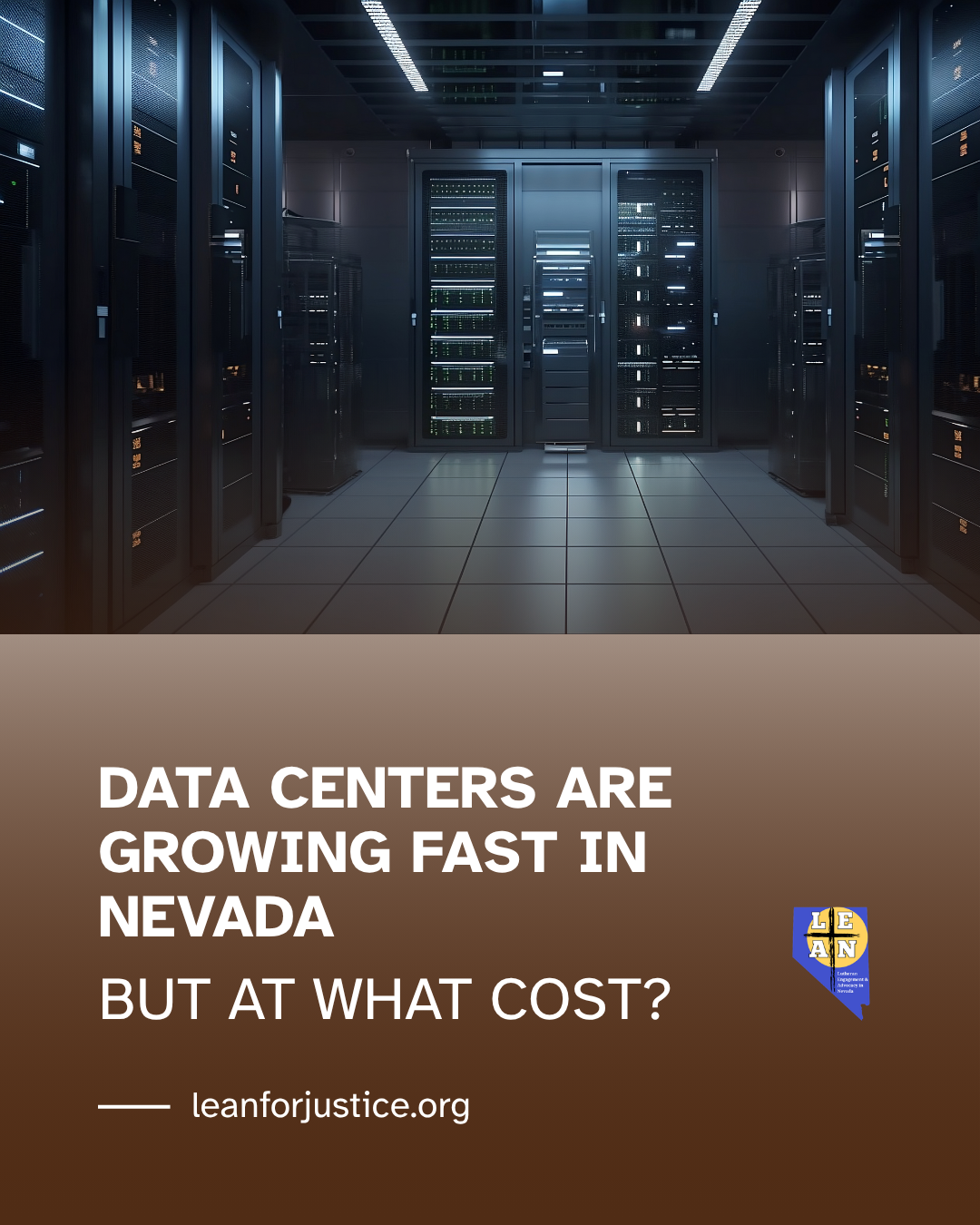
DATA CENTERS ARE GROWING FAST IN NEVADA, BUT AT WHAT COST?

Data centers are becoming a much bigger part of Nevada’s economy, and our demand for electricity, water, land, and public infrastructure.

A new Las Vegas Review-Journal overview highlights just how quickly the industry is expanding and why Nevadans should be paying attention.

ENERGY

Data centers currently account for about 5% of NV Energy’s electricity sales. NV Energy projects that could grow dramatically in the coming decades.

That raises an important question: Who will pay for the new power plants, transmission lines, and other infrastructure needed to serve these massive electricity users?

Nevada households should not be left carrying costs created by some of the largest energy users on the grid.

WATER

Nevada data centers are not currently required to publicly disclose their water consumption.

Available records show data centers collectively used about 716 million gallons of water in 2024.

In the driest state in the nation, transparency about major water users matters.

TAX INCENTIVES

Nevada has offered significant tax abatements to attract data centers.

Supporters argue these incentives bring investment, construction, jobs, and economic development. Others are asking whether the public benefits justify the amount of tax revenue Nevada gives up — including revenue that otherwise supports public services.

LAND & CREATION CARE

Data-center development also raises questions about public lands, wildlife habitat, groundwater, air pollution, and Nevada’s climate goals.

These decisions aren’t only about technology. They are decisions about how we steward the land, water, energy, and resources we share.

COMMUNITY VOICE

Communities across Nevada are already debating moratoriums, water restrictions, development agreements, zoning requirements, and other safeguards.

As Nevada prepares for the 2027 Legislative Session, LEAN believes Nevadans deserve clear information and meaningful opportunities to participate in these decisions.

The questions we should keep asking are:

Who benefits? Who bears the costs? How much water and energy will be required? What public resources are being offered? And how do we ensure Nevada’s growth serves the common good?

Creation care calls us to think not only about what we can build, but how we faithfully steward what has been entrusted to us.

“The earth is the Lord’s and all that is in it.” — Psalm 24:1

LEAN BRIEFING: Tribal Sovereignty and Nevada’s Data Center Boom

As Nevada continues to grapple with the rapid growth of data centers, Tribal Nations and Indigenous advocates are raising another important dimension of the conversation: tribal sovereignty, water, traditional lands, cultural resources and who has a voice in decisions about development.

Recent reporting from KUNR highlights growing opposition to data center development among several Tribal Nations in Northern Nevada.

The Pyramid Lake Paiute Tribe adopted a permanent moratorium on data centers on its homelands in August. The Fallon Paiute-Shoshone Tribe has also banned data centers on its lands.

The concerns extend beyond developments located directly on tribal lands.

WATER CONNECTS OUR COMMUNITIES

The Truckee River flows from Lake Tahoe through Reno and Sparks before terminating at Pyramid Lake. Indigenous advocates warn that major new water demands upstream can therefore have consequences downstream.

Pyramid Lake is also the only existing home of the endangered cui-ui and supports threatened Lahontan cutthroat trout. These species are not simply environmental resources—they hold deep cultural significance for the Pyramid Lake Paiute people.

The Indigenous-led Water Over Data Alliance is calling for Tribal Nations within the Truckee River watershed to have a meaningful role in decisions about data center development.

TRADITIONAL LANDS ARE ALSO PART OF THE CONVERSATION

Near Yerington, the proposed 500-acre Monarch data center has faced opposition from the Yerington Paiute and Walker River Paiute Tribes.

Their concerns include water and electricity use, environmental impacts and effects on traditional lands and cultural resources.

This illustrates an important point: a development does not have to sit within reservation boundaries to affect Tribal communities.

ENERGY REMAINS PART OF THE EQUATION

Tribal concerns also intersect with the larger statewide conversation about the tremendous electricity demand associated with data centers.

Nevada must consider how new generation and transmission infrastructure will be financed, how grid reliability will be protected, who bears environmental impacts and whether households and other ratepayers could shoulder costs associated with industrial growth.

TRIBAL SOVEREIGNTY MATTERS

Tribal Nations are sovereign governments—not simply another stakeholder in a public-comment process.

At the same time, Tribal Nations are not monolithic. Some tribes elsewhere have explored data centers as potential sources of economic development, infrastructure investment and revenue.

The central issue is self-determination: Tribal Nations should have meaningful opportunities to determine what happens on their lands and to participate when projects may affect their water, cultural resources and communities.

WHAT LEAN IS WATCHING

As Nevada policymakers continue examining data center growth and look toward the 2027 Legislative Session, LEAN will be watching several interconnected questions:

• Water use and transparency
• Electricity demand and grid reliability
• Utility costs and ratepayer protections
• Tribal consultation and sovereignty
• Traditional lands and cultural resources
• Environmental and wildlife impacts
• Tax abatements and public benefits
• Local land-use decisions
• Cumulative impacts of multiple data center projects

Data centers are often discussed as an economic-development or technology issue. But Nevada’s debate is becoming much larger.

It is also a conversation about water, energy, land, creation care, economic justice, tribal sovereignty and the kind of communities we want to build for future generations.

For LEAN, these questions reflect our call to care for creation, seek justice and ensure that communities most affected by public decisions have a meaningful voice in shaping them.

Read More: KUNR

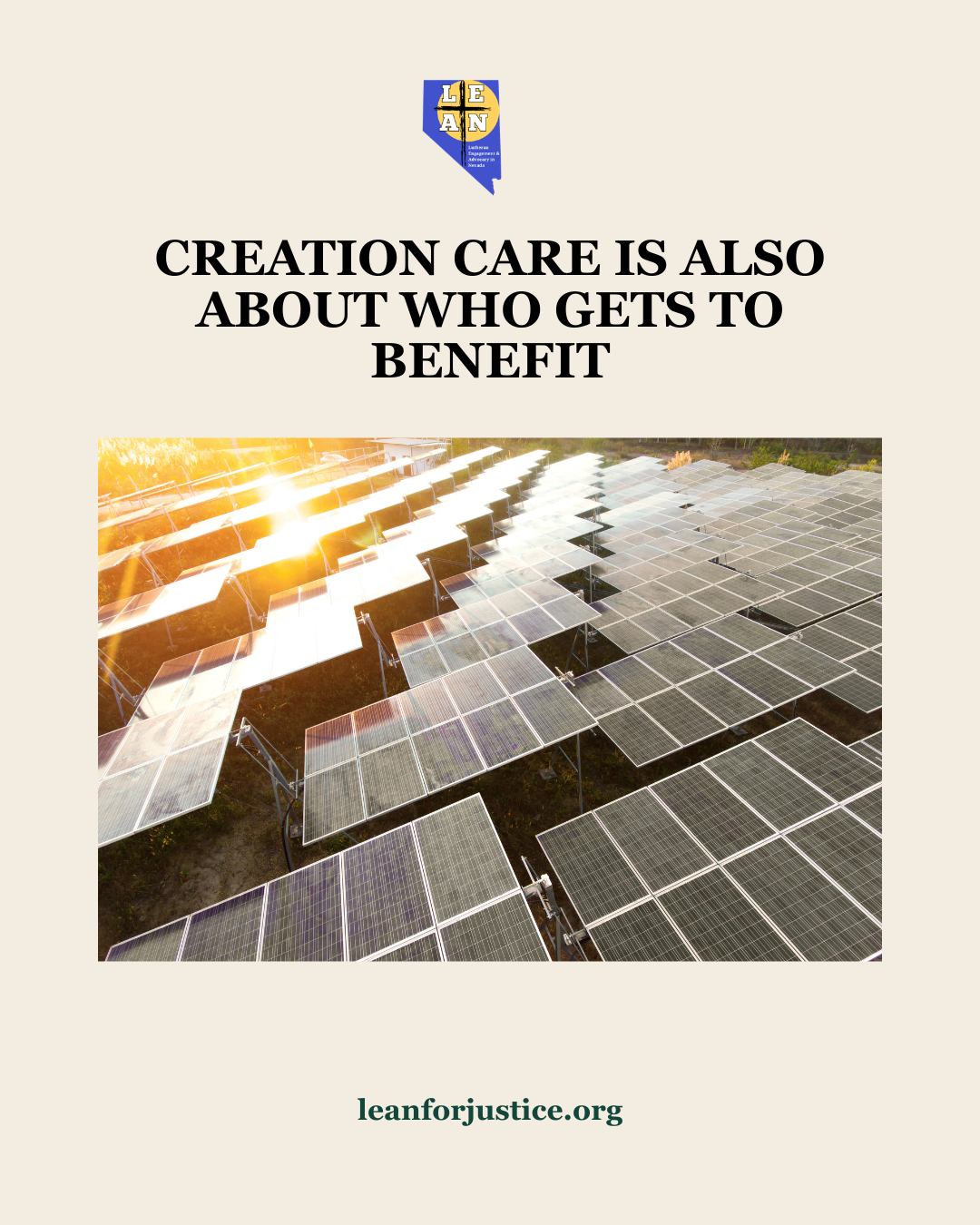
Creation Care Is Also About Who Gets To Benefit

A federal judge has ruled that the EPA unlawfully terminated the $7 billion Solar for All program, an initiative created to expand access to residential and community solar for low-income and disadvantaged households.

The program was intended to reach more than 900,000 households nationwide and help families lower their electricity costs while expanding access to clean energy.

That matters because the transition to clean energy should not be something only higher-income households can afford.

Energy justice asks bigger questions:

Who gets access to clean energy?

Who gets help lowering their power bill?

Who pays when electricity demand increases?

And who benefits from the billions of dollars being invested in our energy system?

Those questions are increasingly important here in Nevada, where we are having major conversations about electricity rates, new generation, transmission infrastructure, water, and the enormous energy demands associated with data centers.

For LEAN, creation care and economic justice are connected.

Our Lutheran tradition calls us to care for creation and our neighbor. That means an energy transition should consider not only how electricity is generated, but whether families struggling with housing, food, health care, and utility costs are able to share in its benefits.

The court ruling does not necessarily end the legal fight over Solar for All. The EPA has indicated it is reviewing its options.

But it raises an important question as Nevada considers its own energy future:

Are we building an energy system that works for everyone—or only asking everyone to help pay for it?

Read more: 2 News