Criminal justice policy affects families, neighborhoods, public safety, rehabilitation, and long-term community health.
Nevada continues to wrestle with questions around incarceration, reentry support, youth justice, policing, addiction treatment, and mental health response systems.
Faith calls us to uphold accountability while also recognizing the humanity and dignity of every person.
LEAN into 2026 by learning how criminal justice reform impacts communities across Nevada.
Ballot measures may look short on the ballot, but their effects can be long-lasting. Some are technical. Some are controversial. Some sound simple but include details that matter deeply for our neighbors, schools, communities, and public life.
That is why Lutheran Engagement and Advocacy in Nevada prepares a voter guide.
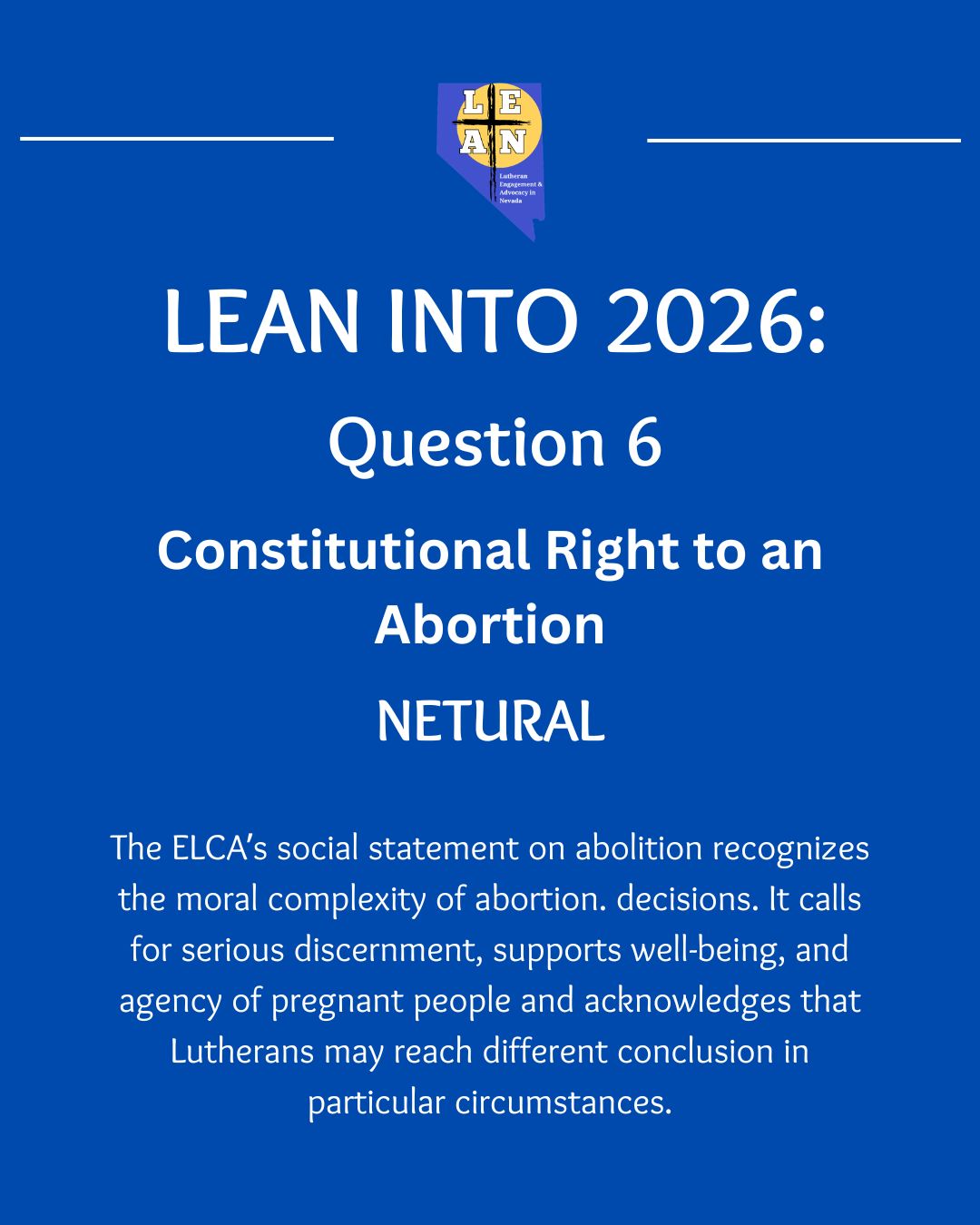
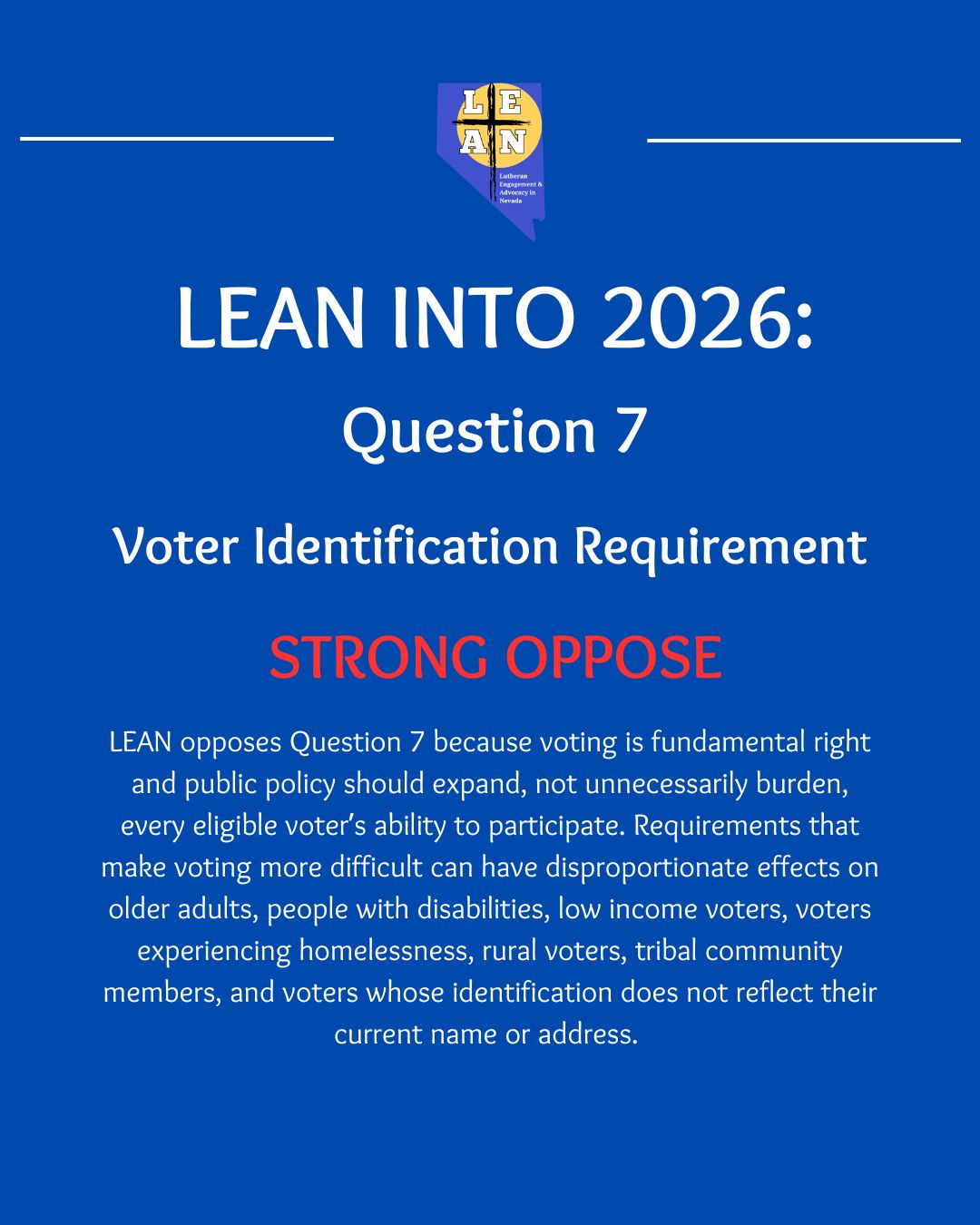
LEAN’s 2026 Voter Guide is designed to help voters look beyond campaign slogans and consider ballot measures through the lens of Lutheran public witness. We do not tell people how to vote simply because an issue is politically charged. LEAN takes a position only when a measure connects clearly to our policy priorities and to ELCA social teaching.
For 2026, LEAN’s priorities include food insecurity; civic engagement, including racial, gender, and economic justice; caring for creation; health care; and housing and homelessness. In reviewing these measures, LEAN also looks to ELCA guideposts:
The equal, God-given dignity of every person
Special concern for people living in poverty or excluded from power
Fair and accessible civic participation
Dignified work and collective voice
Equitable, sufficient, and effective funding for public education
The ELCA describes social teaching as official teaching and policy that helps guide “moral discernment and action.” We take that seriously. Our positions are not based on party labels. They are grounded in a Lutheran understanding that faith is active in love, and that love seeks justice in public relationships and social structures.
The ELCA social statement, Faith and Civic Life: Seeking the Well-being of All, reminds us that Christians are called “to take responsibility for the good of all through civic participation.” It also draws from Luther’s explanation of daily bread, which includes not only food and drink, but also “upright and faithful rulers” and “good government.”
Voting is not separate from faith. It is one way we care for our neighbors and seek the common good.
Share this guide with friends and family, neighbors, and congregation members.
Strong democracy depends on public trust, civic participation, and fair access to the ballot box.
Election administration includes how ballots are counted, voter registration systems, mail voting processes, poll worker support, and election security.
In recent years, election workers and systems have faced growing pressure and misinformation. Learning how elections actually function helps strengthen civic trust and participation.
LEAN into 2026 by staying informed and engaged in Nevada’s democratic process.
Join Lutheran Engagement and Advocacy in Nevada as we post a four part series on how to do Election Research.
Don’t just read it. Question it.
Election season means we are going to see a lot of campaign ads, mailers, social media posts, texts, and videos competing for our attention.
Being an informed voter means doing more than simply reading what a campaign puts in front of us. It means asking questions, checking the evidence, and learning how to recognize when information may be misleading.
Watch for Emotional Language
Some campaign messages are designed to make you feel something before they ask you to think.
Watch for language intended to create:
Fear
Anger
Pride
Urgency
For example:
“If my opponent wins, Nevadans will lose their homes.”
That is a powerful claim. But before accepting it, ask:
What evidence supports this claim?
Labels Instead of Evidence
Sometimes campaigns spend more time attacking a person than explaining their policy differences.
Instead of answering:
“What will I do?”
The message becomes:
“What kind of person is my opponent?”
When you encounter accusations or labels, ask:
What facts support this accusation? Is there evidence I can independently verify?
Big Promises, Few Details
Freedom.
Security.
Family.
Prosperity.
Change.
These words can sound inspiring, but what do they actually mean?
Ask what specific policies a candidate is proposing and how they plan to accomplish them.
Statistics Can Mislead
A number isn’t automatically the whole truth.
Watch for:
Missing context
No source
Misleading graphs or graphics
Percentages without the actual totals
Statistics that don’t explain the time period being measured
Ask:
Where did this number come from, and can I find the original source?
“Us vs. Them”
Some political messages suggest there are only two choices:
“If you’re not with us, you’re against us.”
Real public-policy questions are usually much more complicated.
When a message divides people into heroes and villains, insiders and outsiders, or “us” and “them,” ask what complexity might be missing.
Before you vote, ask yourself:
Who created this?
Where is the evidence?
Can I verify it somewhere else?
What information or context might be missing?
Who benefits if I believe it?
Our democracy depends on more than casting a ballot.