Food security is about more than groceries. It is about dignity, health, and ensuring every neighbor has enough to eat.
Recent data from the Center on Budget and Policy Priorities show that more than 4.5 million Americans—an 11% decline in SNAP participation, lost food assistance between July 2025 and April 2026 as changes to federal law were implemented. More than 700,000 children have lost SNAP in the states where data are currently available, and those numbers continue to grow.
Here in Nevada, these changes matter.
Approximately 433,000 Nevadans rely on SNAP to help put food on the table.
Federal data indicate that SNAP participation in Nevada has declined by more than 10% since July 2025.
Earlier this year, state officials warned that as many as 46,000 Nevadans could be affected by new work requirements, increasing pressure on food banks and community organizations.
Churches, food pantries, and organizations like Three Square faithfully respond to hunger every day. But they were never meant to replace a nutrition program that serves hundreds of thousands of Nevadans.
As Lutherans, we believe caring for our neighbor means both feeding those who are hungry today and advocating for policies that reduce hunger tomorrow.
Ending hunger is not simply an act of charity, it is an act of justice.
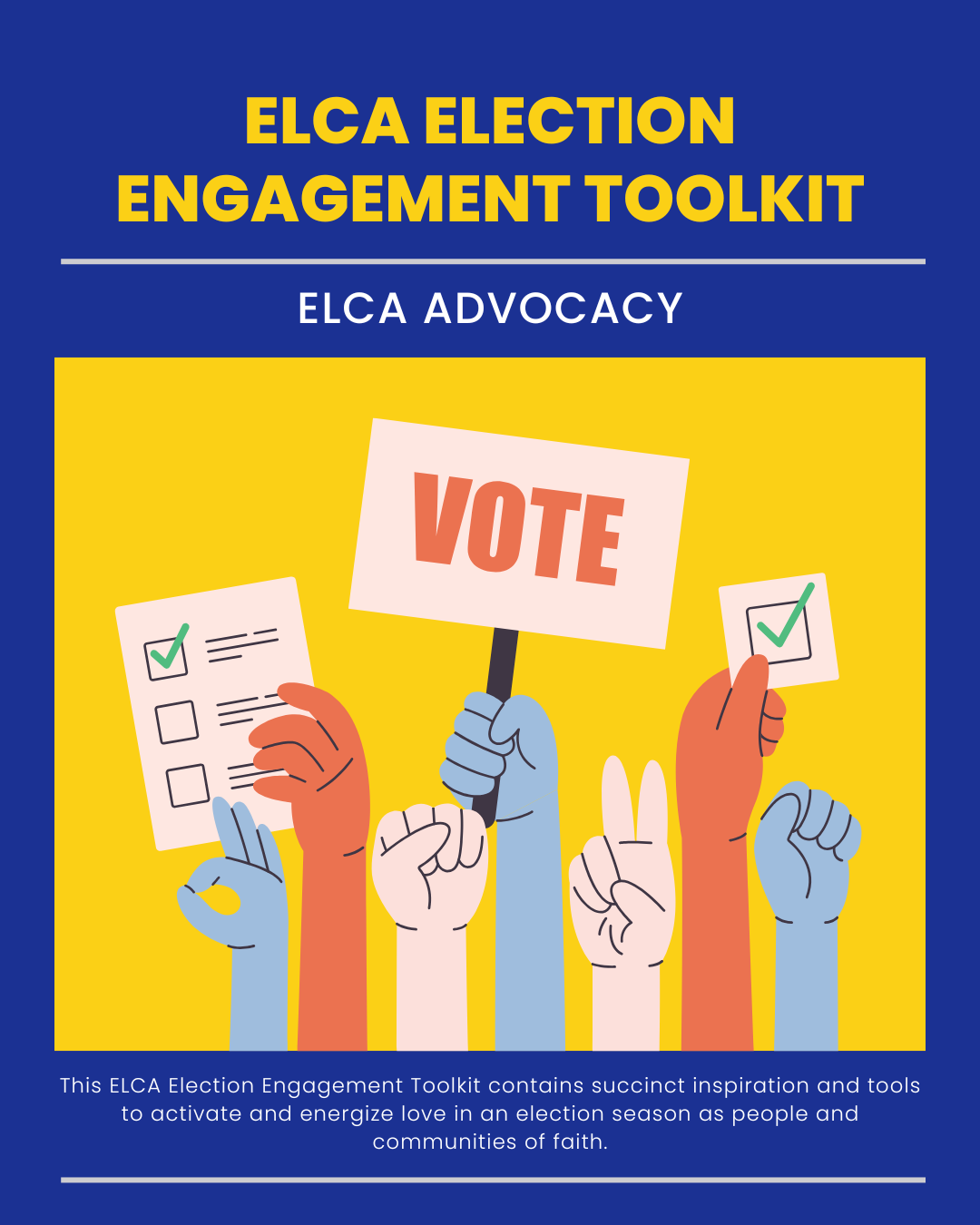
Voting is one way people of faith care for their neighbors and seek the common good. A new ELCA Election Engagement Toolkit offers congregations practical, nonpartisan ways to encourage civic participation, protect access to the ballot, and bring a faithful presence to election season.
Designed for congregations, ministry leaders, and individuals, the 20-page toolkit helps Lutherans engage faithfully in our democracy without telling anyone how to vote. Instead, it provides practical ideas for encouraging informed participation, reducing barriers to voting, and strengthening trust in our election process.
Grounded in the ELCA social statement Faith and Civic Life: Seeking the Well-being of All, the toolkit reminds us that Christians are called “to pray, participate in, and advocate for civic life in the United States.” At the same time, it makes clear that congregational election engagement must always be transparent, legal, and strictly nonpartisan.
Start Where You Are
One of the toolkit’s greatest strengths is that it recognizes every congregation is different. Each section includes three levels of engagement, Beginning, Ready for More, and Challenging, allowing churches to start with simple actions and grow their ministry over time.
The toolkit offers practical guidance for:
Beginning conversations about faith, voting, and the common good.
Helping people check their voter registration and make a voting plan.
Hosting nonpartisan voter registration and get-out-the-vote efforts.
Providing transportation, childcare, or other Election Day support.
Recruiting poll workers, poll observers, and poll chaplains.
Serving as a polling location when appropriate.
Sharing trustworthy election information and responding to misinformation.
Supporting election protection and de-escalation efforts.
Holding prayer vigils and other public expressions of faithful witness.
It also includes Bible studies, worship resources, legal guidance, and conversation tools to help congregations discuss political differences while remaining rooted in Christ’s call to love our neighbors.
Practical Ideas for Nevada Congregations
Here in Nevada, these ideas are especially timely.
Our state is one of the nation’s most closely watched electoral battlegrounds. Statewide elections are often decided by only a few thousand votes, and local elections frequently shape decisions about housing, health care, education, food security, public lands, and other issues that affect our neighbors every day.
Congregations can make a meaningful difference by:
Posting a “Prepared to Vote” checklist.
Helping members verify their voter registration.
Sharing accurate election information from the Nevada Secretary of State and county election officials.
Offering rides to polling locations or early voting sites.
Making election information available through food pantries, community meals, shelters, and other outreach ministries for neighbors who may face barriers to voting, including older adults, people with disabilities, Tribal communities, rural residents, and people experiencing homelessness.
The toolkit also introduces the ministry of poll chaplains, trained clergy and lay leaders who offer a calm, welcoming, nonpartisan presence at voting locations and help foster peaceful civic participation.
Truth Matters
The toolkit gives significant attention to misinformation and disinformation.
Churches are among the most trusted institutions in many communities. That trust carries a responsibility to share accurate information and point people toward reliable sources.
Sometimes faithful leadership is as simple as confirming the correct election date, registration deadline, polling location, or identification requirements. It can also mean building relationships with local election officials so questions can be answered with confidence and accuracy.
As Christians, our commitment to truth calls us to distinguish between honest mistakes, misunderstandings, and intentional falsehoods, and to ask whether what we share reflects our love for our neighbors.
Faithful, Not Partisan
The toolkit draws an important distinction: election engagement is not candidate endorsement.
ELCA congregations may encourage voting, provide nonpartisan voter education, host appropriately structured candidate forums, advocate for fair access to the ballot, and pray for our elected leaders and communities.
They may not use church resources to support or oppose candidates or political parties.
Our faith will not lead every Lutheran to the same political conclusions. But it does call all of us to seek the well-being of our neighbors, uphold human dignity, tell the truth, and participate faithfully in our shared civic life.
As election season approaches, perhaps the question is not whether churches should engage, but how we can do so in ways that reflect Christ’s love for our neighbors and strengthen the communities we share.
What’s one faithful step your congregation can take this election season?
Two issues continue to be top priorities for Nevadans: protecting our public lands and addressing the housing crisis.
Recent polling shows overwhelming support for keeping public lands in public hands, while communities across the state continue to seek practical solutions to make housing more affordable.
At LEAN, we’ve been following both conversations closely. We’ve examined the proposed federal housing legislation and continue to advocate for balanced solutions that include building more housing in existing communities, thoughtful rezoning, expanding housing options like ADUs and “missing middle” housing, and protecting the public lands that are central to Nevada’s identity.
As people of faith, we believe caring for our neighbors means both protecting God’s creation and ensuring everyone has access to a safe, affordable place to call home.
August recess provides congregations and community organizations an important opportunity to meet with members of Congress while they are home in Nevada.
Committee assignments help us understand which lawmakers are especially well positioned to shape legislation before it reaches the House or Senate floor. While every member votes on final passage, committee members often have the earliest opportunity to influence federal policy.
Every Nevadan is represented by two U.S. senators and one member of the House of Representatives. Constituents should always begin by contacting their own representative, but statewide organizations and ministries may also wish to engage members whose committee responsibilities closely intersect with their work.
LEAN’s Federal Priorities
Protect SNAP and strengthen the Farm Bill
Protect Medicaid and health care access
Support affordable housing and homelessness solutions
Protect immigrants, refugees, and asylum seekers
Strengthen democracy and civic participation
Care for creation and strengthen climate resilience
Nevada’s Congressional Delegation
Senator Catherine Cortez Masto
Committees
Finance
Banking, Housing and Urban Affairs
Energy and Natural Resources
Indian Affairs
Why this matters
These committees touch many of LEAN’s priorities:
Medicaid and Medicare
Affordable housing
Banking and consumer protections
Public lands
Tribal communities
Energy policy
This makes Senator Cortez Masto an important contact on health care, housing, economic security, tribal concerns, and stewardship of public lands.
Senator Jacky Rosen
Committees
Armed Services
Commerce, Science and Transportation
Foreign Relations
Small Business and Entrepreneurship
Why this matters
While Senator Rosen does not serve on Agriculture or Finance, these committees oversee issues including:
Economic development
Broadband
Transportation
International humanitarian policy
Small business support
Congregations can share how federal investments strengthen local communities and support working families.
Congressional District 1
Representative Dina Titus
Committees
Transportation and Infrastructure
Foreign Affairs
Select Committee on Strategic Competition with the Chinese Communist Party
Especially relevant issues
Public transportation
Extreme heat preparedness
FEMA disaster assistance
Community infrastructure
Humanitarian assistance
Migration in the Western Hemisphere
Las Vegas congregations may find Representative Titus especially well positioned to discuss transportation, emergency preparedness, resilient communities, and international migration.
Congressional District 2
Representative Mark Amodei
Committees
Appropriations
Interior, Environment and Related Agencies
Homeland Security
Financial Services and General Government
Especially relevant issues
Federal budget
Public lands
National parks
Housing grants
Wildfire resilience
FEMA
Water resources
Rural communities
As Nevada’s only Republican member of Congress, Representative Amodei also serves on the powerful House Appropriations Committee, making him an important voice on annual federal funding that supports communities across Nevada.
Representative Susie Lee
Committees
Appropriations
Energy and Water Development
Defense
Natural Resources
Federal Lands
Energy and Mineral Resources
Especially relevant issues
Federal spending
Water infrastructure
Housing investments
Public lands
Energy policy
Wildfire resilience
Representative Lee’s Appropriations assignment makes her an important contact regarding federal investments that strengthen Nevada communities.
Congressional District 4
Representative Steven Horsford
Committees
Ways and Means
Health
Social Security
Especially relevant issues
Medicare
Medicaid
Social Security
Affordable Care Act
Tax policy
Family economic security
Poverty reduction
Representative Horsford’s committee oversees many of the federal programs that directly affect Nevada families’ financial and physical well-being, making him a key contact on health care access and economic security.
Where LEAN Priorities Best Connect
LEAN Priority
Key Nevada Members
SNAP & Farm Bill
Entire delegation (no Nevada member serves on Agriculture Committee)
Medicaid & Health Care
Sen. Cortez Masto, Rep. Horsford
Housing & Homelessness
Sen. Cortez Masto, Reps. Amodei, Lee, Titus
Public Lands & Creation Care
Sen. Cortez Masto, Reps. Amodei and Lee
Immigration & Refugees
Sen. Rosen, Rep. Titus
Economic Security
Sen. Cortez Masto, Rep. Horsford
Federal Investments
Reps. Amodei and Lee (Appropriations)
Making August Recess Count
You do not need to be a policy expert to be an effective advocate.
The most powerful advocacy often begins with a simple story:
What are you seeing at your food pantry?
How has Medicaid helped someone in your congregation?
What housing challenges are your neighbors facing?
How has extreme heat affected your community?
How are immigrant families experiencing welcome—or barriers—in Nevada?
When meeting with a member of Congress or their staff:
Introduce yourself as a constituent and person of faith.
Share one story from your congregation or community.
Connect that story to the member’s committee responsibilities.
Ask one clear question:
What will you do to protect SNAP?
How will you strengthen Medicaid?
How will Congress support affordable housing?
How will you ensure immigrant families are treated with dignity?
Faithful advocacy is not about party loyalty. It is about bringing the experiences of our neighbors into the public square and encouraging public servants to pursue policies that promote the common good.
If you would like to schedule time with your legislator, please reach out to Pastor Paul,and he is willing to work with ELCA Advocacy Partners to secure a time.
Amplifying support of the Bridging Agency Data Gaps and Ensuring Safety (BADGES) for Native Communities Act H.R. 1010 is one meaningful way we can act now.
The crisis of Missing and Murdered Indigenous Women, Girls and Relatives (MMIWRGR) continues to affect Indigenous communities across the United States and Canada. Indigenous communities continue to experience disproportionately high rates of violence, disappearance and loss, a reality rooted in centuries of colonization and structural violence. “The ELCA, with others in this country, recognizes that this dreadful history must be acknowledged, the status of Native Americans in the United States protected, and efforts at reconciliation and justice increased,” reads the ELCA social statement Faith and Civic Life: Seeking the Well-being of All (p. 68). As a church, we are called not only to awareness, but to repentance, accompaniment and justice. A MMIWRGR resource from the ELCA shares more about the crisis (linked to ELCA.org/MMIW).
With passage in the Senate, this Congress has already made bipartisan steps to enact meaningful legislation in addressing the Missing and Murdered Indigenous Women (MMIW) crisis. Action in the House is now required. Amplifying support of the Bridging Agency Data Gaps and Ensuring Safety (BADGES) for Native Communities Act H.R.1010 is one meaningful way we can act now. If passed, the BADGES for Native Communities Act will:
Establish grant funding opportunities to support investigations.
Promote collaborative responses to missing person cases.
Provide culturally appropriate resources and training for Tribal law enforcement officers.
When discussed recently by the ELCA MMIW Sub Task Force, the group stated: “Since one of the greatest challenges in the MMIW crisis is a lack of support from law enforcement, we encourage all to engage with their representatives in support of the BADGES for Native Communities Act.”
Customize your message to urge your representative to secure justice for Missing and Murdered Indigenous Women, Girls and Relatives.
Contact your lawmakers today. Customize your message with your experiences and values.
If you would like to schedule time with your legislator, please reach out to Pastor Paul,and he is willing to work with ELCA Advocacy Partners to secure a time.
 Lutheran Engagement and Advocacy in Nevada