ELCA Action Alert: Justice for Missing and Murdered Indigenous Women

Amplifying support of the Bridging Agency Data Gaps and Ensuring Safety (BADGES) for Native Communities Act H.R. 1010 is one meaningful way we can act now.

The crisis of Missing and Murdered Indigenous Women, Girls and Relatives (MMIWRGR) continues to affect Indigenous communities across the United States and Canada. Indigenous communities continue to experience disproportionately high rates of violence, disappearance and loss, a reality rooted in centuries of colonization and structural violence. “The ELCA, with others in this country, recognizes that this dreadful history must be acknowledged, the status of Native Americans in the United States protected, and efforts at reconciliation and justice increased,” reads the ELCA social statement Faith and Civic Life: Seeking the Well-being of All (p. 68). As a church, we are called not only to awareness, but to repentance, accompaniment and justice. A MMIWRGR resource from the ELCA shares more about the crisis (linked to ELCA.org/MMIW).

With passage in the Senate, this Congress has already made bipartisan steps to enact meaningful legislation in addressing the Missing and Murdered Indigenous Women (MMIW) crisis. Action in the House is now required. Amplifying support of the Bridging Agency Data Gaps and Ensuring Safety (BADGES) for Native Communities Act H.R.1010 is one meaningful way we can act now. If passed, the BADGES for Native Communities Act will:

  1. Establish grant funding opportunities to support investigations.
  2. Promote collaborative responses to missing person cases.
  3. Provide culturally appropriate resources and training for Tribal law enforcement officers.

When discussed recently by the ELCA MMIW Sub Task Force, the group stated: “Since one of the greatest challenges in the MMIW crisis is a lack of support from law enforcement, we encourage all to engage with their representatives in support of the BADGES for Native Communities Act.”

Customize your message to urge your representative to secure justice for Missing and Murdered Indigenous Women, Girls and Relatives.

Contact your lawmakers today. Customize your message with your experiences and values.

Find your Member of Congress Here

Senator Catherine Cortez Mastro, 202-224-3542, https://www.cortezmasto.senate.gov/

Senator Jackie Rosen, 202-224-6244, https://www.rosen.senate.gov/

Rep. Dina Titus, (202)-225-5965, https://titus.house.gov/

Rep. Mark Amodei, (202)-225-6155, https://amodei.house.gov/

Rep. Susie Lee, (202)-225-3252, https://susielee.house.gov/

Rep Steven Horsford, (202)-225-9894, https://horsford.house.gov/

If you would like to schedule time with your legislator, please reach out to Pastor Paul,and he is willing to work with ELCA Advocacy Partners to secure a time.
Act Now!

Grand Canyon Synod Hunger Leaders Meeting

Calling all hunger champions — Join this network of the Grand Canyon Synod! Meet to hear updates on national and local Hunger and Food Insecurity efforts and initiatives, to learn from one another, and to share with the group what’s happening in our congregations. Anyone interested in alleviating hunger is welcome. Prepare to be encouraged and supported!

If you have any questions about this group, please contact Melanie Hobden (Desert Cross, Tempe) or Solveig Muus (LAMA).

Join here.

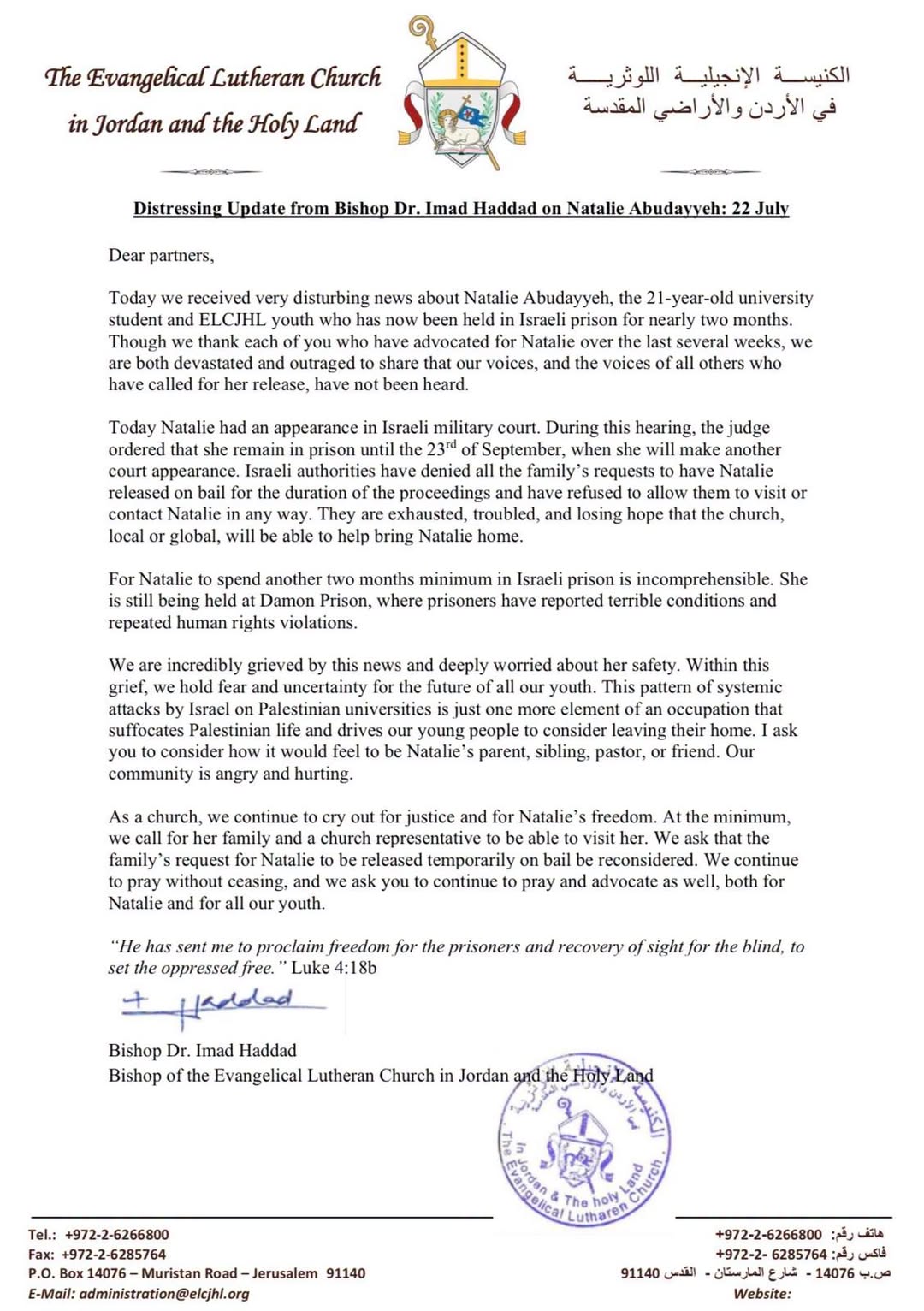
Distressing Update from Bishop Dr. Imad Haddad on Natalie Abudayyeh

Dear partners,

Today we received very disturbing news about Natalie Abudayyeh, the 21-year-old university student and ELCJHL youth who has now been held in Israeli prison for nearly two months. Though we thank each of you who have advocated for Natalie over the last several weeks, we are both devastated and outraged to share that our voices, and the voices of all others who have called for her release, have not been heard.

Today Natalie had an appearance in Israeli military court. During this hearing, the judge ordered that she remain in prison until the 23rd of September, when she will make another court appearance. Israeli authorities have denied all the family’s requests to have Natalie released on bail for the duration of the proceedings and have refused to allow them to visit or contact Natalie in any way. They are exhausted, troubled, and losing hope that the church, local or global, will be able to help bring Natalie home.

For Natalie to spend another two months minimum in Israeli prison is incomprehensible. She is still being held at Damon Prison, where prisoners have reported terrible conditions and repeated human rights violations.

We are incredibly grieved by this news and deeply worried about her safety. Within this grief, we hold fear and uncertainty for the future of all our youth. This pattern of systemic attacks by Israel on Palestinian universities is just one more element of an occupation that suffocates Palestinian life and drives our young people to consider leaving their home. I ask you to consider how it would feel to be Natalie’s parent, sibling, pastor, or friend. Our community is angry and hurting.

As a church, we continue to cry out for justice and for Natalie’s freedom. At the minimum, we call for her family and a church representative to be able to visit her. We ask that the family’s request for Natalie to be released temporarily on bail be reconsidered. We continue to pray without ceasing, and we ask you to continue to pray and advocate as well, both for Natalie and for all our youth.

“He has sent me to proclaim freedom for the prisoners and recovery of sight for the blind, to set the oppressed free.” Luke 4:18b

Bishop Dr. Imad Haddad

Bishop of the Evangelical Lutheran Church in Jordan and the Holy Land

Protecting Dignity at the End of Life

As Lutherans, we believe every person is created in God’s image and deserves compassionate care throughout every stage of life. Supporting accountability in hospice care means protecting vulnerable neighbors while ensuring that legitimate providers can continue offering comfort, dignity, and hope to patients and their families. Good public policy should both safeguard public resources and strengthen access to quality care for every Nevadan.

End-of-life care is one of the most sacred moments in a person’s life.

Nevada has paused licensing new hospice providers while state officials investigate fraud concerns and strengthen oversight of the hospice system. The goal is to protect patients, safeguard public resources, and ensure that Medicare and Medicaid dollars reach the people they are intended to serve.

As people of faith, we believe every person deserves compassionate, dignified care at the end of life. Accountability and access should go hand in hand. Strong oversight is important—but so is making sure families, especially in rural and underserved communities, can receive quality hospice care when they need it most.

This is a reminder that good public policy is about both stewardship and compassion: protecting vulnerable neighbors, supporting ethical providers, and building a healthcare system worthy of the trust Nevadans place in it.

“Bear one another’s burdens, and in this way you will fulfill the law of Christ.” — Galatians 6:2