Vote Down Ballot: Why Judicial Elections Matter in Nevada

When Nevadans vote, we usually hear the most about candidates for Congress, governor, the Legislature, city council, school board, or ballot questions. But another important part of the ballot is easy to overlook: judges.

Judges make decisions that affect people’s lives in profound ways. Courts touch families, housing, public safety, civil rights, business disputes, elections, immigration questions, child welfare, criminal cases, and the basic fairness of public systems. For many people, a courtroom is where government becomes very real and very personal.

That is why Lutheran Engagement and Advocacy in Nevada (LEAN) encourages voters to vote all the way down the ballot.

How Nevada judicial elections work

Nevada uses nonpartisan elections for its judges. Voters elect Nevada Supreme Court justices, Court of Appeals judges, and district court judges. Supreme Court justices and Court of Appeals judges are elected statewide; district court judges are elected by voters in their judicial district. These judges generally serve six-year terms.

Nevada does not use the merit-selection and retention-election system described in some states. A retention election is a yes-or-no vote on whether an appointed judge should stay in office. Nevada voters generally choose among judicial candidates in nonpartisan elections instead.

There is an appointment process when a midterm vacancy occurs on the Supreme Court, Court of Appeals, or a district court. The Nevada Commission on Judicial Selection reviews applicants and sends nominees to the governor, who appoints a judge to serve until the next general election. Voters then choose who will serve the remainder of the term. Justice court and municipal court judges are also selected locally, with election rules and terms governed by state law and, in some cases, local rules.

Judicial candidates do not run under party labels, but their races still deserve careful research. Nevada does not provide a statewide judicial retention report for voters. Look for candidate questionnaires, court and professional biographies, and nonpartisan voter guides that explain candidates’ experience and approach to the role. The Nevada Commission on Judicial Discipline handles complaints about judicial conduct; it is not a voter performance-review commission.

A Lutheran approach to public life begins with the conviction that government, at its best, can help preserve order, protect people, restrain harm, and promote a more just and peaceful society. Courts are a key part of that public trust. Judges are called to be fair, impartial, careful, honest, and attentive to the dignity of every person who comes before them.

Voting on judges is one way we take responsibility for the common good. It is a nonpartisan responsibility, too. Judicial elections are not supposed to be partisan scorecards. They are an opportunity to consider whether candidates have the ability, integrity, temperament, and fairness the role requires.

For people of faith, this is not a small concern. Scripture repeatedly calls God’s people to seek justice, protect the vulnerable, and care about whether public systems treat people fairly. When courts function well, they help uphold accountability and due process. When people cannot understand or access the legal system, the consequences can fall especially hard on low-income neighbors, immigrants, children, people with disabilities, survivors of violence, people facing eviction, and anyone without the resources to navigate a legal dispute.

That does not mean every voter will reach the same conclusion about every candidate. It does mean we should not skip this part of the ballot.

Here are a few ways to prepare:

  • Look up the judicial races on your ballot. Your ballot may include statewide appellate races and local district, justice, or municipal court races. Ballots vary by county and district.
  • Read more than a name. Review candidate questionnaires, professional backgrounds, public records, and reliable nonpartisan voter guides. Be cautious about claims that do not provide evidence or context.
  • Understand the court. Different courts handle different matters. The court’s jurisdiction can help explain the responsibilities of the office.
  • Vote all the way to the end. Judicial races often appear after offices and ballot questions that receive more attention, but these choices still matter.

LEAN does not tell voters how to vote for individual judicial candidates. We encourage every voter to take these choices seriously, seek reliable information, and consider the kind of courts Nevada needs: courts marked by fairness, integrity, competence, patience, and respect for the dignity of all people.

Our democracy depends not only on who writes the laws, but also on how those laws are interpreted and applied. Judges help determine whether people receive a fair hearing, whether rights are protected, whether power is held accountable, and whether the rule of law is carried out with wisdom and restraint.

So when your ballot arrives, do not stop early. Research the candidates. Pray, reflect, and vote with care.

Finish the ballot.

A quick guide to Nevada’s courts

Nevada’s state court system includes appellate courts and trial courts. Each court has a different role.

Nevada Supreme Court

The Nevada Supreme Court is the state’s highest court. It has seven justices, elected statewide to six-year terms in nonpartisan elections. It reviews appeals and oversees the administration of Nevada’s state court system. The court may assign some appeals to the Court of Appeals.

Nevada Court of Appeals

The Court of Appeals is Nevada’s intermediate appellate court. Its judges are elected statewide to six-year terms. The Supreme Court assigns cases to it for review. The Court of Appeals does not conduct trials; it reviews decisions made by lower courts.

District courts

District courts are Nevada’s general-jurisdiction trial courts, organized across the state’s judicial districts. They hear major civil and criminal cases, including felony cases, as well as family and juvenile matters. District court judges are elected by voters in their judicial districts to six-year terms.

Justice courts

Justice courts serve townships and handle matters within their limited jurisdiction. Depending on the case, this can include preliminary hearings in felony cases, misdemeanors, traffic matters, evictions, and small claims. Justices of the peace are elected by voters in their township to six-year terms.

Municipal courts

Municipal courts handle violations of city ordinances, including many traffic and misdemeanor matters. Municipal judges are generally elected by the city’s voters. A city ordinance or charter sets the term, and state law allows some exceptions, including a justice of the peace serving as the city’s municipal judge.

Federal and tribal courts

Federal courts are separate from Nevada’s state courts. Federal district court judges are nominated by the President and confirmed by the U.S. Senate; Article III judges generally serve during good behavior. Federal courts hear cases involving federal law and other matters within federal jurisdiction.

Tribal Nations have their own judicial systems. Tribal court authority and the kinds of cases heard vary by Nation and by the law that applies. Tribal courts are distinct from the Nevada state court system.

Filling midterm vacancies

When a vacancy occurs before the end of a term on the Nevada Supreme Court, Court of Appeals, or a district court, the Nevada Commission on Judicial Selection reviews applicants and submits nominees to the governor. The governor appoints someone to serve until the next general election. Voters then elect a judge to serve the remainder of the term. This is a temporary vacancy-filling process; it is not a retention election.

Local justice and municipal court vacancies are handled under the state laws and local rules that apply to those courts.
Where to learn more

Vote Down Ballot: Who Decides What Happens in Your Neighborhood? Your City Council.

When candidates come knocking, it is easy to think first about presidents, governors, members of Congress, or state legislators. But some elected officials who shape our daily lives serve much closer to home: mayors and city council members.

City councils make decisions about the places where we live, work, worship, shop, travel, and care for our neighbors. They shape budgets, zoning, housing, water, public safety, streets, parks, libraries, homelessness response, heat relief, development, local fees, and how residents are heard.

For people of faith, that matters. Local government is one place where love of neighbor becomes concrete.

Are city council elections partisan?

Nevada municipal elections are generally nonpartisan, meaning candidates appear on the ballot without party labels. But “nonpartisan” does not mean “without values” or “without politics.” Candidates may still have endorsements, donors, priorities, and ties to political parties or interest groups.

That means voters may need to look beyond the ballot and ask: How does this candidate understand the common good? Who is being heard? Who is being left out? How might their decisions affect renters, unhoused neighbors, elders, people with disabilities, workers, students, small businesses, and future generations?

What do city councils do?

In many Nevada cities, the mayor and council set policy while a professional city manager handles day-to-day administration. Councils may approve budgets, adopt ordinances, set priorities, make land-use decisions, and oversee key officials. The details vary by city.

Those decisions affect everyday life: whether a neighborhood has sidewalks, shade trees, bus access, affordable housing, safe parks, clean water infrastructure, public restrooms, cooling centers, emergency services, or support for people experiencing homelessness.

In Nevada, Carson City is a consolidated municipality and county, so its local government carries responsibilities that elsewhere may be handled by separate city and county governments.

Recent decisions in Reno show how much local government matters. The city chose not to renew its contract with Flock Safety, but on October 21, the City Council voted 5–2 to approve a new contract with Axon that includes license plate readers. The question for residents goes beyond which company provides the technology: it also includes privacy, oversight, public safety, and accountability.

Data center development is another local issue. Reno has paused new data center applications through August 31, 2027, or until adequate regulations are adopted. That pause gives the city time to consider rules for future development while residents continue to press for protections around issues such as water, power, noise, and public input.

Recent decisions in the City of Las Vegas show how local action can shape daily life. In July, the City Council adopted a heat mitigation element for the city’s 2050 Master Plan. It will guide future planning around shade, drinking water, cooling centers, and other protections as the city responds to extreme heat. That’s a local planning decision with direct consequences for public health and for how neighborhoods develop.

The city is also moving ahead with the Historic Westside redevelopment, planned to add 635 homes, including public and affordable housing alongside market-rate units. Decisions about what gets built, where it gets built, and whether affordability is part of the plan are local decisions, too.

These are not abstract questions. They are public decisions with consequences for real neighbors.

How often are city councils elected? Are there term limits?

Election schedules, term lengths, and term limits vary by city or town. Many local officials serve four-year terms, and elections may be staggered so that not every seat is on the ballot at once. Some councils are elected by district, some at large, and some use a combination. Check your city or town’s official election page for its rules. Nevada law and local charters set the details. CITY ELECTIONS

What makes a good city council representative?

A good representative listens, studies the issues, communicates clearly, and works for the whole community—not only the loudest voices, wealthiest donors, or most organized neighborhoods.

They are accessible, show up in the community, understand local budgets and trade-offs, respect public process, and are willing to ask hard questions. They ask not only, “What will this cost?” but also, “Who will this help? Who might be harmed? Who has not been heard?”

From a faith perspective, good local leadership pays attention to neighbors who are hungry, unhoused, elderly, disabled, isolated, underrepresented, or priced out.

Questions to ask when candidates knock

A few questions can help you understand how a candidate thinks about the community:

  1. What do you see as the top issue facing our city, and how would your approach help neighbors who are struggling most?
    Listen for whether the candidate connects policy to people’s daily lives.
  2. How will you make decisions about housing, homelessness, water, heat, transportation, and growth in a way that serves the whole community?
    These issues are connected: housing affects homelessness, water affects growth, heat affects public health, and transportation affects access to jobs, food, school, worship, and medical care.
  3. How will you stay accountable and accessible to residents after Election Day?
    Ask how they will listen, communicate, hold office hours, and include people who cannot attend long evening meetings at City Hall.

Why people of faith should pay attention

Lutherans understand civic life as one way we serve our neighbors. City councils make decisions about whether families can afford rent, elders have safe transportation, children have parks and libraries nearby, unhoused neighbors have shade and services, and public meetings are welcoming and accessible. Partisan and Non-Partisan Elections

Local races can receive less attention than statewide or national contests, even though their decisions shape daily life. Faithful voting is not about partisanship. It is about responsibility: asking good questions, listening carefully, seeking truthful information, and voting with love of neighbor and the common good in mind.

Before candidates come knocking, learn who represents you, who is running, and what your city council has decided recently. Then ask: How will your leadership help every neighbor in our city thrive?

LEAN Action Alert: Reach Your Governor About Ending the Death Penalty

Bring progress abolishing the death penalty to states which allow capital punishment.

Residents of Nevada, you live in a state, so Lutheran Engagement and Advocacy in Nevada encourages you to reach out to your Governor Lombardo urging no more state executions.

In 1972, the Supreme Court ruled federal and state penalty practices violated Eighth Amendment constitutional protections against cruel and unusual punishment. That decision reflected long-standing concerns about the historically arbitrary and discriminatory use of the death penalty, including persistent racial disparities that have disproportionately affected Black Americans. This decision was overturned in 1976, but for a moment, capital punishment was outlawed in the U.S. 

Opposition to the death penalty and support for its abolition is growing across the country with public support at its lowest level in over 50 years. Since the death penalty’s reinstatement, 14 states have abolished capital punishment either through state legislation or state supreme court decisions. New death sentences are at historically low levels, with research showing juries are less likely to select the death penalty. Governors of Calif., Pa., Ore., and Ohio, and recently Tenn. – where the death penalty remains on the books – have placed a temporary hold on executions.  

The ELCA social statement The Death Penalty reads: “The practice of the death penalty undermines any possible moral message we might want to ‘send.’ It is not fair and fails to make society better or safer. The message conveyed by an execution, reflected in the attention it receives from the public, is one of brutality and violence” (p. 4). 

Tremendous progress has been made across the U.S. toward abolishing the death penalty. However, a ban on the federal use of the death penalty does not prohibit individual states from using capital punishment. The momentum is with states to halt its use.  

If you reside in one of the 27 states where the death penalty is still utilized, urge your governor to commute the sentences for those on death row to life in prison, to place a moratorium on capital punishment during their tenure and work toward abolishing the death penalty in their state. Customize the action alert with your own words.

Contact your lawmakers today. Customize your message with your experiences and values.

Find your Member of Congress Here

Senator Catherine Cortez Mastro, 202-224-3542, https://www.cortezmasto.senate.gov/

Senator Jackie Rosen, 202-224-6244, https://www.rosen.senate.gov/

Rep. Dina Titus, (202)-225-5965, https://titus.house.gov/

Rep. Mark Amodei, (202)-225-6155, https://amodei.house.gov/

Rep. Susie Lee, (202)-225-3252, https://susielee.house.gov/

Rep Steven Horsford, (202)-225-9894, https://horsford.house.gov/

If you would like to schedule time with your legislator, please reach out to Pastor Paul,and he is willing to work with ELCA Advocacy Partners to secure a time.

Act Now!

ELCA Action Alert: Urge Support of the Federal Death Penalty Prohibition Act


World Day Against the Death Penalty
 is observed annually on Oct. 10. Rooted in God’s intention for a just society and in faithful response to the call of Jesus to mercy and reconciliation, the ELCA teaches that the death penalty undermines the sacredness of life and human dignity by perpetuating cycles of violence and injustice. Urge your lawmakers to support the Federal Death Penalty Prohibition Act (H.R.8940/S.4608) to end the federal use of capital punishment. 

The ELCA social statement The Death Penalty calls Christians to pursue restorative justice that seeks healing, accountability, reconciliation, and the possibility of transformation for both victims and offenders. Rather than relying on retribution ELCA social teaching emphasizes:

  • Seeking restorative justice, following the example of Jesus in Matthew 5:38-39 and John 8:3-11, and through our ministries with people affected by violent crime.
  • Acknowledging the historic and ongoing injustices that render the death penalty incapable of being justly administered.
  • Recognizing that the death penalty has failed to deter violence or make society safer, and by continuing its use, we send a message of brutality and perpetual violence.

While the ELCA teaches that the state’s responsibility under God is to protect citizens and maintain justice, this does not mean governments have an unchecked right to take life. Bipartisan opposition to the death penalty has grown, and public support for the death penalty is at its lowest in over 50 years. Now is the time to end the use of the federal death penalty in the United States.

Urge your lawmakers to uphold the values of mercy, accountability and human dignity by supporting the Federal Death Penalty Prohibition Act. Customize the Action Alert with your own words.

Contact your lawmakers today. Customize your message with your experiences and values.

Find your Member of Congress Here

Senator Catherine Cortez Mastro, 202-224-3542, https://www.cortezmasto.senate.gov/

Senator Jackie Rosen, 202-224-6244, https://www.rosen.senate.gov/

Rep. Dina Titus, (202)-225-5965, https://titus.house.gov/

Rep. Mark Amodei, (202)-225-6155, https://amodei.house.gov/

Rep. Susie Lee, (202)-225-3252, https://susielee.house.gov/

Rep Steven Horsford, (202)-225-9894, https://horsford.house.gov/

If you would like to schedule time with your legislator, please reach out to Pastor Paul,and he is willing to work with ELCA Advocacy Partners to secure a time.

Act Now!

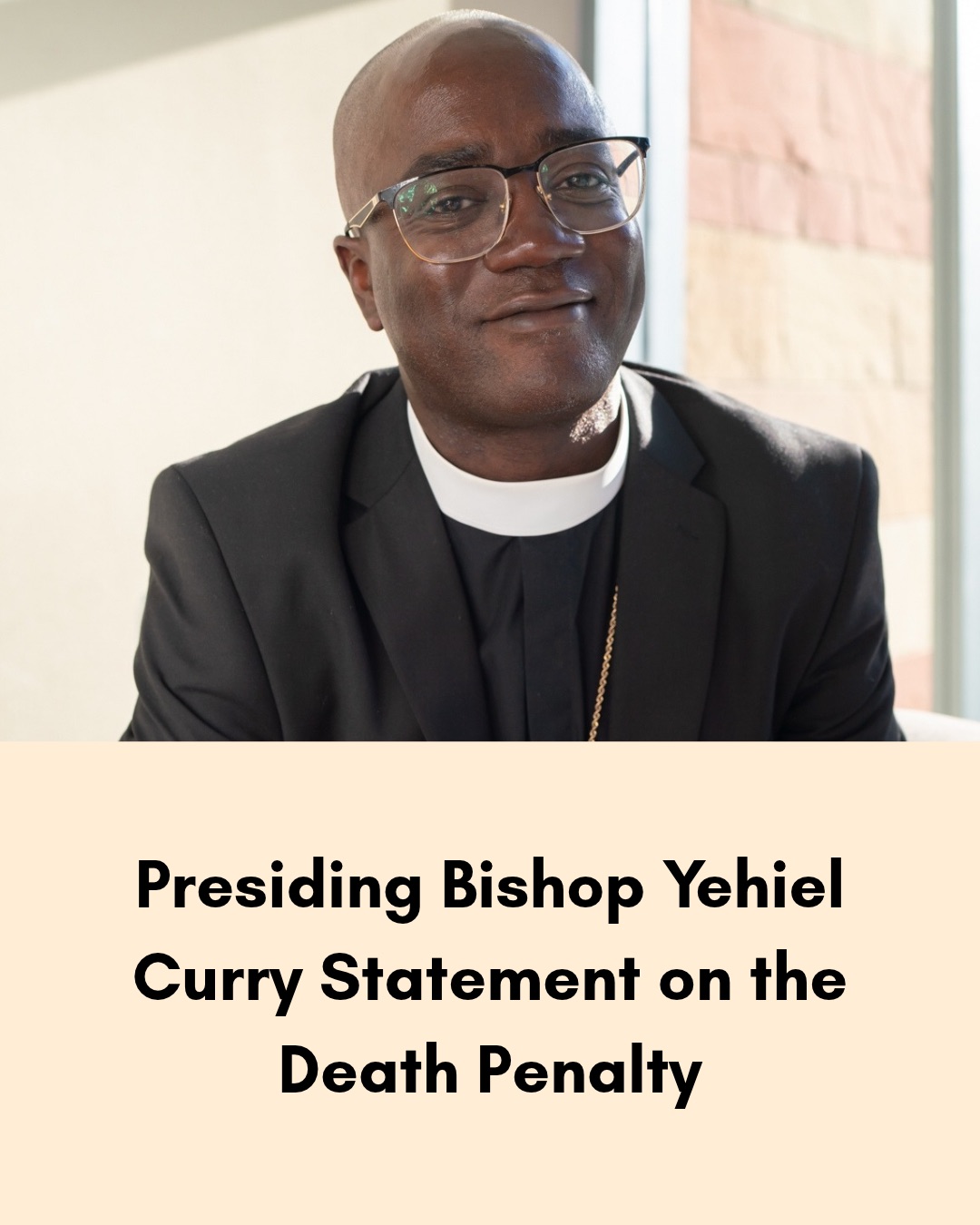
Presiding Bishop Yehiel Curry Statement on the Death Penalty

A message from Presiding Bishop Yehiel Curry:

Dear church,

My heart was troubled by the recent proposal to livestream an execution in the United States.  I am thankful that this plan has now been cancelled. The deliberate taking of a human life should never become a public spectacle. Such actions risk deepening the wounds of victims’ families, loved ones and communities while further desensitizing us to violence. Our society is diminished when violence is conflated with entertainment. Because of our ministry of reconciliation (2 Corinthians 5:16-21), this church opposes the death penalty and the recent plans for public display of the execution of Nidal Hasan.

As a church, we are not strangers to the mournful effects of violent crime. Our congregations minister to victims, to offenders and to communities that experience the ripple effects of its trauma. We recognize the need to protect people from violence, to call perpetrators to repentance, and to seek restoration for victims. United in our resistance to hate and in our joy over the good news of God’s grace, we minister to an often-vengeful society with words and actions of hope, justice and healing.

The 1991 ELCA Churchwide Assembly adopted the social statement The Death Penalty, demonstrating this church’s early opposition to capital punishment. That opposition is grounded in a long tradition of Christian theology and teaching. The social statement calls the church “to respond to violent crime in the restorative way taught by Jesus (Matthew 5:38-39) and shown by his actions (John 8:3-11).” It states that the death penalty’s continued use perpetuates cycles of violence, undermines the possibility of repentance and restoration, and binds our society more deeply to brutality rather than reconciliation. It fosters suffering rather than ends it, as we saw in the attempted execution of Christa Pike.

The statement affirms that God ordains government to be a source and guarantor of safety and justice. Abundant research shows that the death penalty does not give us safety or justice. It does not provide healing to victims’ families or safety for the broader community. It does not deter future crimes. It does not serve the ends God calls government to serve, nor does it reflect the kind of society we are called to be.

We hold in prayer all who are impacted by violent crime, including victims, families, workers in law enforcement and corrections, and those accused or convicted of violent crimes. We give thanks for prison chaplains and ministries that accompany people through suffering and that witness to the possibility of redemption.

I invite you to talk with people in your community about the death penalty. Let our churches continue to be spaces for respectful, faithful dialogue about moral issues. Study the ELCA’s social statements The Death Penalty and The Church and Criminal Justice: Hearing the Cries together. Be part of the whole church’s witness in society to urge public officials to work toward abolishing the death penalty, including support for the Federal Death Penalty Prohibition Act. Together let us build a society that keeps us safe from violence, reflects God’s compassion, honors the dignity of every person and demonstrates that God is always working for and toward abundant life..

In Christ, 


The Rev. Yehiel Curry

Presiding Bishop
Evangelical Lutheran Church in America