ELCA congregations are being encouraged to observe “Creation in Christ” (or “Feast of Creation”) beginning September 1 or the Sunday following. Rooted in ecumenical collaboration and ancient Christian tradition, the observance celebrates Christ’s role in creation while inviting deeper care for the world God has made.
Worship resources, lectionary texts, and planning guidance are beginning to emerge as congregations discern how this observance may fit in their local context. Read More About “Creation in Christ.”
Looking for a meaningful Bible study for your congregation? Conscience and Conversation: A Study During the Reconsideration of the Social Statement Human Sexuality: Gift and Trust invites participants to explore how we navigate agreement and disagreement as a church seeking to pursue justice, peace, and “the unity of the Spirit” (Ephesians 4:3).
Designed for congregational use, each session includes prayers, hymns, Scripture readings, and discussion questions. Participants are also invited to share their reflections directly with the task force through an included survey, helping shape the ongoing conversation across the ELCA. Learn more HERE!
The only facility providing comprehensive cancer care and access to top-tier medical treatment to Palestinians, Augusta Victoria Hospital, needs crucial funding. Learn more by visiting the ELCA Action Center or going to the Action Alert linked in the comment below.
The East Jerusalem Hospital Network (EJHN) includes Augusta Victoria Hospital (AVH), a ministry of the Lutheran World Federation, and five other hospitals in the East Jerusalem area. This network has long been the backbone of the Palestinian healthcare system, providing essential tertiary care, specialized treatments and training for health professionals that are otherwise inaccessible to Palestinians in Gaza and the West Bank. They are critical in addressing the medical needs of Palestinian patients. Currently, AVH is treating on average 150 cancer patients a day.
As the ELCA, we strongly urge Congress to continue its almost 15-year bipartisan tradition of generosity in supporting the EJHN including AVH. At this pivotal moment in Palestine and Israel, following so much destruction, funding is crucial to support the only facility that provides comprehensive cancer care to Palestinians and their only access to top-tier medical treatment due to the many security constraints placed upon the Palestinian people. Significant support for the EJHN from other institutions and governments is urgently needed.
Our advocacy is a response to God’s call to care for the vulnerable and the aid those in need. Add your voice to support paths that lead to peace.
Contact your lawmakers today. Customize your message with your experiences and values.
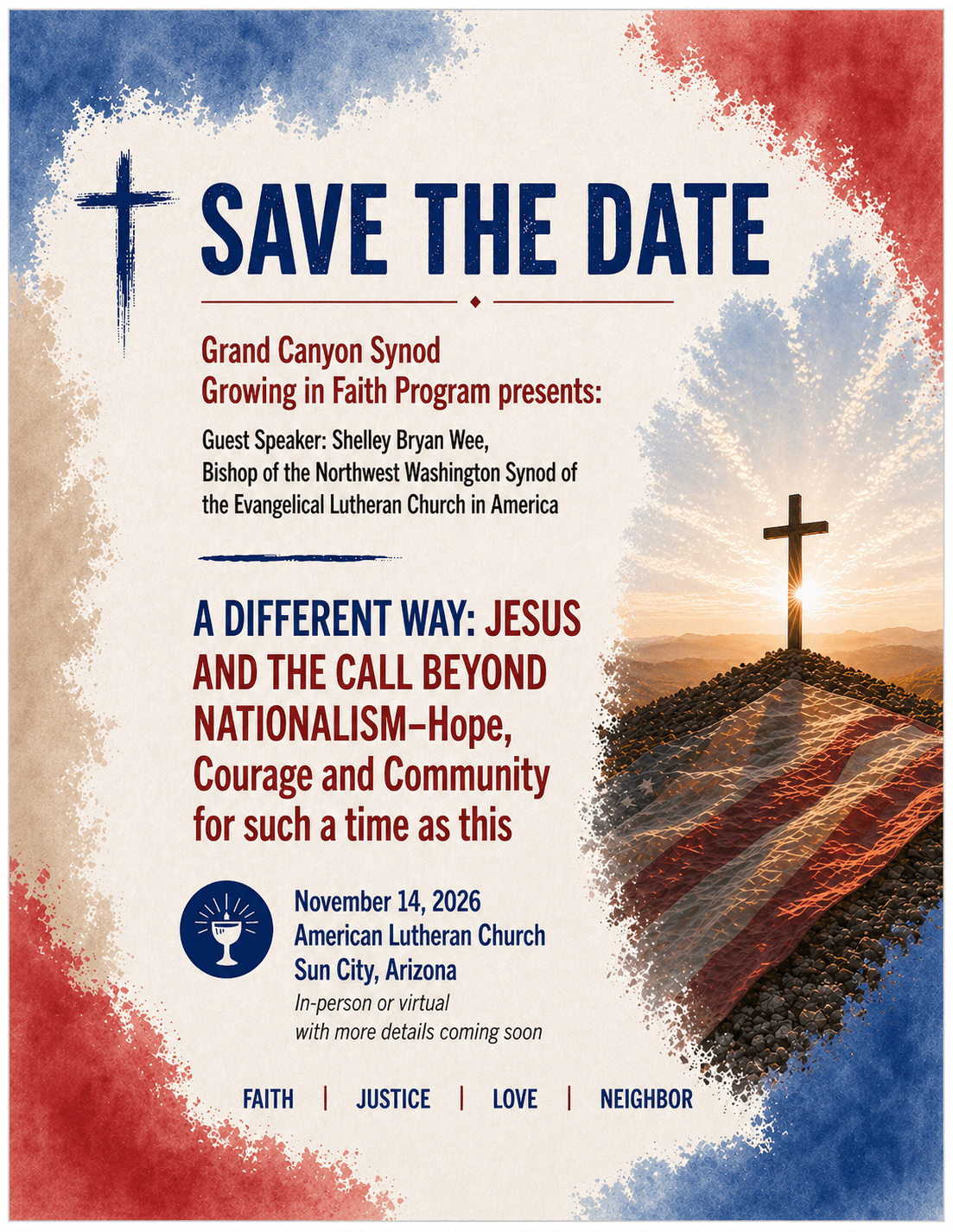
SAVE THE DATE: GROWING IN FAITH PROGRAM TO HOST CHRISTIAN NATIONALISM SYMPOSIUM NOV. 14
The Grand Canyon Synod’s Growing in Faith Program will host a special symposium this fall exploring faithful Christian witness in a time of division, fear and rising nationalism.
The event, titled “A Different Way: Jesus and the Call Beyond Nationalism — Hope, Courage and Community for Such a Time as This,” will take place on Saturday, Nov. 14, 2026, at American Lutheran Church in Sun City, Arizona, with both in-person and virtual participation options available. Additional details and registration information will be shared in the coming months.
The symposium’s featured speaker will be Bishop Shelley Bryan Wee of the Northwest Washington Synod. Bishop Wee is widely known throughout the ELCA for her thoughtful leadership, clear theological voice and commitment to justice, reconciliation and faithful public witness.
As followers of Jesus, Lutherans are called to place our ultimate trust not in political movements or national identity, but in Christ’s call to love God and neighbor. This symposium will invite participants into faithful conversation about Christian nationalism, discipleship, courage, community and hope in challenging times.
The Growing in Faith Program and Diakonia ministries continue to provide opportunities for learning, formation and theological reflection across the synod. This event is designed for rostered ministers, lay leaders and anyone seeking deeper grounding in Lutheran theology and public discipleship.
Please mark your calendars now and watch for additional information on registration, schedule details and participation opportunities later this year.
 Lutheran Engagement and Advocacy in Nevada