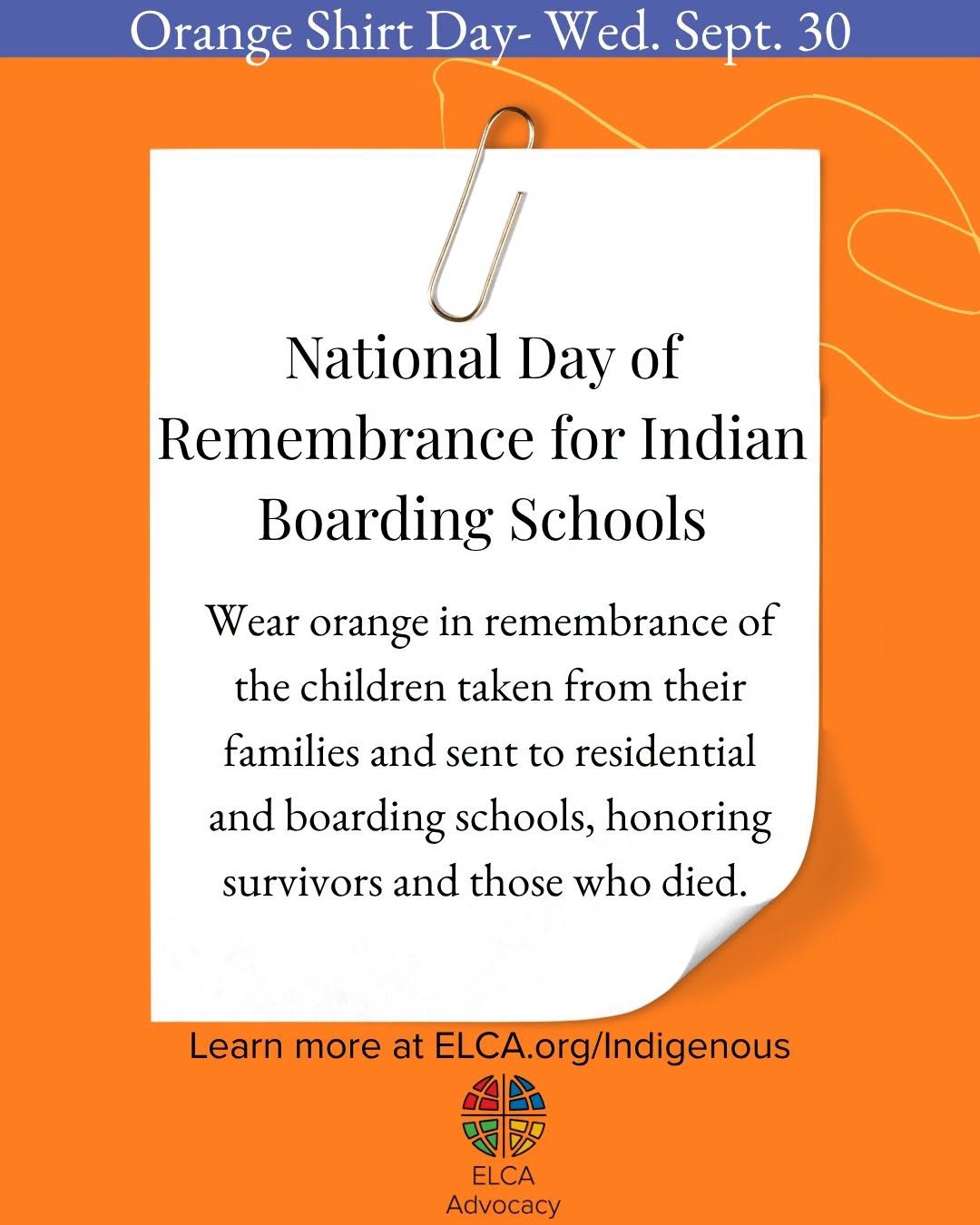
Wear orange on September 30, the National Day of Remembrance for Indian Boarding Schools, to remember the children taken from their families, honor survivors, and acknowledge the ongoing work of healing. Learn more at ELCA.org/Indigenous
Wear orange on September 30, the National Day of Remembrance for Indian Boarding Schools, to remember the children taken from their families, honor survivors, and acknowledge the ongoing work of healing. Learn more at ELCA.org/Indigenous
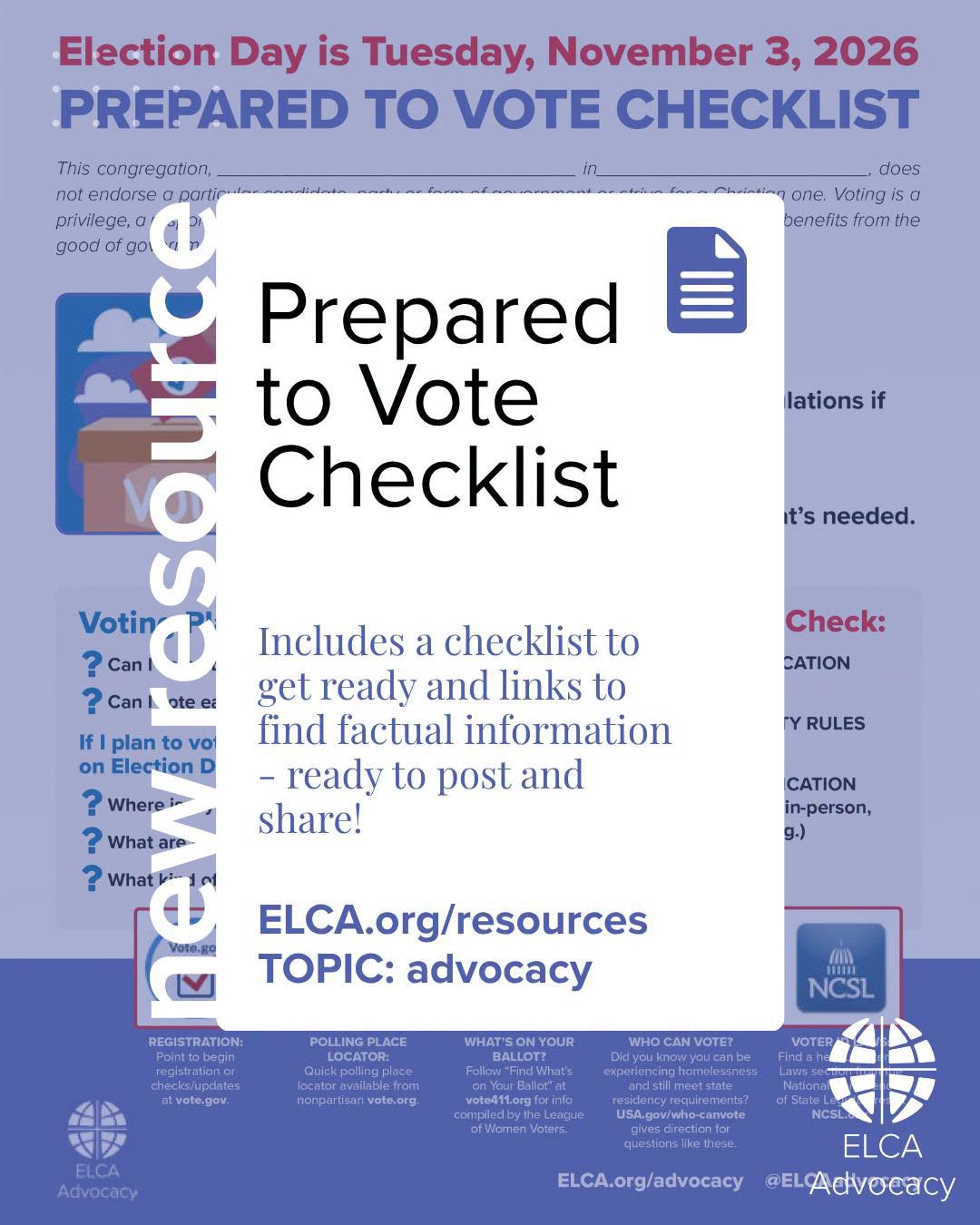
Help everyone get ready for Election Day! Available in English and Spanish, post a “Prepared to Vote Checklist” in your congregation’s lobby or other public space – and even leave a stack for people to share! Find the checklists linked here.

LAMA and the Lutheran Engagement and Advocacy Network invite Grand Canyon Synod hunger leaders, Sierra Pacific Synod hunger leaders, LAMA liaisons, ELCA churchwide hunger leaders, pastors, deacons, congregational advocates, and ministry partners to a special Hunger Leaders Meeting on Tuesday, September 29, 2026, at 6:00 p.m. Arizona time. This month’s theme is “Mercy and Compassion Merging for Hunger Justice,” and the evening will bring together churchwide voices, synod leaders, food-bank partners, congregational advocates, and state public-policy leaders for a focused conversation on hunger, faith, and action.
This special gathering reflects the truth that hunger does not stop at state lines — and neither does our Lutheran public witness. Across Arizona, California, Nevada, and beyond, congregations are responding to food insecurity through mercy ministries, food pantries, community partnerships, advocacy, voter engagement, and public-policy work. On Sept. 29, we will gather to connect those efforts, learn from one another, and act together for hunger justice.
We will hear from Bishop Deborah Hutterer of the Grand Canyon Synod and Bishop Jeff Johnson of the Sierra Pacific Synod, who will help frame the conversation for this shared regional gathering. We will also welcome Milt Liu, CEO of St. Mary’s Food Bank, who will speak about what is happening with SNAP and food insecurity from the perspective of the first food bank in the country.
The meeting will also feature Pr. Steve Holm, who will share practical advocacy wisdom from his journey “From a Hunger Jar to fighting for World Hunger,” and Pr. Nelson Rabell of Iglesia Luterana Santa Maria Peregrina in Stockton, California, who will share a Get Out the Vote video from the Sierra Pacific Synod.
Besides these guest speakers, we will spend time asking what we can do to advocate for hunger justice in our own states, sharing updated resources, and taking immediate action together by signing a letter to the governor of each participant’s state. This is designed to be more than an information session — it is a chance to connect faith, hunger ministry, civic participation, and public witness in a concrete way.
All are welcome, whether you are already leading a congregational hunger ministry, serving in a food pantry, participating as a LAMA liaison, working with ELCA World Hunger, learning about SNAP and food policy, or simply wondering how people of faith can respond faithfully to hunger in this moment.
Special GCS Hunger Leaders Meeting
Tuesday, September 29, 2026
6:00 p.m. Arizona Time
Zoom Meeting ID: 874 3817 1116
Come ready to listen, learn, pray, and act for hunger justice — until all are fed.
The Grand Canyon Synod Hunger Leaders Network invites Lutherans and hunger advocates in Arizona, Nevada, and California to add their names to a regional sign-on letter urging our governors to take stronger action against hunger.
The action is simple: follow the link, choose your state, and sign the letter to your governor. Participants from Arizona, Nevada, and California will each see a letter focused on hunger concerns in their own state — from SNAP access and food bank capacity to school meals, senior nutrition, rural food access, and the rising cost of basic needs.
Sign the letter here: https://forms.gle/JHsw9eVy8cFKPzMv7
As people of faith, we believe every neighbor deserves enough nutritious food to live with dignity. Lutheran congregations and partners across our region serve through food pantries, community meals, school and summer food programs, senior nutrition, refugee and immigrant ministries, and advocacy for stronger public policy. But charity alone cannot meet the scale of hunger our neighbors are facing. Public leadership matters.
This sign-on letter is also the call to action for the Hunger Leaders Network’s special online education event on Tuesday, September 29, 2026, at 6:00 p.m. Arizona Time. The meeting will feature:
During the gathering, participants will learn more about hunger, food assistance, and faithful advocacy in our three-state region — and then take action together by signing the governor letter while still online.
All are welcome to attend, whether you are part of a congregation, hunger ministry, food pantry, advocacy team, or simply care about neighbors who are struggling to afford food.
Hunger Leaders Network Meeting
Tuesday, September 29, 2026
6:00 p.m. Arizona Time
Zoom Meeting: 874 3817 1116
Take action now: https://forms.gle/JHsw9eVy8cFKPzMv7
Together, Lutherans across Arizona, Nevada, and California can lift a faithful regional voice for hunger justice — and remind our governors that people of faith are watching, praying, serving, and asking for action.
During the Hawk Fire, Washoe County officials believed emergency alerts were reaching local radio and television stations. They were not. The county reportedly did not learn about the failure until KUNR investigated weeks later. The incident is a serious reminder: during a fast-moving wildfire, we cannot depend on one alert, one app, or one communication system.
After the Hawk Fire, it got me thinking about St. Paul’s and Carson City’s vulnerabilities. Disaster preparedness is part of creation care, and part of our call to love and protect our neighbors.
WHAT SHOULD CONGREGATIONS PLAN FOR?
1. Know how warnings will be received
2. Create a communication tree
Decide who will contact:
Keep printed contact lists available in case internet or cloud-based systems are unavailable.
3. Make an evacuation plan
Congregations should identify:
Practice the plan before it is needed.
4. Plan for people who need additional help
Ask now:
Preparedness must include everyone—not only people with smartphones, vehicles, money, and flexible schedules.
5. Prepare the building
Congregations should maintain:
Churches considering serving as shelters, cooling centers, smoke-relief spaces, or supply-distribution sites should coordinate with emergency officials before a disaster.
6. Protect important information
Keep secure backups of:
Congregations should also know who has authority to make decisions if the pastor, council president, or property leader is unavailable.
7. Build community partnerships now
Introduce your congregation to local emergency managers, fire officials, nonprofits, food banks, disability advocates, and neighboring faith communities.
A congregation should know both what it can offer and where it must refer people for professional assistance.
WHAT SHOULD PUBLIC POLICY PROVIDE?
Preparedness cannot rest entirely on individual households or congregations. LEAN supports:
When systems fail, the people with the fewest resources often face the greatest danger.
Faith communities can prepare, communicate, and care for their neighbors—but government remains responsible for maintaining dependable public-safety infrastructure.
Preparedness is not fear. It is faithful care.
Make the plan. Practice the plan. Check on your neighbor.
Read KUNR’s reporting: https://www.kunr.org/local-stories/2026-09-18/hawk-fire-alert-failure

