August Recess: Your Voice. Your Story Matter.

August recess brings Nevada’s members of Congress home, creating one of the year’s best opportunities to speak with them at town halls, community events, district offices and congregational visits.

You do not need to be a policy expert or deliver a lengthy presentation. Introduce yourself as a constituent and person of faith, briefly explain what you are seeing in your community, and make one clear request.

Here are three messages you can use or personalize—each in fewer than 100 words.

Protect Nevadans from hunger

I am your constituent and a Lutheran who believes no neighbor should go hungry. Nevada food banks and congregations are already seeing families struggle with high food, housing and utility costs. Please protect and strengthen SNAP, support efforts to restore food assistance, and oppose further barriers that take food assistance away from children, older adults, veterans and working families. Charitable food ministries cannot replace an effective federal nutrition program. What will you do to protect SNAP and ensure Nevada families can put food on the table?

No Nevada member currently serves on a congressional agriculture committee, but every member will ultimately have a voice in Farm Bill and federal funding decisions affecting SNAP. Contact both senators and your own representative.

Invest in affordable housing and protection from extreme heat

I am your constituent and a person of faith concerned about Nevada neighbors facing homelessness, unaffordable rents and deadly heat. Please protect federal investments in rental assistance, affordable housing, homelessness services, cooling assistance and community heat resilience. Nevada congregations and nonprofit organizations serve people in crisis every day, but charitable ministries cannot meet this need alone. Stable housing and protection from extreme heat are matters of human dignity and public health. Will you support strong federal housing and heat-response funding in this year’s appropriations bills?

Several members of Nevada’s delegation are particularly well positioned on these issues. Sen. Catherine Cortez Masto serves on the Senate Banking, Housing and Urban Affairs Committee and the Energy and Natural Resources Committee. Rep. Dina Titus serves on the House Transportation and Infrastructure Committee, including the Subcommittee on Economic Development, Public Buildings and Emergency Management. Rep. Mark Amodei serves on the House Appropriations Committee.

But housing affordability and extreme heat affect communities across Nevada, so every member of our delegation needs to hear from constituents.

Uphold dignity and due process in immigration policy

I am your constituent and a Lutheran called to welcome the stranger and protect human dignity. Nevada needs an immigration system that keeps communities safe while preserving asylum, due process and family unity. Please oppose inhumane detention conditions and indiscriminate enforcement that separates families, disrupts congregations and leaves longtime community members living in fear. Congress should provide meaningful oversight of ICE and Customs and Border Protection and pursue workable, humane immigration reform. What will you do to ensure that federal immigration policy reflects both accountability and respect for every person?

Immigration policy directly affects Nevada congregations, communities and mixed-status families. Rep. Mark Amodei is especially important to contact because he chairs the House Appropriations Subcommittee on Homeland Security, which has responsibility for funding the Department of Homeland Security.

But immigration policy is ultimately the responsibility of the entire Congress. Every Nevada senator and representative should hear from constituents about the kind of immigration system we want our nation to build.

Your story is the most important part

Choose the issue closest to your experience and add one sentence about a family, food pantry, cooling center, shelter, school or congregation you know.

You might say:

“At our congregation, we are seeing more families asking for help with groceries.”

Or:

“Our congregation serves neighbors experiencing homelessness during periods of extreme heat.”

Or:

“People in our community are afraid that seeking help or simply going to work could separate them from their families.”

A short, personal message with a clear request is often more memorable than a long list of statistics.

Nevada Congressional Delegation

Nevada is represented by Senators Catherine Cortez Masto and Jacky Rosen and four members of the U.S. House representing Nevada’s four congressional districts.

Contact both senators and the representative for your congressional district. Then visit Lutheran Engagement and Advocacy in Nevada (LEAN) for guidance on requesting a meeting, inviting a member of Congress to visit your ministry, or preparing to attend a town hall.

Faithful advocacy is not about party loyalty. It is about bringing our neighbors’ experiences into the public square and asking those who represent us to seek the well-being of all.

This August, tell your story. Ask the question. Make the invitation.

Our elected officials need to hear from people of faith—and they need to hear what is happening in our Nevada communities.

Voting Rights Act of 1965: The Struggle Continues

The Voting Rights Act of 1965 was one of the most consequential civil rights laws in our nation’s history.

It was enacted because, for generations, Black Americans and other communities of color were systematically denied access to the ballot through poll taxes, literacy tests, intimidation, discriminatory district maps, and countless other barriers.

The Voting Rights Act said clearly: the right to vote cannot depend on the color of your skin.

For decades, one of the law’s strongest protections was preclearance. States and local governments with histories of voting discrimination had to receive federal approval before changing certain voting laws or procedures.

But over the last 13 years, several Supreme Court decisions have significantly weakened the Voting Rights Act.

In Shelby County v. Holder (2013), the Supreme Court effectively ended the preclearance system by striking down the formula that determined which jurisdictions were covered.

That fundamentally shifted the burden.

Instead of stopping discriminatory voting changes before they could harm voters, communities increasingly had to challenge those laws after they went into effect.≤m./

op÷≥k the Court made certain challenges to voting restrictions under Section 2 of the Voting Rights Act more difficult.

And this year, the Supreme Court went further.

In Louisiana v. Callais (2026), the Court significantly narrowed how Section 2 applies to redistricting. The majority held that Section 2 liability requires circumstances creating a strong inference of intentional racial discrimination.

The Voting Rights Act still exists.

But some of the strongest tools created to prevent and remedy racial discrimination in voting have been significantly weakened.

Why should people of faith care?

Because voting is not simply about politics.

Voting is one way our neighbors participate in shaping our common life together.

The people we elect make decisions about whether families have food, whether children have strong schools, whether people can access health care, whether housing is affordable, how we care for God’s creation, how immigrants and refugees are treated, and whether every person can participate fully in our democracy.

The ELCA calls Lutherans into civic life not as partisans, but as people committed to our neighbors and the common good.

And here in Nevada, voting access is not an abstract issue.

Tribal communities, rural voters, naturalized citizens, students, older adults, people with disabilities, low-income voters, people without reliable transportation, and neighbors whose names or addresses have changed can encounter very different barriers to participating in our elections.

When the Voting Rights Act becomes weaker, preventing and remedying discrimination can become harder.

For Lutheran Engagement and Advocacy in Nevada, the question is not which political party benefits.

The question is:

Can every eligible neighbor participate in our democracy freely, safely, fairly, and with dignity?

Election security and voting access do not have to be competing values. A healthy democracy requires both.

As people of faith, we can help.

We can share accurate, nonpartisan election information.

We can help neighbors check their voter registration.

We can support accessible polling places and voting options.

We can volunteer as poll workers and with nonpartisan voter-protection efforts.

We can listen to Tribal communities and other communities that have historically experienced barriers to the ballot.

And we can advocate when public policies make it harder for eligible voters to participate.

Sixty-one years after the Voting Rights Act became law, its promise remains unfinished.

But weakening the law does not mean that people of faith are powerless.

We can organize.
We can educate.
We can accompany.
We can advocate.

And we can continue to proclaim something fundamental to our Lutheran understanding of public life:

Our neighbor’s voice matters.

Re-Volv Solar Info Session

Are you interested in bringing solar power to your church? 

What if you could install solar panels for less than the cost of your current electricity bill?

Join RE-volv and our Synod Disaster Preparedness Community Organizers for a free informational Zoom session to learn how churches can save money and be better environmental stewards by leasing solar panels from nonprofit RE-volv, with no money down, and no ongoing maintenance obligations. 

Sign up HERE to join the Zoom meeting on Tuesday, August 18 

at 2 pm. If you can’t attend at that time, please still sign up so we know to email you the recording. 

Questions? Email Jamie at jamie@spselca.org.

LEAN INTO 2026: Statewide Race Guide

As we approach the 2026 General Election, Lutheran Engagement and Advocacy in Nevada wants to help Lutherans across our state become informed and faithful participants in our democracy.

Over the coming weeks, we will be taking time to look at the candidates running for Nevada’s statewide constitutional offices and their publicly stated positions on issues addressed by ELCA Social Statements, Social Messages, and other adopted church teaching.

This is not an endorsement of any candidate or political party.

Instead, our goal is to provide a resource that allows Lutherans to ask deeper questions:

The ELCA has adopted social teaching addressing many of the issues facing Nevada today, including:

Economic life and poverty

Economic dignity:

What responsibility does Nevada have to ensure that economic growth benefits everyone, not simply businesses and those who already have economic security? The ELCA’s Sufficient, Sustainable Livelihood for All calls for economic activity that advances human well-being, pays particular attention to people experiencing poverty, and remains sustainable for future generations. 

Housing:

Is housing primarily a market commodity, or does government have a responsibility to ensure that people can obtain safe and affordable shelter? LEAN believes secure housing is foundational to people’s ability to access employment, health care, education, and other necessities. 

Education:

What does Nevada owe its children regardless of their ZIP code, family income, or background? ELCA teaching calls for broad access to high-quality education and specifically supports equitable, sufficient, and effective funding for public schools. 

Creation, energy, and data centers:

Who should bear the costs of Nevada’s economic development? As data centers increase demands on electricity, water, and land, Lutheran teaching invites us to consider not only economic growth but sustainability, environmental justice, and our responsibility to future generations.

Democracy:

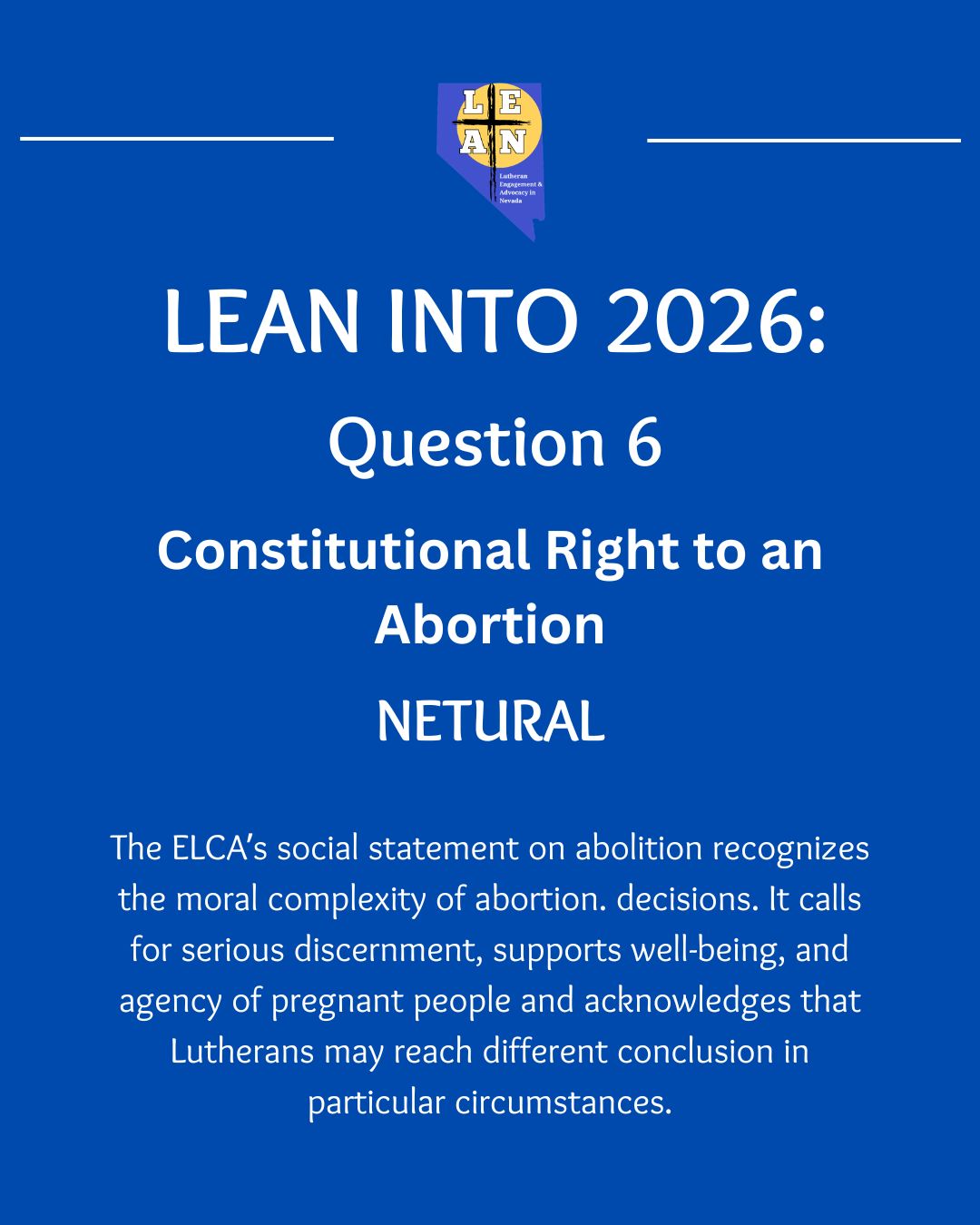
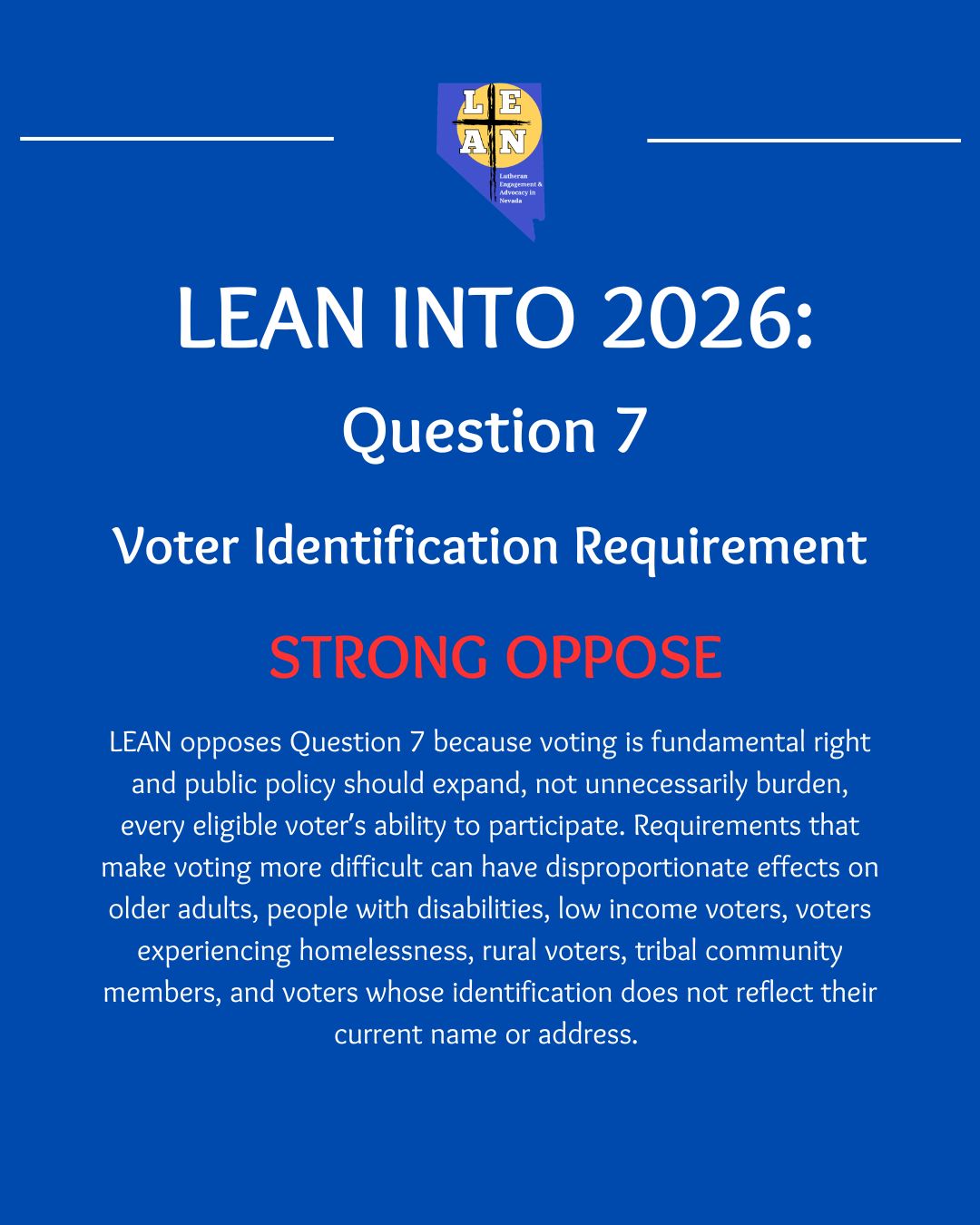
Should voting policy emphasize additional safeguards against potential fraud, greater access to the ballot, or some combination of both? How do we protect confidence in elections while ensuring eligible Nevadans can participate? Lutherans are called to energetic civic participation and understand that good government as something intended to serve the well-being of all. 

Criminal justice:

What is the purpose of Nevada’s criminal justice system, punishment, public safety, rehabilitation, restoration, or some combination? And how should concerns about racial and economic disparities shape those decisions? These are questions that can be examined through the ELCA’s social teaching on criminal justice, human rights, and human dignity.

We will look at candidates for Governor, Lieutenant Governor, Attorney General, Secretary of State, Treasurer, and Controller, using candidates’ own websites, public statements, voting records when applicable, and other reliable sources.

We will also connect those positions directly to relevant ELCA Social Statements and Messages.

Our purpose is not to tell you who to vote for.

Our purpose is to encourage all of us to think faithfully about how our Lutheran understanding of neighbor, justice, human dignity, creation, and the common good accompanies us into public life.

Faith does not give us a partisan checklist. It does call us to love our neighbor, seek justice, protect those who are vulnerable, and participate responsibly in the communities we share.

As Lutherans, we are called to be engaged.

As Nevadans, we have a responsibility to be informed.

And as voters, we have the opportunity to ask what our choices mean for our neighbors.

Myth vs. Fact: Elections

Elections can bring a lot of noise, confusion, and misinformation. That’s why voter education matters.

At Lutheran Engagement and Advocacy in Nevada (LEAN), we believe faithful civic engagement begins with truth, patience, and participation.

Over the coming weeks, we’ll be sharing an “Election Myth vs. Fact” series focused on:
• Mail Voting
• Voter ID
• Ballot Counting
• Election Security

Our goal is simple: provide calm, factual, and nonpartisan information to help Nevadans better understand how our elections work.

Healthy democracy depends on informed communities, respectful dialogue, and people who continue showing up for one another, even when we disagree.

Because democracy is not just something we inherit.
It’s something we practice together.