Nevada is not an afterthought in national elections. We are a state where turnout, organizing, and faith-based engagement have shaped real outcomes.
National leaders are investing heavily here because they know what we already know: when Nevadans organize, elections shift.
Faith communities across Nevada have been part of that story. Congregations have hosted voter education forums, encouraged civic participation, and helped build cultures of engagement that last far beyond a single election cycle.
Our state is competitive because our communities are engaged.
That did not happen by accident. It happened because people kept showing up.
And we are doing it again.
Do you want to make an impact in the 2026 Nevada midterm elections?
Reach out to LEAN with the subject line Voter Education, and Pastor Paul will help coordinate with your congregation, county officials, and the Secretary of State’s office to host a voter education forum.
Now more than ever, we need trusted community spaces that strengthen confidence in our election system and encourage full participation in our democracy. Please vote.
Our planet is an amazing place, but it needs our help to thrive. That’s why each year on April 22, more than a billion people celebrate Earth Day. Earth Day is an annual event celebrated on April 22nd worldwide.
Earth Day 2026 affirms that environmental progress is real, resilient, and ongoing despite policy uncertainty. Innovation, education, and community problem-solving remain durable. Local systems — cities, schools, Tribal nations — continue implementing solutions that strengthen energy reliability, conserve resources, and reduce risk because they’re grounded in economic sense and public safety.
The theme for Earth Day 2026 remains Our Power, Our Planet, but its application reflects current global economic, environmental, and civic conditions.
In 2026, Our Power. Our Planet. refers to the role of people and communities worldwide in sustaining environmental protections that affect the cost of living, public health, infrastructure reliability, and long-term stability. Environmental conditions influence food systems, water availability, energy access, disaster risk, and economic resilience across all regions. Community participation has historically shaped these outcomes across countries and political systems.
Since the first Earth Day in 1970, civic action has helped establish and strengthen environmental institutions, laws, and international norms. These measures have been associated with reductions in pollution-related illness, improved access to clean water, and long-term public health and economic benefits in many parts of the world.
Earth Day 2026 calls on communities worldwide to take action during Earth Week to support clean air, clean water, clean energy, protected natural resources, and climate stability. These factors are directly linked to human health, economic predictability, food security, and cross-border infrastructure performance.
TAKE ACTION: Educate. Advocate. Mobilize. Pledge.
52 Ways to Invest in Our Planet
Every day is Earth Day! If this is how you feel, here are 52 actions and tips to make a difference, every day of the year.
“Jesus said, ‘Let the children come to me, and do not stop them, for it is to such as these that the kingdom of heaven belongs’” (Matthew 19:14).
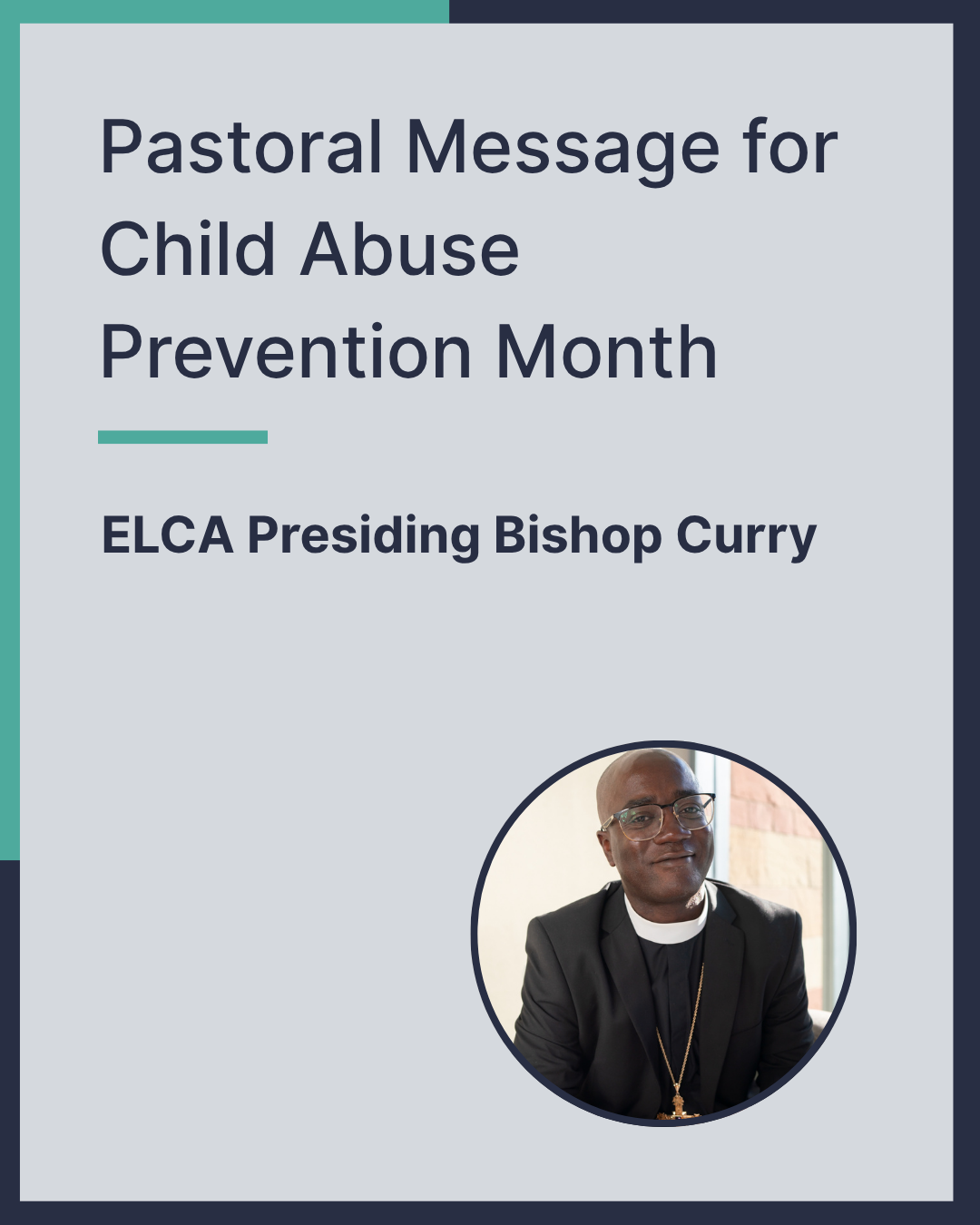
Dear church,
Christ is risen!
This Easter Sunday, we celebrated the good news by proclaiming “Alleluia!” for the first time since Ash Wednesday. In four short syllables, that word — “Alleluia!” — encompasses all our joy in the resurrection of Jesus Christ. To a world beset by fear and violence, it is a bold declaration of faith in God’s promise that sin and death will not have the final say.
Yet there are times when “alleluia” springs forth not as a shout but as an anguished whisper, an expression of our yearning for the fulfillment of that promise. Even as the church celebrates Easter, we remember many among us who still long for the church to bear witness to that promise.
April is National Child Abuse Prevention Month. This month, I invite us as a church to be the people we are called to be — witnesses to God’s desire for the well-being of all, especially the vulnerable children and adult survivors in our midst.
At least 1 in 7 — and as many as 1 in 4 — children in the United States experiences abuse or neglect. Many of them will face lifelong consequences of physical and emotional trauma, including higher rates of depression, thoughts of suicide, substance abuse, and even cancer and heart disease. When the church has failed them, many others will face the deep spiritual trauma of guilt and of anger toward the church and God.
But it does not have to be this way. Trauma need not have the final say.
The ELCA social message “Child Protection” (2025) describes the harsh realities of child maltreatment, acknowledges the Christian church’s complicity in this sin and names steps the ELCA is called to take to prevent harm and accompany survivors. It offers words of promise and challenge to each of us as we commemorate this month:
To survivors of child maltreatment: Even amid your pain, anger and doubt, be assured of God’s unending love and unfailing promise for your well-being.
To preachers and teachers in congregations: Share the good news of Jesus Christ by studying and teaching the theology of childhood described in the social message. Remember that every worshiping community in the ELCA likely includes victims of child maltreatment. Preach and teach Jesus’ model of welcome and care for children.
To council members and congregation staff: Take time this month to review your child protection policies and practices. Read and discuss the policies recommended in the social message.
To rostered ministers: As stated in the social message, this church expects you to report suspected instances of child maltreatment. Learn more about your state’s legal requirements for clergy as mandated reporters of child abuse or neglect by visiting www.childwelfare.gov/resources/clergy-mandatory-reporters-child-abuse-and-neglect/. Encourage your congregations to advocate for public policies endorsed in the social message.
To counselors, chaplains, teachers, school administrators, social service providers and all those who work for the safety and well-being of children: Thank you, and may God continue to bless your efforts.
In this Easter season, let us pray that all our neighbors may experience resurrection hope and that, for children of all ages, everywhere, a resounding shout of “Alleluia!” may be the last word in God’s story.
In Christ,
The Rev. Yehiel Curry Presiding Bishop Evangelical Lutheran Church in America
This month’s ELCA World Hunger Domestic Hunger Spotlight shares the story of Floricel Liborio, a community leader in California, and the faithful response of Iglesia Luterana Santa María Peregrina. Amid fear surrounding immigration enforcement and real hunger among farmworker families, the congregation—supported by an ELCA World Hunger grant—is providing grocery assistance and standing in visible solidarity.
Grounded in relationships, advocacy, and Christ-centered love, this story lifts up what it looks like to accompany neighbors in vulnerable moments. It is a powerful reminder of how the church participates in God’s work of abundant life. Read more.
Editor’s note: Iglesia Luterana Santa María Peregrina in Stockton, CA is the congregation served by the Rev. Nelson H. Rabell-González, who is the curator of the 40-40-40 Region 2 Lenten Challenge for 2026.
A year ago, I moved from Nevada from California, and the first time I walked into a grocery store, I was taken aback. Slot machines at a supermarket? I come in to grab milk and yogurt, and I could leave play a couple spins on the way out. It felt jarring.
Now that I’ve lived here a while, I’m less shocked by slot machines in gas stations and grocery stores, but it still feels strange, the ease of access to gambling woven into everyday life. But then I started wondering: what’s the difference between a slot machine in a supermarket and platforms like Kalshi or Polymarket that I can access instantly on my smartphone?
When the United States Supreme Court overturned the federal ban on sports betting, I don’t think anyone imagined we’d arrive here. Today, you can bet on almost anything, sports, politics, cultural moments. What will a guest talk about on The Late Show with Stephen Colbert? Who will win tonight’s NBA game? You can even predict the outcome of our current wars in Venezuela and Iran. Everything becomes a market. Everything becomes a wager.
Last month, I was in Minnesota. I’m part of a fantasy league for Survivor, and I caught myself thinking about how easy it would be to sway the group if I had information others didn’t. Even without money at stake, the temptation was there, to leverage knowledge, to influence outcomes, to gain an edge on who would be voted out.
That’s what struck me most: gambling isn’t just about money anymore. It’s about access, information, and influence. It seeps into how we think, how we relate, how we trust one another.
In his recent piece Sucker: My Year a Life in Gambling, McKay Coppins explores not just the systems of gambling, but the culture surrounding it, the normalization, the quiet pull, the ways it reshapes our habits and even our moral boundaries.
And maybe that’s what feels most unsettling. It’s not just that gambling is everywhere, it’s that it’s becoming invisible. Ordinary. Expected.
So the question isn’t just where we gamble anymore. It’s how gambling is shaping us.
Because the danger today isn’t just losing money. It’s:
Trust being replaced by strategy
Community being replaced by competition
Relationships being filtered through advantage
When everything becomes a wager, people can start to become… means to an outcome. And that cuts directly against the Gospel.
Because in Christ, people are not bets to be leveraged. They are neighbors to be loved.
Here is a resource from ELCA Witness and Society for congregations to use regarding gambling.

 Lutheran Engagement and Advocacy in Nevada