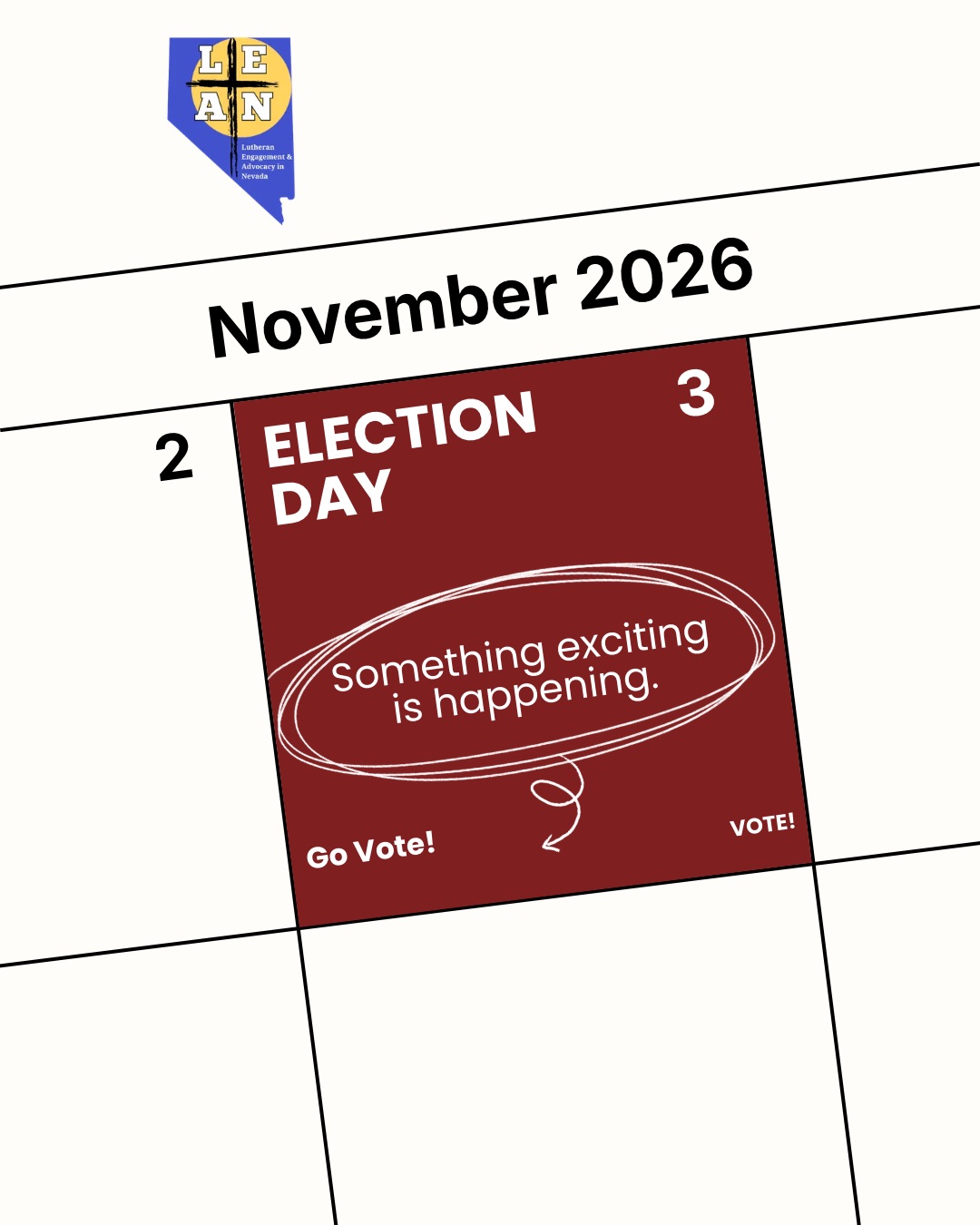
Early voting in Nevada begins Saturday, October 17, and continues through October 30. Election Day is Tuesday, November 3.
LEAN wants to remind you: the power is yours. When you vote, you help choose the elected officials and policies that shape issues affecting us all, including housing, creation care, health care access, and the cost of living.
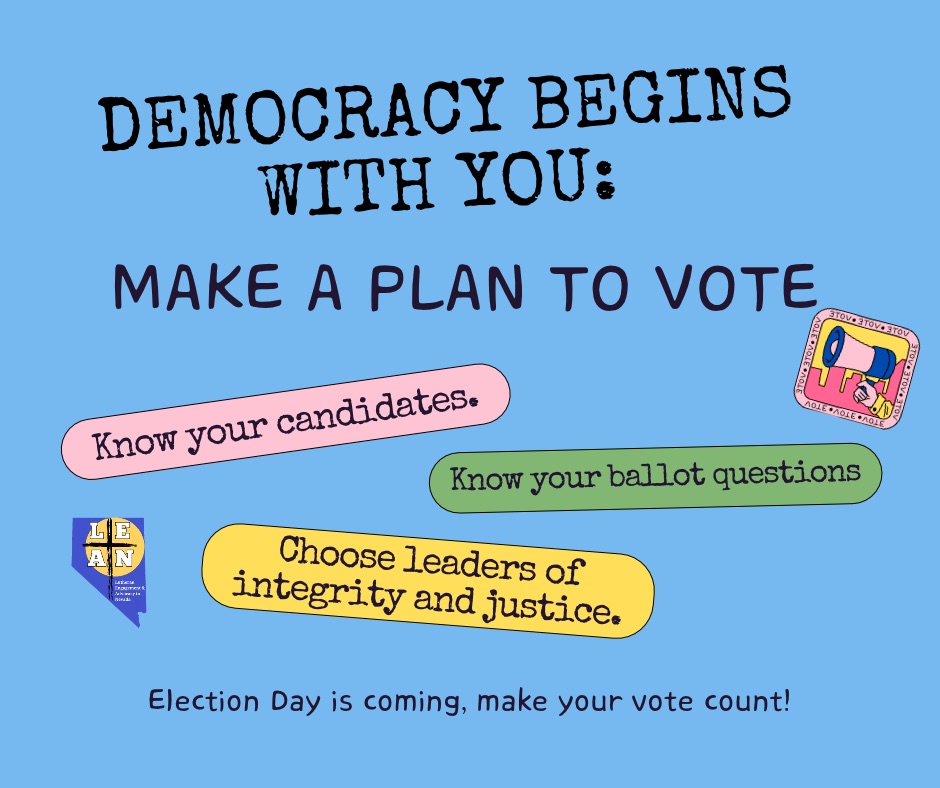
We encourage you to make a plan to vote and exercise your right as a citizen. You are part of this country, and your voice matters.
As you pray and discern where the Holy Spirit is sending you, we also pray for election workers and officials as they carry out the sacred responsibility of protecting every American’s right to vote.
Our democracy is strongest when people can make their voices heard.
Lutheran Engagement and Advocacy in Nevada wants to remind you of the important dates.
Voter Registration: October 6th, 2026
Mail/in person deadline was October 6th, 2026
Missed it? You can still register to vote online on the Secretary of State’s website through Election Day (November 3rd).
Early Voting Dates: October 17th- October 30th
You don’t have to wait until Election date.
LEAN has complied a list of Early Voting Sites in Nevada.
The Secretary of State’s has as well.
Voting By Mail
Every registered voter in Nevada will receive a ballot by mail.
Ballots are mailed starting no later than 20 days before Election Day for in-state voters and no later than 40-45 days before Election Day for Out-of State voter.
If you do not receive your ballot packer by the start of early voting (Oct 12), immediately contact your local elections office.
Election Day: November 3, 2026
Make a plan now:
How will you vote?
When will you vote?
Where will you vote?
Who will you bring with you?
Then put it on your calendar, or that handy cellphone.
Save this and share it with your community.
Make your voting Plan.
Last day to submit identification or Proof of Residence (only if needed) for provisional ballots: November 6th by 5pm
During the June primary, 1,837 mail ballots in Washoe County were rejected because they received late postmarks. Nearly all arrived within Nevada’s four-day grace period, but they still could not be counted because they were postmarked after Election Day.
As we prepare for the November election, this is a real example of how a U.S. Postal Service processing change can affect mail-in voting. USPS now postmarks mail when it reaches a processing facility—not necessarily when it is placed in a mailbox. A same-day postmark is not guaranteed.
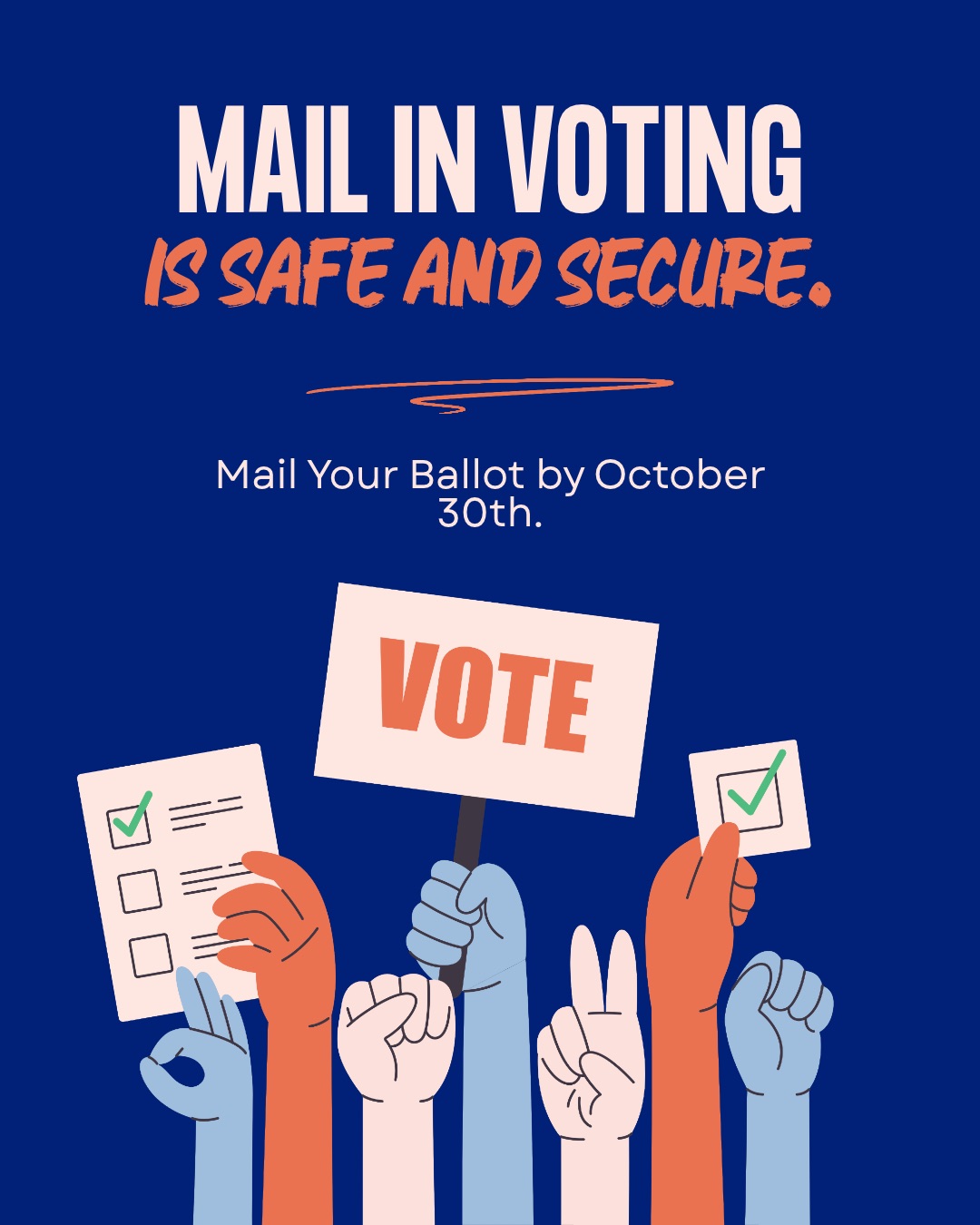
The burden should not fall on voters to navigate a complicated process just to make sure their vote counts. LEAN encourages voters to return their ballots by October 30. After that date, use an official drop box or return your ballot directly to the registrar’s office or a drop box at an Election Day vote center. If you mail your ballot, you can ask for a same-day postmark at the post office counter
As Hispanic Heritage Month comes to a close, we’re thinking not only about celebration, but also about solidarity.
Our communities have stood alongside one another before. Black and Latino leaders joined the Poor People’s Campaign to challenge poverty and economic injustice. Mexican American and Filipino farmworkers organized together for better wages and working conditions. Across generations, communities of color have built coalitions because they understood that our struggles may not look the same, but none of us achieves justice alone.
That history has something to teach us today.
Many Latino and immigrant people are navigating fear, uncertainty, and threats to their safety and well-being. Solidarity with BIPOC communities matters. It means more than saying we support one another. It means paying attention when another community is harmed, speaking up, showing up, and building relationships strong enough to help us care for and protect one another.
We will not always share the same experiences or face the same challenges. But we can refuse to let those differences isolate us.
As Hispanic Heritage Month ends, let’s carry this commitment forward. Let’s keep building communities where all of us can be safe, have a voice, and thrive.
Nevada voters approved both proposed constitutional amendments in 2024. Citizen-initiated constitutional amendments must pass in two successive general elections to become part of the Nevada Constitution. Questions 6 and 7 are back for that second vote in 2026.WHY ARE WE VOTING AGAIN?
Because Question 7 began as an initiative petition to amend the Nevada Constitution, voters must approve it in two consecutive general elections before it can take effect.
2026 is the second and final vote.
IMPORTANT: Question 7 does NOT require you to show photo ID to vote in the November 3, 2026 election.
Question 7: Voter Identification
Question 7 asks whether Nevada’s Constitution should require voters to verify their identity when voting in person or by mail.
Important: You do not need to show photo ID to vote in the November 3, 2026, election. If approved, Question 7’s requirements would take effect on November 24, 2026.
What would change?
For in-person voting, voters would have to show an approved photo ID. Examples include a driver’s license, passport, military ID, tribal photo ID, or certain other government-issued IDs. Most IDs would need to be current or expired no more than four years ago.
For mail voting, voters would provide one of these numbers next to their signature:
The last four digits of their Nevada driver’s license number;
If they do not have a Nevada driver’s license, the last four digits of their Social Security number; or
If they have neither, the number provided by their county clerk when they registered to vote.
What does a YES or NO vote mean?
Yes: Adds the proposed voter identification requirements to the Nevada Constitution.
No: The proposed amendment does not take effect, and the Constitution remains unchanged.
Why is Question 7 being debated?
Supporters argue that voter ID requirements add an election safeguard and could strengthen public confidence.
Opponents argue that Nevada already has voter identity verification procedures, and that adding new requirements could create barriers for some eligible voters. Current law, for example, provides for comparing a voter’s signature with the signature on their registration or an accepted form of identification.
LEAN recommends a Strong Oppose vote on Question 7.
Don’t stop at the summary
Ballot questions can make significant changes to state law and the Nevada Constitution. Before you vote:
Read the official ballot language.
Review arguments for and against each measure.
Make sure you understand what Yes and No mean.
Make your own informed decision.
Ballot measures can make lasting changes to Nevada law and the state Constitution. Before you vote, read the official ballot language, review arguments on both sides, and understand what current law says, what the proposal would change, and what a Yes or No vote means.
Read. Learn. Ask questions. Vote the entire ballot.